Oklahoma Social Studies MWH.C.7.1.C
The Standard
- MWH.C.7
- Evaluate post-World War II regional events leading to the transformations of the modern world.
- MWH.C.7.1
- Evaluate the effects of World War II including the origins and escalation of the Cold War.
Explain how tensions escalated, fueled by the Berlin Blockade, Suez Canal Crisis, and subsequent uprisings by people in Soviet-dominated satellites (e.g., Poland, Hungary, Czechoslovakia).
Oklahoma Academic Standards for Social Studies (2026) · MWH.C.7.1
Teacher's field guide
What This Standard Means
What Students Need to Do
- Students place the Berlin Blockade, the Suez Crisis, and resistance in Poland, Hungary, and Czechoslovakia in time order. They explain how each event exposed conflict or raised tensions during the Cold War.
What Mastery Looks Like
- A student can date the Berlin Blockade to 1948–49, Suez and the Polish and Hungarian protests to 1956, and the Prague Spring to 1968. They can explain how Suez strained Western allies while Soviet crackdowns limited independence in Eastern Europe.
Common Misconceptions
- Students may think the Soviet Union attacked Egypt during Suez, rather than Britain, France, and Israel. They may place the Prague Spring in 1956 with the Polish and Hungarian protests. Some assume Western troops fought Soviet forces in Hungary, but they did not.
How to Assess It
- Exit ticket: Place the Berlin Blockade, Suez Crisis, Polish protests, Hungarian uprising, and Prague Spring on a timeline. Beside each, name who acted and write one way tensions grew.
Lesson moves
Ways to Teach It
Give pairs five dated event cards and a blank 1948 to 1968 timeline; have them place the cards and draw arrows showing reactions.
Give students two short 1956 news excerpts, one on Suez and one on Hungary; ask what each reveals about Western actions.
Play a matching game with event, year, and consequence cards; require each group to defend one match with a specific detail.
Compare a 1955 Cold War map with a current NATO map; mark Poland, Hungary, Czechia, and Slovakia, then record what changed.
Free download
Printable MWH.C.7.1.C Worksheet
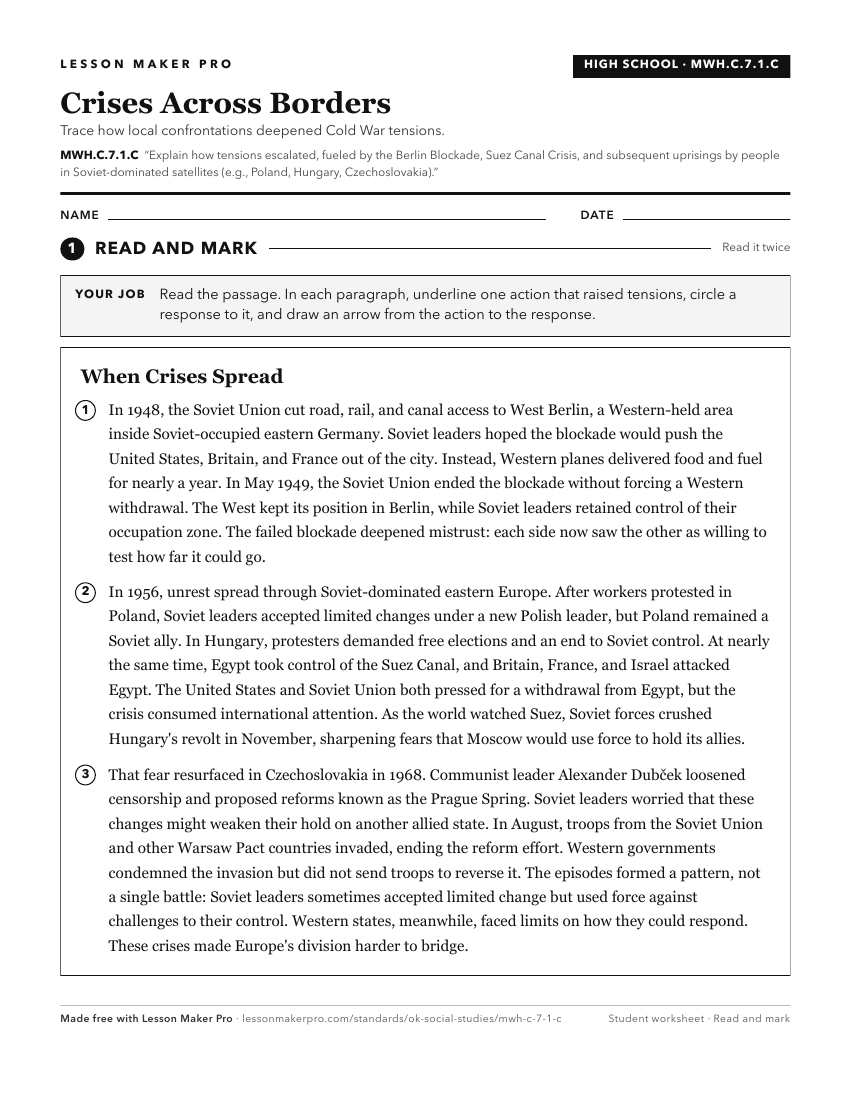
A ready-to-print activity worksheet aligned to MWH.C.7.1.C, with an answer key for the teacher on its own page. No account needed.
PDF, US Letter, prints cleanly in black and white.
Download the worksheetKeep exploring
Related Standards
- USH.C.6.1.D
Identify early confrontations between the Soviet Union and the United States of America including the postwar division of Berlin, the Berlin Blockade and Airlif...
- USH.C.6.3
Analyze the escalation of international tensions by examining the series of events and their long- term foreign and domestic consequences during the height of t...
- TOT.C.9.1
Examine the USSR’s occupation of Eastern Europe after World War II, including Soviet Communization of Eastern Europe, the coup d’etat in Czechoslovakia, chronic...
- MWH.C.7.6.C
Explain how the Revolutions of 1989 and the weakening of Soviet control contributed to the collapse of communist governments in the Eastern Bloc.
Turn this exact standard into a lesson
Grade, subject, topic, and the complete standard are prefilled. Create one free, no account needed.
Also for this standard:Make a WorksheetMake a QuizMake a Sub Lesson