Oklahoma Social Studies TOT.C.9.1
The Standard
Examine the USSR’s occupation of Eastern Europe after World War II, including Soviet Communization of Eastern Europe, the coup d’etat in Czechoslovakia, chronic rebellions in the Eastern Bloc (e.g., East German Uprising, Hungarian Uprising, “Prague Spring” in Czechoslovakia, and “Solidarity” in Poland) and neutrality of Finland and Austria.
Oklahoma Academic Standards for Social Studies (2026)
Teacher's field guide
What This Standard Means
What Students Need to Do
- Students trace how the USSR helped install communist governments in Eastern Europe after World War II. They put the 1948 Czechoslovak coup and later protests in order. They compare Soviet control with neutrality in Finland and Austria.
What Mastery Looks Like
- Students can locate the countries on a map and place the East German, Hungarian, Prague Spring, and Solidarity movements in the right decades. They can explain why Soviet troops entered Hungary and Czechoslovakia in 1968, while Finland and Austria stayed outside the Eastern Bloc.
Common Misconceptions
- Students may assume every country near the USSR joined the Eastern Bloc. Austria became neutral after Allied occupation ended in 1955, while Finland stayed outside the bloc. Students may also mistake Poland's crackdown on Solidarity for a Soviet invasion.
How to Assess It
- On an exit ticket, ask students to explain how Soviet influence shaped the 1948 Czechoslovak coup and the 1968 crackdown. Have them add one sentence on why Finland was different.
Lesson moves
Ways to Teach It
Give pairs a blank Europe map and country cards; have them shade Soviet-aligned states and circle neutral Finland and Austria.
Ask: Why did Soviet leaders send troops into Hungary in 1956 but not Finland? Use one detail from a map.
Deal event cards for East Germany, Hungary, Czechoslovakia, and Poland; teams place them on a timeline and name each government's response.
Pair a 1980 Solidarity strike photo with a current union organizing flyer; students identify what each group wanted from leaders.
Free download
Printable TOT.C.9.1 Worksheet
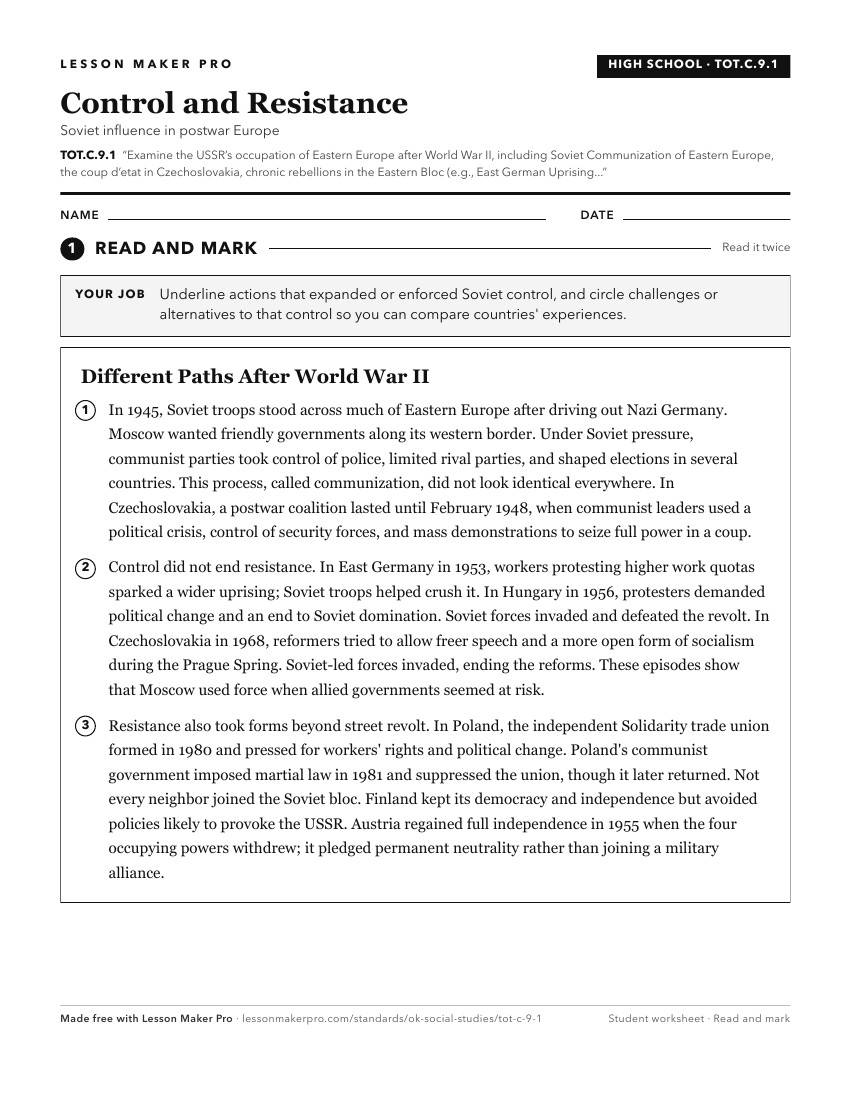
A ready-to-print activity worksheet aligned to TOT.C.9.1, with an answer key for the teacher on its own page. No account needed.
PDF, US Letter, prints cleanly in black and white.
Download the worksheetKeep exploring
Related Standards
- MWH.C.7.6
Evaluate the conditions leading to the collapse of the Soviet Union and the consequences for Europe.
- USH.C.6.1.D
Identify early confrontations between the Soviet Union and the United States of America including the postwar division of Berlin, the Berlin Blockade and Airlif...
- TOT.C.9.10
Examine the dissolution of the Union of Soviet Socialist Republics and the August Coup (e.g., the rise of Boris Yeltsin and the pluralist movement, uprisings in...
- TOT.C.3.1
Examine the response of communist and socialist leaders and parties in Europe and the United States of America to changing conditions created by the First World...
Turn this exact standard into a lesson
Grade, subject, topic, and the complete standard are prefilled. Create one free, no account needed.
Also for this standard:Make a WorksheetMake a QuizMake a Sub Lesson