Oklahoma Social Studies TOT.C.3.1
The Standard
Examine the response of communist and socialist leaders and parties in Europe and the United States of America to changing conditions created by the First World War (e.g., repudiation of nationalism, pacifist movements, the Espionage and Sedition Acts, role of wartime politics, formation of post-World War I national socialism).
Oklahoma Academic Standards for Social Studies (2026)
Teacher's field guide
What This Standard Means
What Students Need to Do
- Compare European socialists who backed the war with those who rejected nationalism and called for peace or revolution. Explain how U.S. laws affected antiwar socialists. Trace how postwar national socialism drew on nationalism and opposed communism.
What Mastery Looks Like
- A student can use Germany’s 1914 war credits vote and a 1917 call for peace to explain a split among socialists. They can explain why Eugene Debs was prosecuted and why the Nazi Party was not communist.
Common Misconceptions
- Students may think all socialists opposed the war, but Germany’s Social Democrats voted to fund it in 1914. They may assume the Nazi Party was communist because its name included “socialist,” or that antiwar speech could not lead to prosecution in the United States.
How to Assess It
- Exit ticket: Name one wartime split among European socialists, explain how U.S. law affected Eugene Debs, and give one reason the Nazi Party was not communist.
Lesson moves
Ways to Teach It
Place cards for Germany’s 1914 war credits vote, Lenin’s 1917 peace decree, Debs’s 1918 speech, and the Nazi Party’s 1920 platform on a timeline.
Ask students to write: Why might one socialist party support its country’s war effort while another calls for workers across borders to resist?
Give pairs four short source excerpts to sort into war support, antiwar revolution, U.S. prosecution of dissent, and nationalist anti-communism.
Compare a local protest permit form with a Sedition Act excerpt, and circle which rules address logistics versus the speaker’s message.
Free download
Printable TOT.C.3.1 Worksheet
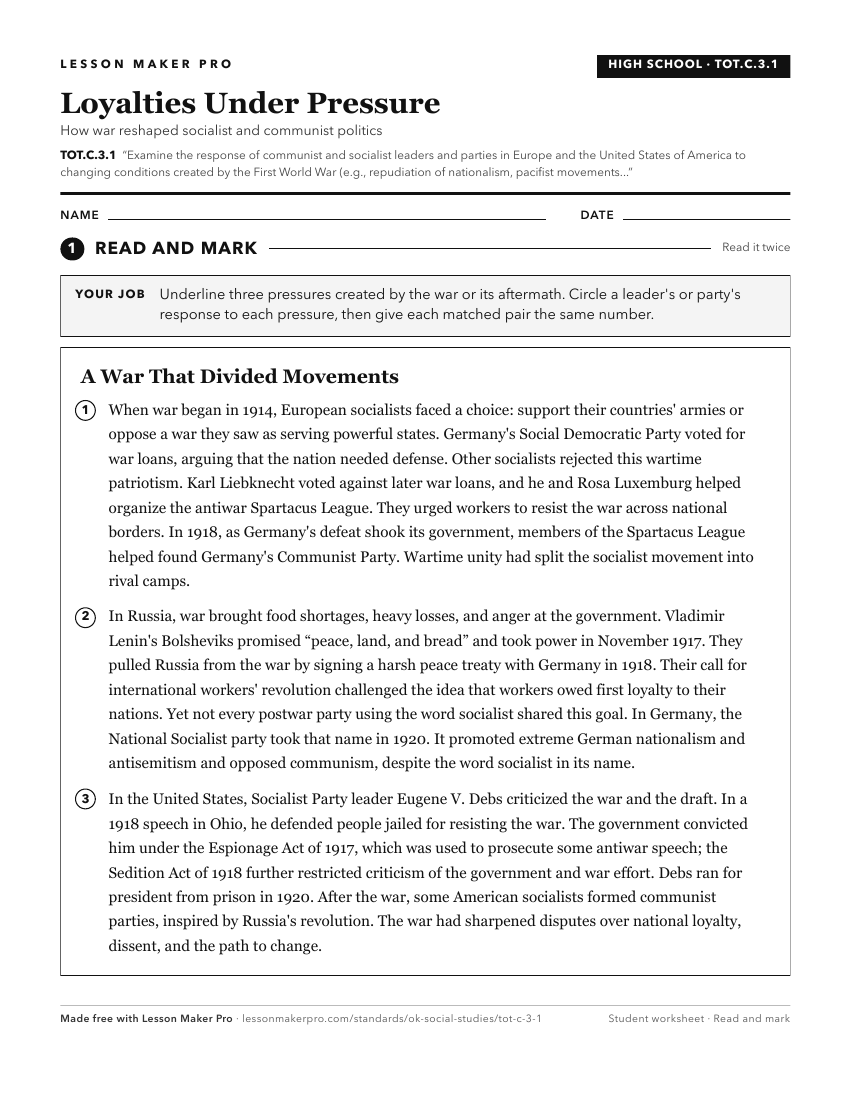
A ready-to-print activity worksheet aligned to TOT.C.3.1, with an answer key for the teacher on its own page. No account needed.
PDF, US Letter, prints cleanly in black and white.
Download the worksheetKeep exploring
Related Standards
- USH.C.6.1
Analyze the origins of international alliances and efforts at containment of communism immediately following World War II.
- TOT.C.2.1
Identify political responses to Communist and socialist political parties in Europe, including
- USH.C.5.1.B
Examine the roles of appeasement and isolationism in the United States of /America’s reluctance to respond to Fascist military aggression in Europe and Asia inc...
- TOT.C.9.1
Examine the USSR’s occupation of Eastern Europe after World War II, including Soviet Communization of Eastern Europe, the coup d’etat in Czechoslovakia, chronic...
Turn this exact standard into a lesson
Grade, subject, topic, and the complete standard are prefilled. Create one free, no account needed.
Also for this standard:Make a WorksheetMake a QuizMake a Sub Lesson