Oklahoma Social Studies USH.C.6.1
Standard Cluster
- USH.C.6
- Analyze foreign events and policies during the early Cold War Era.
Analyze the origins of international alliances and efforts at containment of communism immediately following World War II. Analyze the effect of massive aid given to Western Europe under the Marshall Plan on the rebuilding of Europe. Describe the goals for the formation of the United Nations, including its focus on international security, as well as cooperation among nations regarding economic, social, and humanitarian issues. Evaluate ideological factors that contributed to the Cold War, identifying differences between the Soviet and American political and economic systems, including the concept of an Iron curtain, and describing the strategy of containment as the United States of America’s response to Soviet expansionist actions. Identify early confrontations between the Soviet Union and the United States of America including the postwar division of Berlin, the Berlin Blockade and Airlift, and Soviet attempts to overthrow governments in Europe. Describe the roles and consequences of the spheres of influence created by the formation of NATO and the Warsaw Pact. Assess the impact and successes of the Truman Doctrine including the American military response to the invasion of South Korea. Describe American containment strategies as they applied to the Middle East, as well as United States of America’s military involvement in Latin America.
Oklahoma Academic Standards for Social Studies (2026) · USH.C.6
Cluster contents
Standards in This Cluster
USH.C.6.1 is a cluster heading. These are the individual standards under it.
- USH.C.6.1.A
Analyze the effect of massive aid given to Western Europe under the Marshall Plan on the rebuilding of Europe.
- USH.C.6.1.B
Describe the goals for the formation of the United Nations, including its focus on international security, as well as cooperation among nations regarding econom...
- USH.C.6.1.C
Evaluate ideological factors that contributed to the Cold War, identifying differences between the Soviet and American political and economic systems, including...
- USH.C.6.1.D
Identify early confrontations between the Soviet Union and the United States of America including the postwar division of Berlin, the Berlin Blockade and Airlif...
- USH.C.6.1.E
Describe the roles and consequences of the spheres of influence created by the formation of NATO and the Warsaw Pact.
- USH.C.6.1.F
Assess the impact and successes of the Truman Doctrine including the American military response to the invasion of South Korea.
- USH.C.6.1.G
Describe American containment strategies as they applied to the Middle East, as well as United States of America’s military involvement in Latin America.
Teacher's field guide
What This Cluster Means
What Students Need to Do
- Students explain why U.S. and Soviet leaders clashed after World War II. They trace how aid, alliances, and military action aimed to stop Soviet expansion. They weigh the results of containment in Europe, Korea, the Middle East, and Latin America.
What Mastery Looks Like
- Students explain how Marshall Plan aid helped rebuild Western Europe and how the UN addressed security, economic cooperation, and humanitarian needs. They compare U.S. elections and private business with Soviet one-party rule and state planning. They connect the Iron Curtain, Berlin Airlift, NATO, Warsaw Pact, and Korean War to containment and rival spheres.
Common Misconceptions
- Students may mistake the Marshall Plan for military aid or the UN for an anti-Soviet alliance. They may confuse the Berlin Blockade with the Berlin Wall or assume NATO and the Warsaw Pact began together. Some think containment always meant sending U.S. troops, rather than using aid, diplomacy, or covert action.
How to Assess It
- Exit ticket: Explain how the Marshall Plan and Berlin Airlift each supported containment. Name one effect of each.
Lesson moves
Ways to Teach It
Give pairs printed event cards for the Czech coup, Marshall Plan, Berlin Blockade, NATO, and Warsaw Pact; have them build a dated timeline.
Ask: Did aid to Greece and Turkey and the defense of South Korea meet Truman's goals? Write one success and one limit.
Play a map relay: teams label divided Berlin, NATO, Warsaw Pact, Korea, Lebanon, and the Dominican Republic, then explain two labels.
Pair a current UN disaster relief notice with NATO's collective-defense pledge; students identify which addresses humanitarian needs and which addresses defense.
Free download
Printable USH.C.6.1 Worksheet
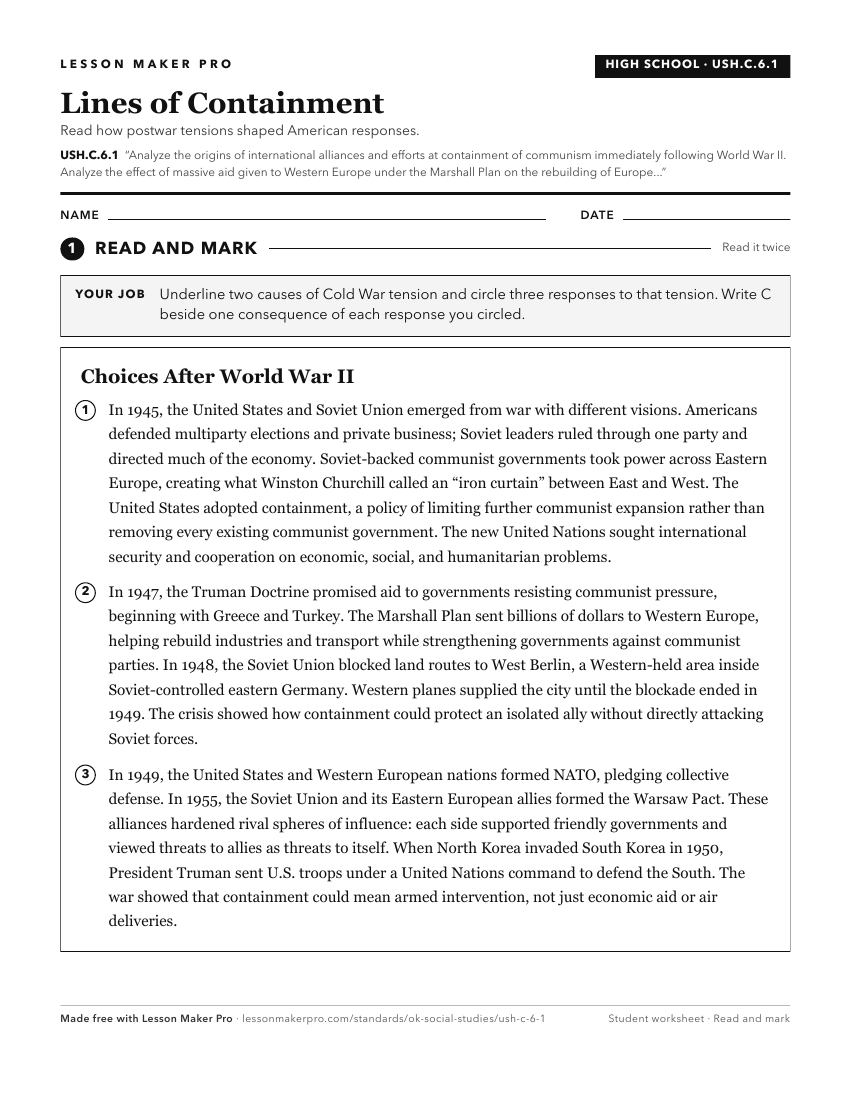
A ready-to-print activity worksheet aligned to USH.C.6.1, with an answer key for the teacher on its own page. No account needed.
PDF, US Letter, prints cleanly in black and white.
Download the worksheetKeep exploring
Related Standards
- MWH.C.6.4
Analyze the economic, social, and political conditions that resulted in World War II.
- USH.C.5.2
Analyze the series of events affecting the outcome of World War II.
- MWH.C.7.1
Evaluate the effects of World War II including the origins and escalation of the Cold War.
- USH.C.6
Analyze foreign events and policies during the early Cold War Era.
Turn this cluster into a lesson
Grade, subject, topic, and the complete cluster are prefilled. Create one free, no account needed.
Also for this cluster:Make a WorksheetMake a QuizMake a Sub Lesson