Oklahoma Social Studies USH.C.6.1.C
The Standard
- USH.C.6
- Analyze foreign events and policies during the early Cold War Era.
- USH.C.6.1
- Analyze the origins of international alliances and efforts at containment of communism immediately following World War II.
Evaluate ideological factors that contributed to the Cold War, identifying differences between the Soviet and American political and economic systems, including the concept of an Iron curtain, and describing the strategy of containment as the United States of America’s response to Soviet expansionist actions.
Oklahoma Academic Standards for Social Studies (2026) · USH.C.6.1
Teacher's field guide
What This Standard Means
What Students Need to Do
- Students compare how the United States and Soviet Union governed and ran their economies after World War II. They explain why Soviet control in Eastern Europe worried U.S. leaders and how containment aimed to limit further Soviet influence. They use the Iron Curtain to describe Europe's political divide, not a physical barrier.
What Mastery Looks Like
- Students distinguish competitive U.S. elections and private businesses from Soviet one-party rule and central planning. On a postwar map, they identify the approximate Iron Curtain and explain why the Berlin Airlift fit containment.
Common Misconceptions
- Some students think the Iron Curtain was a literal wall across Europe or confuse it with the Berlin Wall, which came later. Others think containment meant invading the Soviet Union.
How to Assess It
- Exit ticket: In three sentences, name one difference between the two systems, explain what the Iron Curtain described, and connect one Soviet action in Europe to a U.S. containment response.
Lesson moves
Ways to Teach It
Use a 1948 Europe map to color Soviet-aligned states and Western states, then draw the approximate Iron Curtain boundary.
Read a short excerpt from Churchill's Iron Curtain speech and ask: What did he fear, and which map detail supports your answer?
Sort cards labeled competitive elections, one-party rule, central planning, and private businesses into U.S. or Soviet columns; defend one choice.
Show a grocery ad, circle one price, and compare how a U.S. store and Soviet planners would set that price.
Free download
Printable USH.C.6.1.C Worksheet
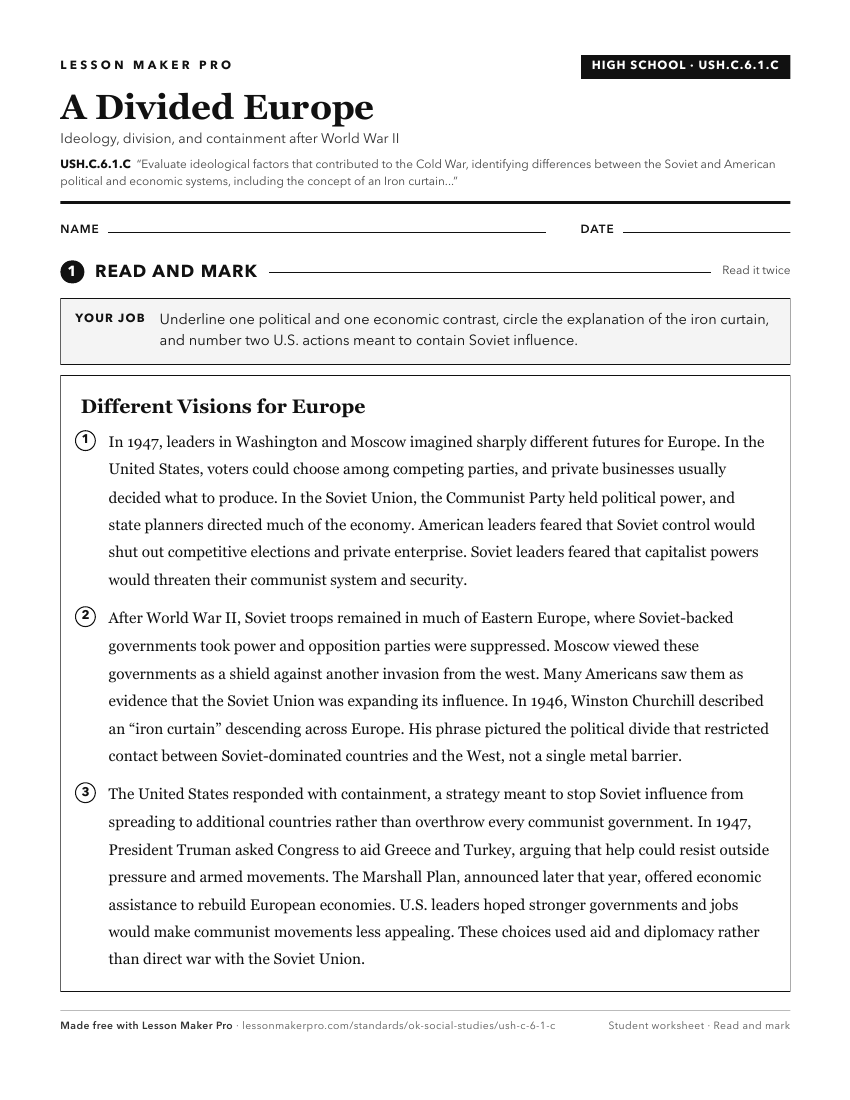
A ready-to-print activity worksheet aligned to USH.C.6.1.C, with an answer key for the teacher on its own page. No account needed.
PDF, US Letter, prints cleanly in black and white.
Download the worksheetKeep exploring
Related Standards
- USH.C.6.1.D
Identify early confrontations between the Soviet Union and the United States of America including the postwar division of Berlin, the Berlin Blockade and Airlif...
- MWH.C.7.1.B
Compare the ideological, political, and economic distinctions between the United States of America and Western bloc versus the Union of Soviet Socialist Republi...
- USH.C.6.3
Analyze the escalation of international tensions by examining the series of events and their long- term foreign and domestic consequences during the height of t...
- TOT.C.9.2
Explain the West’s response to communism in the early Cold War, including the policy of containment, the Truman Doctrine, the Marshall Plan, the Berlin Airlift,...
Turn this exact standard into a lesson
Grade, subject, topic, and the complete standard are prefilled. Create one free, no account needed.
Also for this standard:Make a WorksheetMake a QuizMake a Sub Lesson