Oklahoma Social Studies MWH.C.7.1.B
The Standard
- MWH.C.7
- Evaluate post-World War II regional events leading to the transformations of the modern world.
- MWH.C.7.1
- Evaluate the effects of World War II including the origins and escalation of the Cold War.
Compare the ideological, political, and economic distinctions between the United States of America and Western bloc versus the Union of Soviet Socialist Republics (USSR) and the Eastern bloc, leading to the division of Europe and separation by an “Iron Curtain.”
Oklahoma Academic Standards for Social Studies (2026) · MWH.C.7.1
Teacher's field guide
What This Standard Means
What Students Need to Do
- Students compare each bloc's beliefs about rights and the role of government. They contrast multiparty elections with one-party rule, and mostly private businesses with state-planned economies. They explain how those rival systems divided postwar Europe.
What Mastery Looks Like
- A student can locate East and West Germany and divided Berlin on a map. They can give one clear difference in beliefs, political rule, and ownership, then explain how those differences shaped the divide.
Common Misconceptions
- Some students picture the Iron Curtain as one wall across Europe, rather than a name for a political divide. Others assume every Western country had identical policies or that Eastern European governments acted independently of Soviet pressure.
How to Assess It
- On an exit ticket, ask students to name one difference in beliefs, one in political rule, and one in economics between the blocs. Then ask why Germany and Berlin were divided.
Lesson moves
Ways to Teach It
Give pairs a blank 1950 Europe map and a country list; have them shade each bloc and mark divided Germany and Berlin.
Ask students to write: Why might families in East and West Berlin have different choices about jobs and voting?
Give teams cards labeled private factories, multiparty elections, state production plans, and one-party rule; have them sort the cards by bloc.
Show a Berlin Wall Memorial map; have students trace a blocked route to school or work and describe the daily disruption.
Free download
Printable MWH.C.7.1.B Worksheet
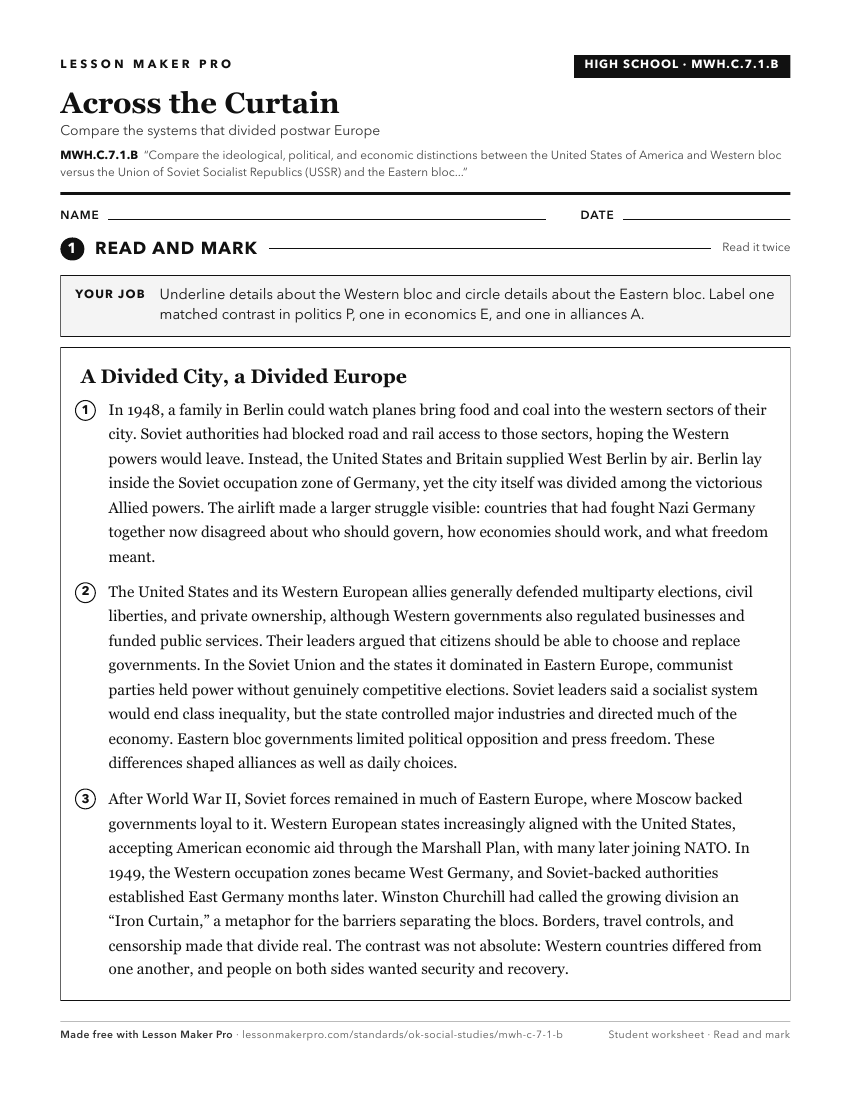
A ready-to-print activity worksheet aligned to MWH.C.7.1.B, with an answer key for the teacher on its own page. No account needed.
PDF, US Letter, prints cleanly in black and white.
Download the worksheetKeep exploring
Related Standards
- USH.C.6.1.D
Identify early confrontations between the Soviet Union and the United States of America including the postwar division of Berlin, the Berlin Blockade and Airlif...
- USH.C.8.2.C
Summarize the emergence of the United States of America and the shift in world power following the fall of the Berlin Wall and the collapse of the Soviet Union.
- USH.C.6.1.C
Evaluate ideological factors that contributed to the Cold War, identifying differences between the Soviet and American political and economic systems, including...
- TOT.C.9.1
Examine the USSR’s occupation of Eastern Europe after World War II, including Soviet Communization of Eastern Europe, the coup d’etat in Czechoslovakia, chronic...
Turn this exact standard into a lesson
Grade, subject, topic, and the complete standard are prefilled. Create one free, no account needed.
Also for this standard:Make a WorksheetMake a QuizMake a Sub Lesson