Oklahoma Social Studies USH.C.8.2.C
The Standard
- USH.C.8
- Analyze the rationale and impact of foreign and domestic policies of the late 20th century.
- USH.C.8.2
- Analyze the presidency of Ronald Reagan and the rise of the conservative movement in American politics.
Summarize the emergence of the United States of America and the shift in world power following the fall of the Berlin Wall and the collapse of the Soviet Union.
Oklahoma Academic Standards for Social Studies (2026) · USH.C.8.2
Teacher's field guide
What This Standard Means
What Students Need to Do
- Students put the 1989 fall of the Berlin Wall and the 1991 Soviet breakup in order. They explain how the end of the US-Soviet rivalry left the US as the only superpower. They describe how Soviet control over Eastern Europe ended.
What Mastery Looks Like
- A student can name what happened in 1989 and 1991 without treating them as one event. They can explain that US influence grew, while former Soviet countries became independent rather than coming under US control.
Common Misconceptions
- Students may think the Soviet Union dissolved as soon as the wall fell. Some think Russia disappeared in 1991 or that the US took control of former Soviet countries.
How to Assess It
- On an exit ticket, ask: What happened in 1989 and 1991, and how did those events change US power? Ask for three sentences.
Lesson moves
Ways to Teach It
Give pairs 1988 and 1992 maps; have them color Soviet territory on each and label the newly independent countries.
Ask students to write two sentences answering: How did US power change between 1988 and 1992?
Run a four-card timeline race with the wall opening, German reunification, the Gulf War coalition, and the Soviet breakup.
On a current NATO map, locate Poland and Estonia, then compare their present alliances with their Soviet-era status.
Free download
Printable USH.C.8.2.C Worksheet
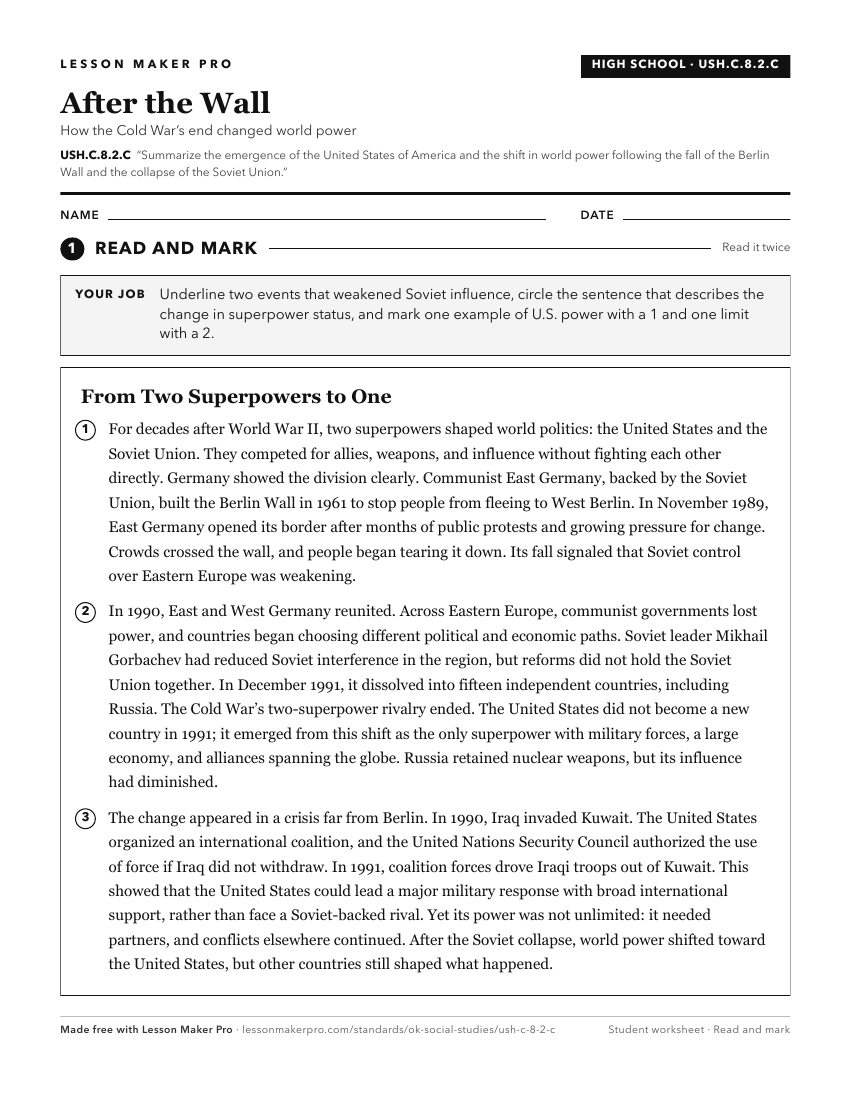
A ready-to-print activity worksheet aligned to USH.C.8.2.C, with an answer key for the teacher on its own page. No account needed.
PDF, US Letter, prints cleanly in black and white.
Download the worksheetKeep exploring
Related Standards
- MWH.C.7.6
Evaluate the conditions leading to the collapse of the Soviet Union and the consequences for Europe.
- USH.C.3.1.A
Explain the rise of the United States of America as a world power amidst debates over the United States of America’s role in world affairs and overseas expansio...
- MWH.C.7.1.B
Compare the ideological, political, and economic distinctions between the United States of America and Western bloc versus the Union of Soviet Socialist Republi...
- MWH.C.7.6.D
Analyze the effect of the collapse of the Soviet Union on global power dynamics, including the emergence of new democracies in Eastern Europe.
Turn this exact standard into a lesson
Grade, subject, topic, and the complete standard are prefilled. Create one free, no account needed.
Also for this standard:Make a WorksheetMake a QuizMake a Sub Lesson