Oklahoma Social Studies USH.C.6
Standard Cluster
Analyze foreign events and policies during the early Cold War Era. Analyze the origins of international alliances and efforts at containment of communism immediately following World War II. Analyze the effect of massive aid given to Western Europe under the Marshall Plan on the rebuilding of Europe. Describe the goals for the formation of the United Nations, including its focus on international security, as well as cooperation among nations regarding economic, social, and humanitarian issues. Evaluate ideological factors that contributed to the Cold War, identifying differences between the Soviet and American political and economic systems, including the concept of an Iron curtain, and describing the strategy of containment as the United States of America’s response to Soviet expansionist actions. Identify early confrontations between the Soviet Union and the United States of America including the postwar division of Berlin, the Berlin Blockade and Airlift, and Soviet attempts to overthrow governments in Europe. Describe the roles and consequences of the spheres of influence created by the formation of NATO and the Warsaw Pact. Assess the impact and successes of the Truman Doctrine including the American military response to the invasion of South Korea. Describe American containment strategies as they applied to the Middle East, as well as United States of America’s military involvement in Latin America. Describe domestic events related to the Cold War and its aftermath. Summarize the reasons for the public fear of communist influence within the United States of America and how politicians capitalized on this fear. Explain the origins and consequences of McCarthyism and the Second Red Scare, including the Hollywood Blacklist and President Eisenhower’s reaction. Describe the Army-McCarthy hearings and examine controversies related to Alger Hiss and the Rosenberg spy trials, explaining the role of the Federal Bureau of Investigation and the House Committee on Un-American Activities. Analyze the escalation of international tensions by examining the series of events and their long-term foreign and domestic consequences during the height of the Cold War. Examine the impact of the proliferation of nuclear weapons and the resulting nuclear arms race on public perceptions of security, including the goals of the NASA program and the beginnings of the space race prompted by Sputnik’s launch. Explain President Dwight Eisenhower’s concern regarding the power of the military industrial complex to influence American foreign policy (e.g., Eisenhower’s Farewell Address). Evaluate the continuing role of television and other mass media regarding their influence over the 1960 Nixon-Kennedy debates. Explain President Kennedy’s foreign policy as expressed in his inaugural address, including the establishment of the Peace Corps and reaction to the completion of the Berlin Wall. Evaluate President Kennedy’s decisions regarding the Bay of Pigs Invasion and the Cuban Missile Crisis, leading to the Nuclear Test Ban Treaty. Explain how the concept of brinkmanship and the doctrine of mutually assured destruction (MAD) affected defense strategies. Analyze the escalation of events drawing the United States into military involvement in Vietnam (e.g., Domino Theory, Vietnamization, the Gulf of Tonkin Resolution, the Tet Offensive, Paris Peace Accords). Explain how the Vietnam conflict impacted domestic affairs (e.g., outcome of the presidential election of 1968, university student protests, counterculture movement, expanded televised coverage of the conflict, passage of the War Powers Resolution Act and the 26th Amendment). Analyze the political and economic impact of President Nixon’s foreign policies including détente and the opening of China.
Oklahoma Academic Standards for Social Studies (2026)
Cluster contents
Standards in This Cluster
USH.C.6 is a cluster heading. These are the individual standards under it.
- USH.C.6.1
Analyze the origins of international alliances and efforts at containment of communism immediately following World War II.
- USH.C.6.1.A
Analyze the effect of massive aid given to Western Europe under the Marshall Plan on the rebuilding of Europe.
- USH.C.6.1.B
Describe the goals for the formation of the United Nations, including its focus on international security, as well as cooperation among nations regarding econom...
- USH.C.6.1.C
Evaluate ideological factors that contributed to the Cold War, identifying differences between the Soviet and American political and economic systems, including...
- USH.C.6.1.D
Identify early confrontations between the Soviet Union and the United States of America including the postwar division of Berlin, the Berlin Blockade and Airlif...
- USH.C.6.1.E
Describe the roles and consequences of the spheres of influence created by the formation of NATO and the Warsaw Pact.
- USH.C.6.1.F
Assess the impact and successes of the Truman Doctrine including the American military response to the invasion of South Korea.
- USH.C.6.1.G
Describe American containment strategies as they applied to the Middle East, as well as United States of America’s military involvement in Latin America.
- USH.C.6.2
Describe domestic events related to the Cold War and its aftermath.
- USH.C.6.2.A
Summarize the reasons for the public fear of communist influence within the United States of America and how politicians capitalized on this fear.
- USH.C.6.2.B
Explain the origins and consequences of McCarthyism and the Second Red Scare, including the Hollywood Blacklist and President Eisenhower’s reaction.
- USH.C.6.2.C
Describe the Army-McCarthy hearings and examine controversies related to Alger Hiss and the Rosenberg spy trials, explaining the role of the Federal Bureau of I...
- USH.C.6.3
Analyze the escalation of international tensions by examining the series of events and their long- term foreign and domestic consequences during the height of t...
- USH.C.6.3.A
Examine the impact of the proliferation of nuclear weapons and the resulting nuclear arms race on public perceptions of security, including the goals of the NAS...
- USH.C.6.3.B
Explain President Dwight Eisenhower’s concern regarding the power of the military industrial complex to influence American foreign policy (e.g., Eisenhower’s Fa...
- USH.C.6.3.C
Evaluate the continuing role of television and other mass media regarding their influence over the 1960 Nixon-Kennedy debates.
- USH.C.6.3.D
Explain President Kennedy’s foreign policy as expressed in his inaugural address, including the establishment of the Peace Corps and reaction to the completion ...
- USH.C.6.3.E
Evaluate President Kennedy’s decisions regarding the Bay of Pigs Invasion and the Cuban Missile Crisis, leading to the Nuclear Test Ban Treaty.
- USH.C.6.3.F
Explain how the concept of brinkmanship and the doctrine of mutually assured destruction (MAD) affected defense strategies.
- USH.C.6.3.G
Analyze the escalation of events drawing the United States into military involvement in Vietnam (e.g., Domino Theory, Vietnamization, the Gulf of Tonkin Resolut...
- USH.C.6.3.H
Explain how the Vietnam conflict impacted domestic affairs (e.g., outcome of the presidential election of 1968, university student protests, counterculture move...
- USH.C.6.3.I
Analyze the political and economic impact of President Nixon’s foreign policies including détente and the opening of China.
Teacher's field guide
What This Cluster Means
What Students Need to Do
- Students trace how U.S. and Soviet rivalry shaped aid, alliances, wars, and nuclear policy after World War II. They explain how fear of communism, mass media, and Vietnam affected U.S. politics and daily life. They link decisions from Berlin to Cuba to China with their causes and effects.
What Mastery Looks Like
- Students can explain why the UN formed and why U.S. leaders backed European recovery, NATO, and containment in Korea and Vietnam. They can connect McCarthyism, Sputnik, and televised war coverage to changes in public opinion. They use dates and evidence to distinguish containment, brinkmanship, and détente.
Common Misconceptions
- Students often mistake the Marshall Plan for military aid or assume NATO and the Warsaw Pact formed at the same time. Some think the Cold War involved no fighting, overlooking Korea and Vietnam. Others treat McCarthy's accusations as proof of spying.
How to Assess It
- Exit ticket: For the Cuban Missile Crisis, name one cause, one Kennedy decision, and one effect on Americans' fears. Give a specific fact for each.
Lesson moves
Ways to Teach It
Give pairs a Europe map and dated event cards; have them mark the Berlin Blockade, airlift, NATO, and Warsaw Pact.
After reading a Marshall Plan aid chart, have students write two sentences on whether economic recovery also served containment.
Run a card sort matching the Truman Doctrine, Korean War, Vietnamization, and détente to their goals and outcomes.
Show a 1962 fallout shelter poster and a local emergency alert screenshot; students compare how each describes a threat and gives instructions.
Free download
Printable USH.C.6 Worksheet
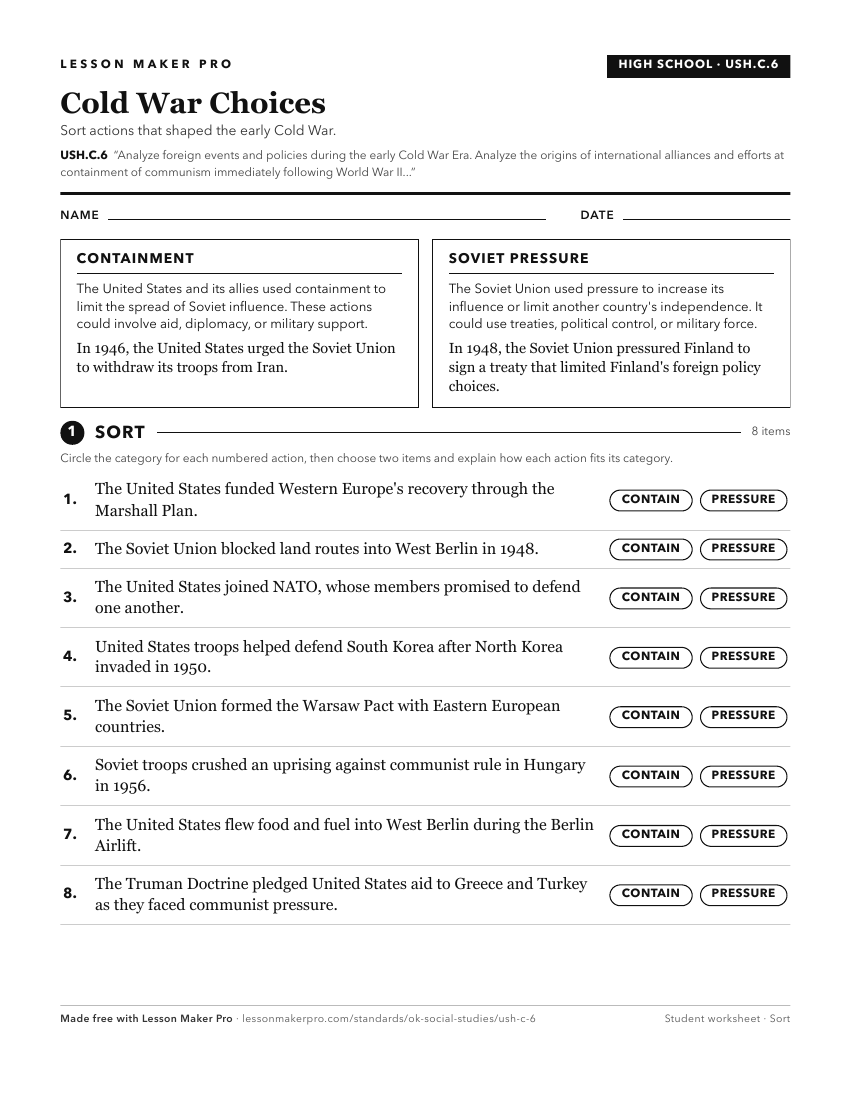
A ready-to-print activity worksheet aligned to USH.C.6, with an answer key for the teacher on its own page. No account needed.
PDF, US Letter, prints cleanly in black and white.
Download the worksheetKeep exploring
Related Standards
Turn this cluster into a lesson
Grade, subject, topic, and the complete cluster are prefilled. Create one free, no account needed.
Also for this cluster:Make a WorksheetMake a QuizMake a Sub Lesson