Oklahoma Social Studies USH.C.6.3.F
The Standard
- USH.C.6
- Analyze foreign events and policies during the early Cold War Era.
- USH.C.6.3
- Analyze the escalation of international tensions by examining the series of events and their long- term foreign and domestic consequences during the height of the Cold War.
Explain how the concept of brinkmanship and the doctrine of mutually assured destruction (MAD) affected defense strategies.
Oklahoma Academic Standards for Social Studies (2026) · USH.C.6.3
Teacher's field guide
What This Standard Means
What Students Need to Do
- Students explain how a threat to escalate a crisis could pressure a rival without starting a war. They explain why countries kept nuclear weapons ready to retaliate even after an attack.
What Mastery Looks Like
- Students can identify a threat to escalate a blockade as brinkmanship and a hidden nuclear submarine as a way to preserve retaliation. They can explain how each choice might discourage an attack while still carrying risks.
Common Misconceptions
- Students may think brinkmanship means starting a war, rather than risking one to gain leverage. They may think mutually assured destruction required both sides to launch at once or made accidental war impossible.
How to Assess It
- Exit ticket: A country keeps nuclear submarines at sea and threatens to fire on rival ships unless they turn back. Name the strategy behind each move and explain how it affects the risk of war.
Lesson moves
Ways to Teach It
Draw two rival countries on paper; pairs move ship and submarine tokens, then mark which moves risk war or preserve retaliation.
Have students write two sentences explaining why leaders would keep nuclear submarines at sea if they hoped never to use them.
Sort four cards, nuclear ultimatum, submarine patrol, first strike, and hotline call, into brinkmanship, deterrence, attack, and de-escalation.
Show a photo of a nuclear submarine; students write why a hidden retaliatory force could discourage an attack today.
Free download
Printable USH.C.6.3.F Worksheet
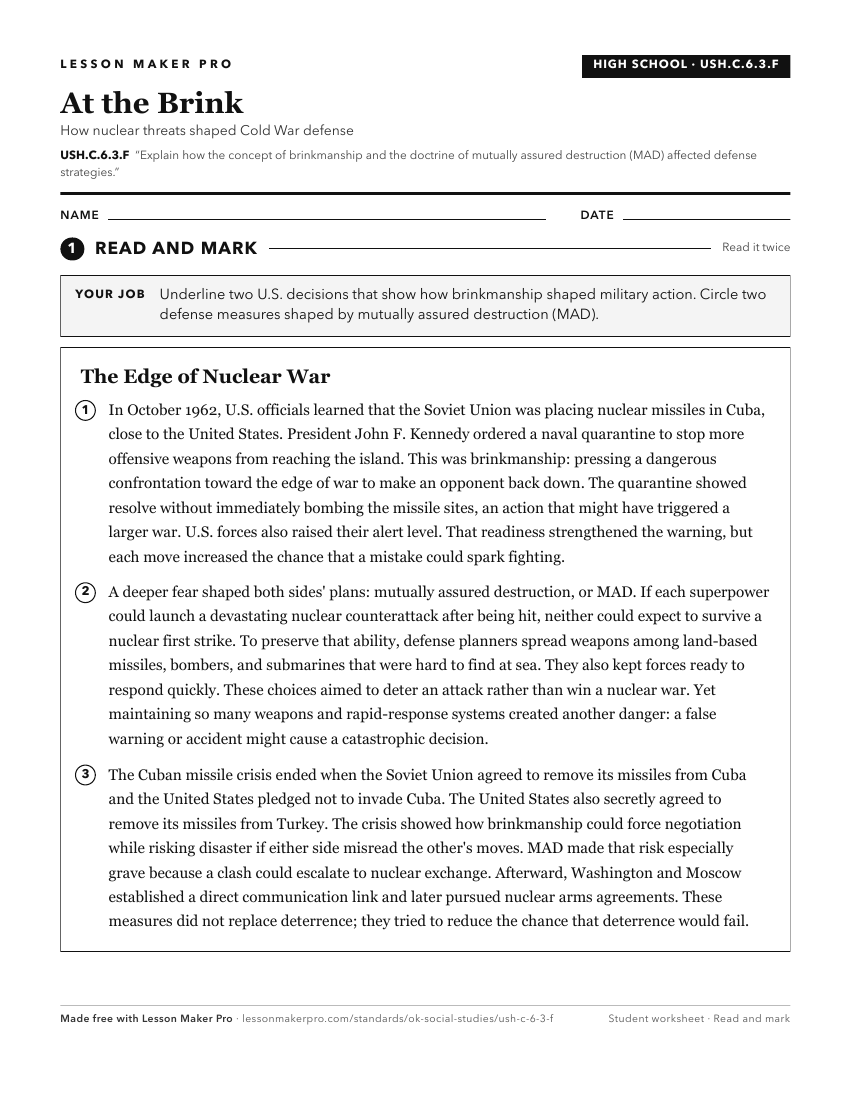
A ready-to-print activity worksheet aligned to USH.C.6.3.F, with an answer key for the teacher on its own page. No account needed.
PDF, US Letter, prints cleanly in black and white.
Download the worksheetKeep exploring
Related Standards
- USH.C.6.1.E
Describe the roles and consequences of the spheres of influence created by the formation of NATO and the Warsaw Pact.
- MWH.C.7.1.D
Compare military power shifts caused by the war and a proliferation of nuclear armaments, describing the impact of transnational organizations and alliances (e....
- USH.C.6.1.C
Evaluate ideological factors that contributed to the Cold War, identifying differences between the Soviet and American political and economic systems, including...
- 8.C.12.3
Identify the key strategies used during the war and evaluate their effectiveness in determining the war’s outcome.
Turn this exact standard into a lesson
Grade, subject, topic, and the complete standard are prefilled. Create one free, no account needed.
Also for this standard:Make a WorksheetMake a QuizMake a Sub Lesson