Oklahoma Social Studies USH.C.8
Standard Cluster
Analyze the rationale and impact of foreign and domestic policies of the late 20th century. Evaluate the foreign and domestic policies, as well as the legacy of President Jimmy Carter. Examine the economic challenges of the 1970s, including stagflation (characterized by slow economic growth, high unemployment, and rising inflation) which affected the Carter administration. Describe the negotiation of the Camp David Accords leading to the Egypt-Israel Peace Treaty. Explain reaction to the OPEC oil embargo and issuance of the Carter Doctrine regarding national interests in the Persian Gulf. Evaluate the impact of the diplomatic standoff of the Iran Hostage Crisis and the failed rescue mission. Describe the legacy of public service exemplified by President Carter’s post-public service humanitarian efforts. Analyze the presidency of Ronald Reagan and the rise of the conservative movement in American politics. Identify the economic and domestic policies of the Reagan Administration known as “Reaganomics” featuring tax cuts and less regulation including the response to the air-traffic controllers’ strike. Describe Reagan’s anti-communist stance, as expressed in his Tear Down This Wall speech and defense policies (e.g., response to Communist aggression in Afghanistan and Grenada, Strategic Defense Initiative). Summarize the emergence of the United States of America and the shift in world power following the fall of the Berlin Wall and the collapse of the Soviet Union. Explain how the public’s perception of the President was influenced by the Iran-Contra Scandal. Describe the policy goals of President George H.W. Bush. Evaluate the effectiveness of the international coalition to counter Iraqi aggression in the Persian Gulf. Examine justifications for using United States of America’s troops to overthrow the regime of Panama’s General Noriega. Describe the significance of passage of the Americans with Disabilities Act of 1990. Evaluate the major domestic and foreign policies of the William J. Clinton administration. Describe the United States of America’s continuing global influence which contributed to the creation of NAFTA and NATO interventions to restore stability to the former Yugoslav republics. Explain how President Clinton’s economic policies of taxation, limits on discretionary spending, and economic conditions contributed to a balanced budget. Evaluate the rise of domestic terrorism as exemplified by the bombing of the Alfred P. Murrah Federal Building. Summarize the political impact of President Clinton’s impeachment on the perceptions of the presidency and powers of Congress.
Oklahoma Academic Standards for Social Studies (2026)
Cluster contents
Standards in This Cluster
USH.C.8 is a cluster heading. These are the individual standards under it.
- USH.C.8.1
Evaluate the foreign and domestic policies, as well as the legacy of President Jimmy Carter.
- USH.C.8.1.A
Examine the economic challenges of the 1970s, including stagflation (characterized by slow economic growth, high unemployment, and rising inflation) which affec...
- USH.C.8.1.B
Describe the negotiation of the Camp David Accords leading to the Egypt-Israel Peace Treaty.
- USH.C.8.1.C
Explain reaction to the OPEC oil embargo and issuance of the Carter Doctrine regarding national interests in the Persian Gulf.
- USH.C.8.1.D
Evaluate the impact of the diplomatic standoff of the Iran Hostage Crisis and the failed rescue mission.
- USH.C.8.1.E
Describe the legacy of public service exemplified by President Carter’s post-public service humanitarian efforts.
- USH.C.8.2
Analyze the presidency of Ronald Reagan and the rise of the conservative movement in American politics.
- USH.C.8.2.A
Identify the economic and domestic policies of the Reagan Administration known as “Reaganomics”, featuring tax cuts and less regulation, including the response ...
- USH.C.8.2.B
Describe Reagan’s anti-communist stance, as expressed in his Tear Down This Wall speech and defense policies (e.g., response to Communist aggression in Afghanis...
- USH.C.8.2.C
Summarize the emergence of the United States of America and the shift in world power following the fall of the Berlin Wall and the collapse of the Soviet Union.
- USH.C.8.2.D
Explain how the public's perception of the President was influenced by the Iran-Contra Scandal.
- USH.C.8.3
Describe the policy goals of President George H.W. Bush.
- USH.C.8.3.A
Evaluate the effectiveness of the international coalition to counter Iraqi aggression in the Persian Gulf.
- USH.C.8.3.B
Examine justifications for using United States of America’s troops to overthrow the regime of Panama’s General Noriega.
- USH.C.8.3.C
Describe the significance of passage of the Americans with Disabilities Act of 1990.
- USH.C.8.4
Evaluate the major domestic and foreign policies of the William J. Clinton administration.
- USH.C.8.4.A
Describe the United States of America’s continuing global influence which contributed to the creation of NAFTA and NATO interventions to restore stability to th...
- USH.C.8.4.B
Explain how President Clinton’s economic policies of taxation, limits on discretionary spending, and economic conditions contributed to a balanced budget.
- USH.C.8.4.C
Evaluate the rise of domestic terrorism as exemplified by the bombing of the Alfred P. Murrah Federal Building.
- USH.C.8.4.D
Summarize the political impact of President Clinton’s impeachment on the perceptions of the presidency and powers of Congress.
Teacher's field guide
What This Cluster Means
What Students Need to Do
- Students compare how Carter, Reagan, George H. W. Bush, and Clinton handled economic problems and conflicts abroad. They explain the goals and results of major policies. They use evidence to judge those results and describe how scandals, civil rights laws, and public service shaped each president’s legacy.
What Mastery Looks Like
- A student can explain how stagflation affected Carter and how Reagan’s tax cuts reflected conservative goals. They can weigh the results of the Camp David Accords, the Gulf War coalition, and NAFTA against each policy’s goal. They can explain why impeachment did not remove Clinton from office.
Common Misconceptions
- Students often place the 1973 oil embargo during Carter’s presidency. They may think stagflation means rising prices alone or credit Reagan alone for the Soviet Union’s collapse. They may confuse Iran-Contra with the Iran hostage crisis.
How to Assess It
- Exit ticket: Why did the United States lead a coalition against Iraq in 1991? Name one goal, one result, and one limit of the operation.
Lesson moves
Ways to Teach It
Give pairs dated event cards for the oil embargo, Camp David, Iran-Contra, the ADA, and NAFTA; sort them by administration and note one effect.
Ask: Did Camp David or the hostage crisis shape Carter’s reputation more? Cite two facts and consider his later humanitarian work.
Run a matching race: connect Reaganomics, the Carter Doctrine, the Gulf War coalition, and NAFTA to their goals and outcomes.
Measure the classroom doorway, compare its clear width with the ADA’s 32-inch minimum, and discuss access for a wheelchair user.
Free download
Printable USH.C.8 Worksheet
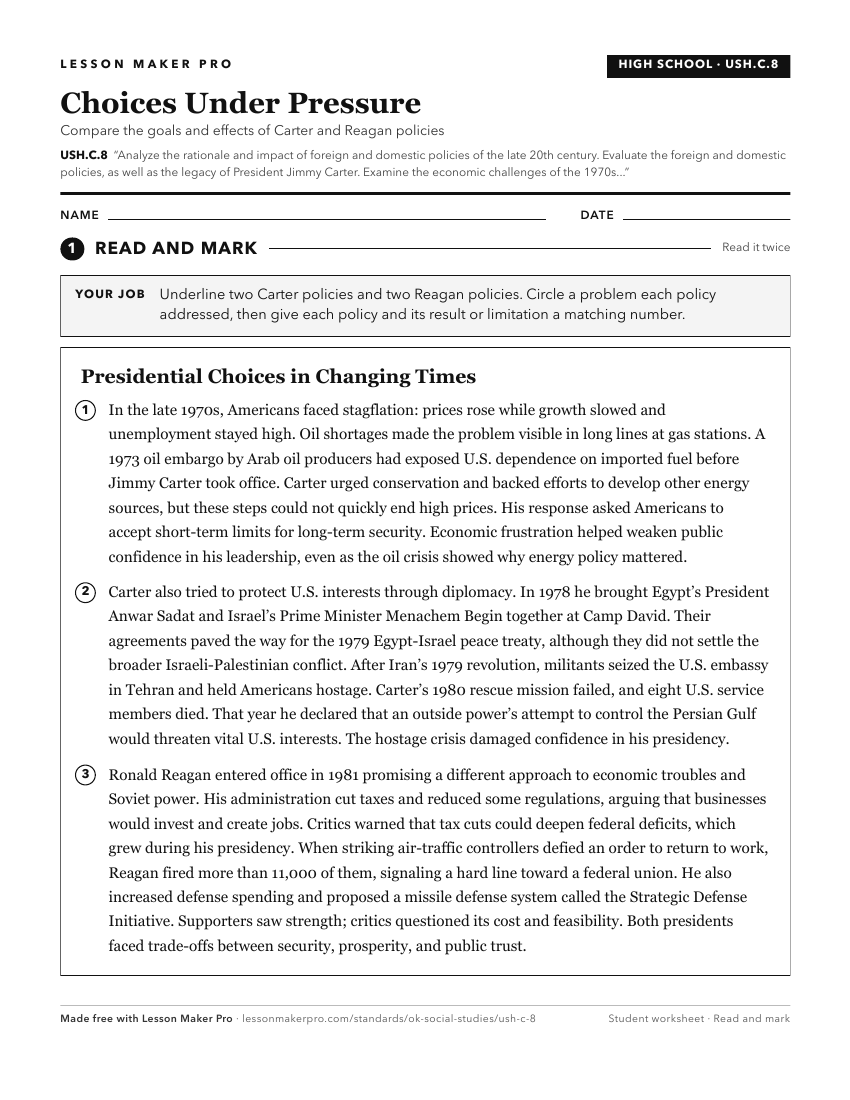
A ready-to-print activity worksheet aligned to USH.C.8, with an answer key for the teacher on its own page. No account needed.
PDF, US Letter, prints cleanly in black and white.
Download the worksheetKeep exploring
Related Standards
- USH.C.7.3
Analyze the ongoing social and political transformations within the United States of America , affecting domestic and foreign policy.
- USH.C.6.3.I
Analyze the political and economic impact of President Nixon’s foreign policies including détente and the opening of China.
- USH.C.7
Analyze the cause and effects of significant domestic events and policies impacting the lives of American citizens.
- USH.C.6
Analyze foreign events and policies during the early Cold War Era.
Turn this cluster into a lesson
Grade, subject, topic, and the complete cluster are prefilled. Create one free, no account needed.
Also for this cluster:Make a WorksheetMake a QuizMake a Sub Lesson