Oklahoma Social Studies USH.C.7
Standard Cluster
Analyze the cause and effects of significant domestic events and policies impacting the lives of American citizens. Analyze the major events, personalities, tactics, and effects of the Civil Rights Movement. Explain how segregation took multiple forms by comparing de jure segregation (e.g., miscegenation laws, public transportation) and de facto segregation (e.g., redlining, loan practices) which maintained the policies of “separate but equal.” Describe the legal attacks on segregation by the NAACP and its attorney Thurgood Marshall, summarizing major Supreme Court’s rulings (e.g., Sipuel v. Board of Regents of the University of Oklahoma, Brown v. Board of Education, Topeka, Heart of Atlanta Motel, Inc. v. United States, and Loving v. Virginia). Describe violent responses to the Civil Rights Movement, including the Birmingham church bombing and the assassination of Dr. Martin Luther King, Jr. Identify the tactics used at different times to achieve racial equality (e.g., Montgomery Bus Boycott, desegregation of Little Rock Central High School, Oklahoma City lunch counter sit-ins, Freedom Rides coordinated by the Congress of Racial Equality [CORE], the marches on Washington and from Selma to Montgomery supported by the Student Nonviolent Coordinating Committee [SNCC]). Compare the viewpoints and influence of civil rights leadership (e.g., Dr. Martin Luther King, Jr. reflected in his I Have a Dream speech, the perspectives of Malcolm X, and Robert Kennedy’s advocacy of civil rights legislation). Identify legislative achievements arising from the Civil Rights Movement and their impact on African American political power and economic status, including the adoption of the 24th Amendment, passage of the Civil Rights Act of 1964 and the Voting Rights Act of 1965. Describe the influence of American religion and prominent religious leaders on civil rights and human rights activism (e.g., Dr. Martin Luther King, Jr., Billy Graham, Malcolm X). Examine how the Civil Rights Movement intersected with various other movements for individual rights and liberties. Describe the goals of American Indian civil rights efforts by evaluating the strategies of the American Indian Movement and the leadership of Dennis Banks (e.g., occupations of Wounded Knee and Alcatraz) in response to federal mismanagement of Native affairs. Explain changes in tribal self-determination gained through legislation, such as the Indian Civil Rights Act of 1968, Indian Self Determination and Education Assistance Act, and the American Indian Religious Freedom Act. Describe how the League of the United Latin American Citizens (LULAC) challenged school segregation through landmark lawsuits and organized voter registration drives for Mexican Americans. Describe the goals and effectiveness of the United Farm Workers movement, including the leadership of César Chávez and Dolores Huerta to improve working conditions for migrant laborers. Compare the changing roles of women including the goals of the Women’s Liberation Movement and the National Organization of Women, comparing the views of Betty Friedan and Phyllis Schlafly. Examine perspectives on issues related to the debate over the Equal Rights Amendment and the Roe v. Wade decision. Analyze the ongoing social and political transformations within the United States of America , affecting domestic and foreign policy. Examine the role of the Warren Court’s application of the due process clause of the 14th Amendment (Incorporation Doctrine) which applies the Bill of Rights to the states, thereby securing and further defining individual rights and civil liberties. Assess the rise of liberalism in the 1960s and the lasting impact of President Lyndon Johnson’s War on Poverty and the Great Society by expanding the role of the federal government in economic and social issues. Describe the changing immigration policy, with emphasis on how the Immigration Act of 1965 began to transform American society through removal of an origins quota system. Identify the goals of the environmental protection movement, including the influence of the publication of Rachel Carson’s Silent Spring and passage of the Clean Air Act. Analyze the political and economic impact of President Nixon’s foreign policies including détente and the opening of China. Describe the election of Richard Nixon, including his appeal to “the silent majority” and the effects of the Watergate Scandal (e.g., public distrust of government, investigative role of the media, Pentagon Papers, first use of the 25th Amendment, President Ford’s pardon).
Oklahoma Academic Standards for Social Studies (2026)
Cluster contents
Standards in This Cluster
USH.C.7 is a cluster heading. These are the individual standards under it.
- USH.C.7.1
Analyze the major events, personalities, tactics, and effects of the Civil Rights Movement.
- USH.C.7.1.A
Explain how segregation took multiple forms by comparing de jure segregation (e.g., miscegenation laws, public transportation) and de facto segregation (e.g., r...
- USH.C.7.1.B
Describe the legal attacks on segregation by the NAACP and its attorney Thurgood Marshall, summarizing major Supreme Court’s rulings (e.g., Sipuel v. Board of R...
- USH.C.7.1.C
Describe violent responses to the Civil Rights Movement, including the Birmingham church bombing and the assassination of Dr. Martin Luther King, Jr.
- USH.C.7.1.D
Identify the tactics used at different times to achieve racial equality (e.g., Montgomery Bus Boycott, desegregation of Little Rock Central High School, Oklahom...
- USH.C.7.1.E
Compare the viewpoints and influence of civil rights leadership (e.g., Dr. Martin Luther King, Jr. reflected in his I Have a Dream speech, the perspectives of M...
- USH.C.7.1.F
Identify legislative achievements arising from the Civil Rights Movement and their impact on African American political power and economic status, including the...
- USH.C.7.1.G
Describe the influence of American religion and prominent religious leaders on civil rights and human rights activism (e.g., Dr. Martin Luther King, Jr., Billy ...
- USH.C.7.2
Examine how the Civil Rights Movement intersected with various other movements for individual rights and liberties.
- USH.C.7.2.A
Describe the goals of American Indian civil rights efforts by evaluating the strategies of the American Indian Movement and the leadership of Dennis Banks (e.g....
- USH.C.7.2.B
Explain changes in Tribal self-determination gained through legislation, such as the Indian Civil Rights Act of 1968, Indian Self Determination and Education As...
- USH.C.7.2.C
Describe how the League of the United Latin American Citizens (LULAC) challenged school segregation through landmark lawsuits and organized voter registration d...
- USH.C.7.2.D
Describe the goals and effectiveness of the United Farm Workers movement, including the leadership of César Chávez and Dolores Huerta to improve working conditi...
- USH.C.7.2.E
Compare the changing roles of women including the goals of the Women’s Liberation Movement and the National Organization of Women, comparing the views of Betty ...
- USH.C.7.2.F
Examine perspectives on issues related to the debate over the Equal Rights Amendment and the Roe v. Wade decision.
- USH.C.7.3
Analyze the ongoing social and political transformations within the United States of America , affecting domestic and foreign policy.
- USH.C.7.3.A
Examine the role of the Warren Court’s application of the due process clause of the 14th Amendment (Incorporation Doctrine) which applies the Bill of Rights to ...
- USH.C.7.3.B
Assess the rise of liberalism in the 1960s and the lasting impact of President Lyndon Johnson’s War on Poverty and the Great Society by expanding the role of th...
- USH.C.7.3.C
Describe the changing immigration policy, with emphasis on how the Immigration Act of 1965 began to transform American society through removal of an origins quo...
- USH.C.7.3.D
Identify the goals of the environmental protection movement, including the influence of the publication of Rachel Carson’s Silent Spring and passage of the Clea...
- USH.C.7.3.E
Analyze the political and economic impact of President Nixon’s foreign policies including détente and the opening of China.
- USH.C.7.3.F
Describe the election of Richard Nixon, including his appeal to “the silent majority” and the effects of the Watergate Scandal (e.g., public distrust of governm...
Teacher's field guide
What This Cluster Means
What Students Need to Do
- Students trace how protests, court rulings, and laws changed rights and daily life. They compare legal segregation with housing discrimination and examine efforts by Native activists, farmworkers, and women's groups. They connect federal programs, immigration and environmental laws, Nixon's opening of China, and Watergate to changes in policy and public trust.
What Mastery Looks Like
- Students can explain how Brown challenged school segregation and how the Voting Rights Act changed access to voting. They can compare a boycott with a sit-in and name an outcome of each. They can use a source to link another policy or scandal to a change in daily life or public trust.
Common Misconceptions
- Students may think segregation existed only where a law required it, missing redlining and biased lending. They may assume a court ruling ended discrimination right away. They may confuse the Civil Rights Act's ban on discrimination with the Voting Rights Act's protections for voting.
How to Assess It
- On an exit ticket, ask students to name one example each of legal and informal segregation. Have them explain how one protest or court case challenged either example.
Lesson moves
Ways to Teach It
Give pairs a bus ordinance, redlining map, boycott flyer, and Brown ruling to sort into barriers and responses.
Read short excerpts from Betty Friedan and Phyllis Schlafly, then write two sentences explaining their disagreement over the Equal Rights Amendment.
Play a matching game pairing the Voting Rights Act, Indian Self Determination Act, Immigration Act, and Clean Air Act with their effects.
Compare a historic redlining map with a current city housing map, then ask which patterns persist and what the maps cannot prove.
Free download
Printable USH.C.7 Worksheet
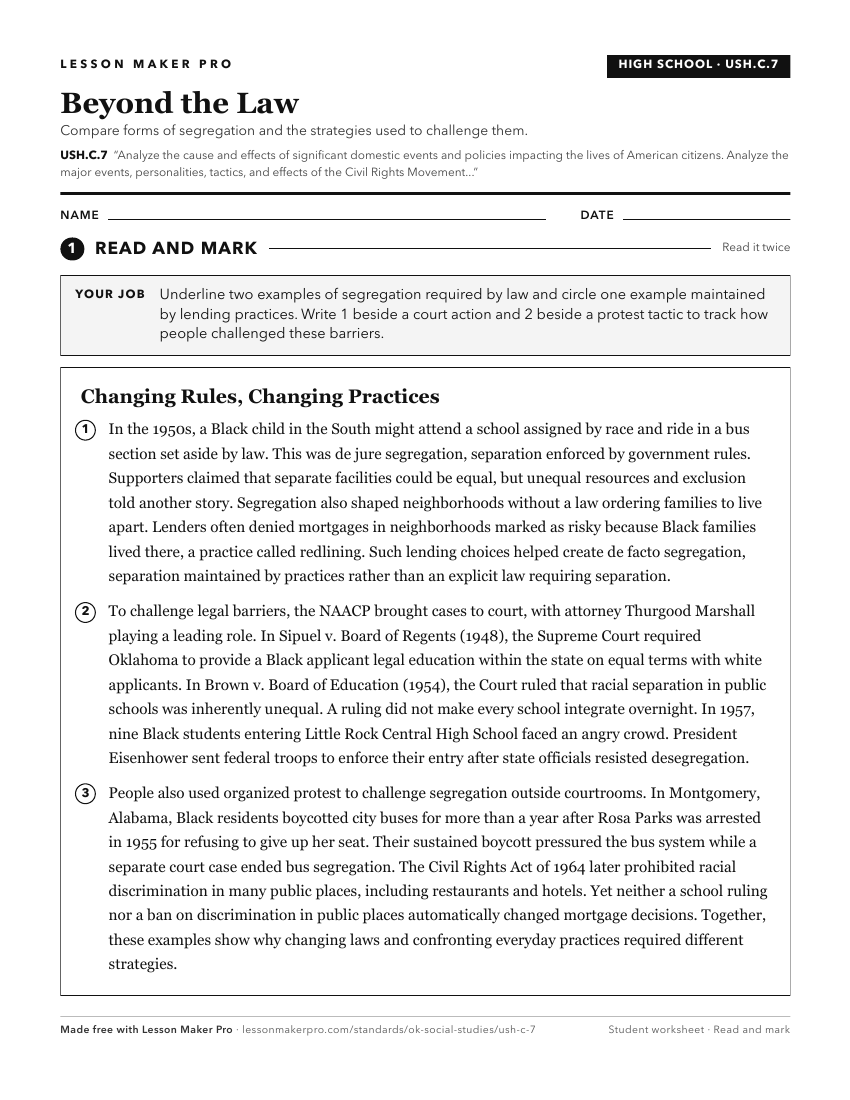
A ready-to-print activity worksheet aligned to USH.C.7, with an answer key for the teacher on its own page. No account needed.
PDF, US Letter, prints cleanly in black and white.
Download the worksheetKeep exploring
Related Standards
Turn this cluster into a lesson
Grade, subject, topic, and the complete cluster are prefilled. Create one free, no account needed.
Also for this cluster:Make a WorksheetMake a QuizMake a Sub Lesson