Oklahoma Social Studies 2.C.2
Standard Cluster
Examine the history of significant events and individuals who impacted our nation and the world. Compare perspectives of people in the past to people in the present and explain the importance of considering multiple viewpoints. Explain the benefits of using both primary sources (e.g., diaries, documents, photographs, artifacts, oral accounts) and secondary sources (e.g., textbooks, films, literature) to understand a past or current event. Explain reasons why past events happened and the changes they created by identifying the cause(s) and describing the effect(s) of an historical event. Describe why people from various places and cultures have migrated to the United States of America (e.g., improved quality of life, economic opportunities, individual freedom). Identify the contributions of people and groups who have shaped our history and explain how they are honored by federal holidays (e.g., Veterans Day, Presidents’ Day, Dr. Martin Luther King, Jr. Day, Constitution Day, Memorial Day, Independence Day). Research biographies of notable Americans who exhibited patriotism and civic virtues by describing how each individual contributed to the welfare and betterment of the nation. Leadership (e.g., Abraham Lincoln, Chief Joseph, Rosa Parks, Cesar Chavez) Military Service (e.g., Davy Crockett, General Dwight Eisenhower, General Colin Powell) Science and Technology (e.g., Orville and Wilbur Wright, Jonas Salk, Amelia Earhart, Neil Armstrong) Public Service (e.g., Harriet Tubman, Clara Barton, Theodore Roosevelt, Mary McLeod Bethune). Examine how people from other nations and other times made a difference in their communities around the world (e.g., Cincinnatus, Winston Churchill, Mohandas Gandhi, Nelson Mandela).
Oklahoma Academic Standards for Social Studies (2026)
Cluster contents
Standards in This Cluster
2.C.2 is a cluster heading. These are the individual standards under it.
- 2.C.2.1
Compare perspectives of people in the past to people in the present and explain the importance of considering multiple viewpoints.
- 2.C.2.2
Explain the benefits of using both primary sources (e.g., diaries, documents, photographs, artifacts, oral accounts) and secondary sources (e.g., textbooks, fil...
- 2.C.2.3
Explain reasons why past events happened and the changes they created by identifying the cause(s) and describing the effect(s) of an historical event.
- 2.C.2.4
Describe why people from various places and cultures have migrated to the United States of America (e.g., improved quality of life, economic opportunities, indi...
- 2.C.2.5
Identify the contributions of people and groups who have shaped our history and explain how they are honored by federal holidays (e.g., Veterans Day, Presidents...
- 2.C.2.6
Research biographies of notable Americans who exhibited patriotism and civic virtues by describing how each individual contributed to the welfare and betterment...
- 2.C.2.6.A
Leadership (e.g., Abraham Lincoln, Chief Joseph, Rosa Parks, Cesar Chavez)
- 2.C.2.6.B
Military Service (e.g., Davy Crockett, General Dwight Eisenhower, General Colin Powell)
- 2.C.2.6.C
Science and Technology (e.g., Orville and Wilbur Wright, Jonas Salk, Amelia Earhart, Neil Armstrong)
- 2.C.2.6.D
Public Service (e.g., Harriet Tubman, Clara Barton, Theodore Roosevelt, Mary McLeod Bethune).
- 2.C.2.7
Examine how people from other nations and other times made a difference in their communities around the world (e.g., Cincinnatus, Winston Churchill, Mohandas Ga...
Teacher's field guide
What This Cluster Means
What Students Need to Do
- Students use photos, firsthand accounts, and short biographies to learn how people changed communities here and abroad. They explain why events happened, what changed, and why families migrated to the United States. They compare viewpoints from the past and present and explain why holidays honor people and groups.
What Mastery Looks Like
- Given a 1956 photo of Rosa Parks and a short biography, a student identifies the primary source and tells what each source adds. They explain how her arrest helped start the bus boycott and how the boycott changed bus rules. They can give a reason a family moved to the United States and explain why Martin Luther King Jr. Day honors King's work.
Common Misconceptions
- Students may think a photo tells the whole story or mistake a later biography for an eyewitness account. Some think Rosa Parks alone ended bus segregation. Others assume all families came to the United States for the same reason.
How to Assess It
- Show a 1956 photo of Rosa Parks on a bus and a short account of the boycott. Ask students to name the primary source, tell what each source adds, and write one cause and one effect of the boycott.
Lesson moves
Ways to Teach It
Give pairs a 1956 photo of Rosa Parks on a bus and a short biography; have them label each source and compare details.
Read a short Nelson Mandela biography; ask students to compare school choices under apartheid with those in South Africa today.
Give teams family story cards about moving for work, safety, or freedom; have them match each story to a reason for migrating.
Show the school calendar's Martin Luther King Jr. Day entry; ask students whom it honors and what he worked to change.
Free download
Printable 2.C.2 Worksheet
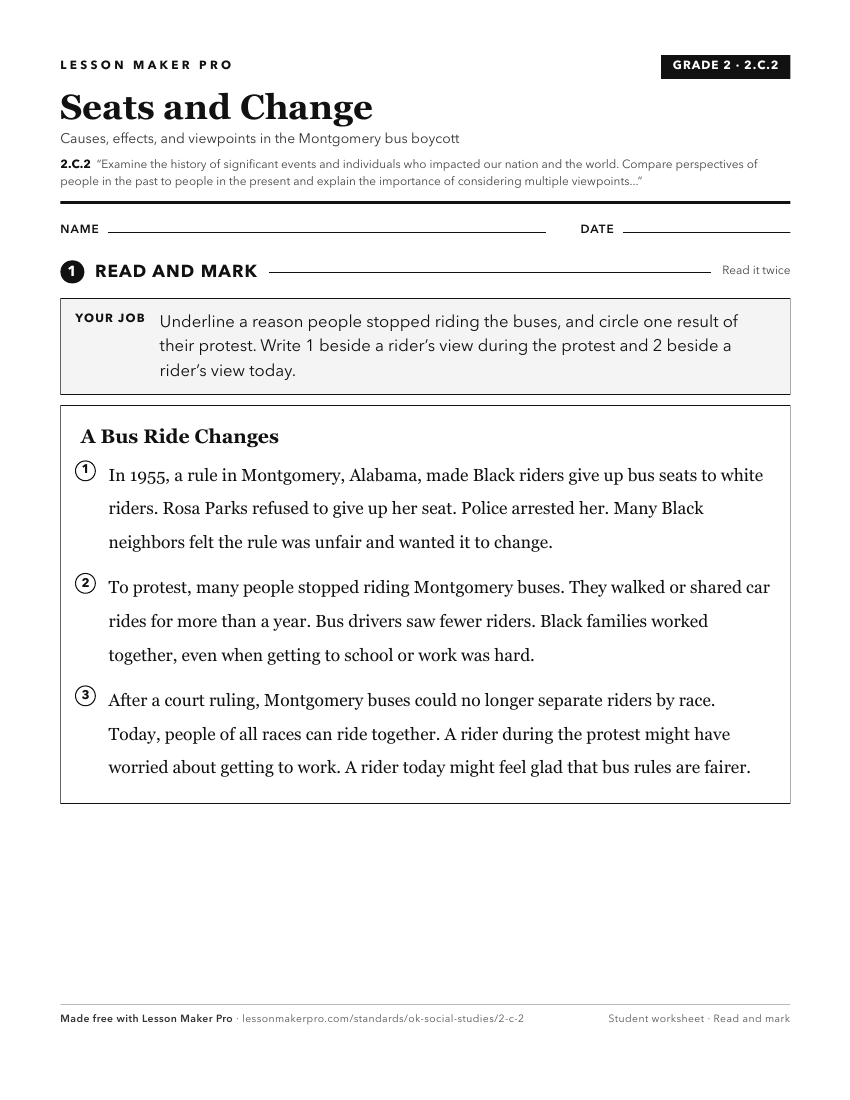
A ready-to-print activity worksheet aligned to 2.C.2, with an answer key for the teacher on its own page. No account needed.
PDF, US Letter, prints cleanly in black and white.
Download the worksheetKeep exploring
Related Standards
Turn this cluster into a lesson
Grade, subject, topic, and the complete cluster are prefilled. Create one free, no account needed.
Also for this cluster:Make a WorksheetMake a QuizMake a Sub Lesson