Oklahoma Social Studies 2.C.2.6
Standard Cluster
- 2.C.2
- Examine the history of significant events and individuals who impacted our nation and the world.
Research biographies of notable Americans who exhibited patriotism and civic virtues by describing how each individual contributed to the welfare and betterment of the nation. Leadership (e.g., Abraham Lincoln, Chief Joseph, Rosa Parks, Cesar Chavez) Military Service (e.g., Davy Crockett, General Dwight Eisenhower, General Colin Powell) Science and Technology (e.g., Orville and Wilbur Wright, Jonas Salk, Amelia Earhart, Neil Armstrong) Public Service (e.g., Harriet Tubman, Clara Barton, Theodore Roosevelt, Mary McLeod Bethune).
Oklahoma Academic Standards for Social Studies (2026) · 2.C.2
Cluster contents
Standards in This Cluster
2.C.2.6 is a cluster heading. These are the individual standards under it.
- 2.C.2.6.A
Leadership (e.g., Abraham Lincoln, Chief Joseph, Rosa Parks, Cesar Chavez)
- 2.C.2.6.B
Military Service (e.g., Davy Crockett, General Dwight Eisenhower, General Colin Powell)
- 2.C.2.6.C
Science and Technology (e.g., Orville and Wilbur Wright, Jonas Salk, Amelia Earhart, Neil Armstrong)
- 2.C.2.6.D
Public Service (e.g., Harriet Tubman, Clara Barton, Theodore Roosevelt, Mary McLeod Bethune).
Teacher's field guide
What This Cluster Means
What Students Need to Do
- Students read short biographies to find what each person did and who benefited. They explain how those actions helped people in the United States. They use facts from the biographies to show courage or service.
What Mastery Looks Like
- A student can describe how Rosa Parks challenged an unfair bus rule and how Jonas Salk's polio vaccine helped protect people. They can point to a fact in each biography and explain who benefited.
Common Misconceptions
- Students may say Rosa Parks ended segregation by herself, rather than describing her role in a larger movement. They may name Jonas Salk as a doctor without explaining how his vaccine helped people. Some think serving the country only means joining the military.
How to Assess It
- Hand out short biographies of Rosa Parks and Jonas Salk. Ask students to name one action each person took, who it helped, and one detail that shows courage or service.
Lesson moves
Ways to Teach It
Give pairs printed biographies of Rosa Parks and Jonas Salk; have them mark each person's action and add its effect to a sticky-note chart.
Ask students to write how Rosa Parks and Jonas Salk helped people in different ways, using one fact from each biography.
Play a card match using names, actions, and people helped from short biographies of Harriet Tubman, Clara Barton, and Jonas Salk.
Show a Red Cross blood drive flyer and ask students how Clara Barton's work and today's blood donations help people.
Free download
Printable 2.C.2.6 Worksheet
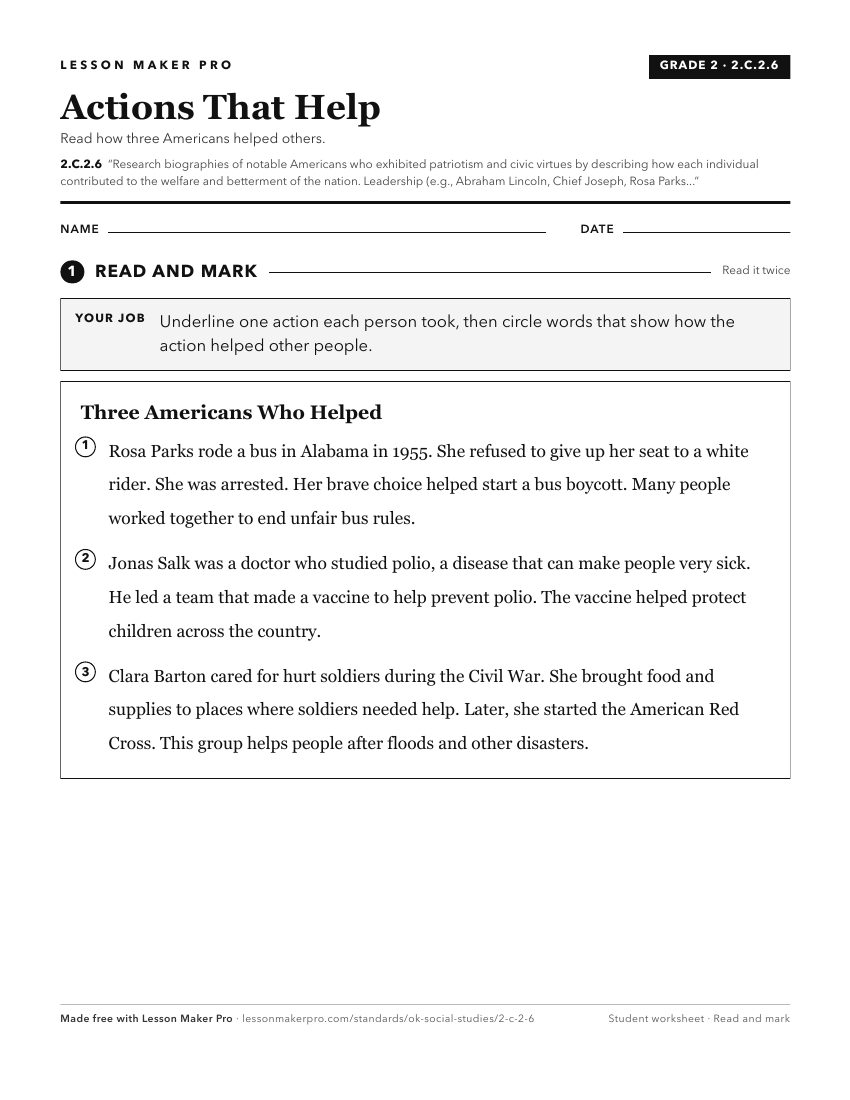
A ready-to-print activity worksheet aligned to 2.C.2.6, with an answer key for the teacher on its own page. No account needed.
PDF, US Letter, prints cleanly in black and white.
Download the worksheetKeep exploring
Related Standards
- AWH.P.2.1.A
Evaluate various significant documents from the United States of America and other nations to compare civic virtues and principles of political systems.
- TOT.P.2.1.A
Evaluate various significant documents from the United States of America and other nations to compare civic virtues and principles of political systems.
- 1.C.1.6
Using biographies from early United States of America’s history, explain historical examples of patriotism and civic virtue as exemplified during the early Amer...
- 2.C.4.8
Use biographies of American inventors and entrepreneurs, explaining how their ideas and work helped the nation grow (e.g., George Washington Carver, John Deere,...
Turn this cluster into a lesson
Grade, subject, topic, and the complete cluster are prefilled. Create one free, no account needed.
Also for this cluster:Make a WorksheetMake a QuizMake a Sub Lesson