Oklahoma Social Studies USH.C.7.3.D
The Standard
- USH.C.7
- Analyze the cause and effects of significant domestic events and policies impacting the lives of American citizens.
- USH.C.7.3
- Analyze the ongoing social and political transformations within the United States of America , affecting domestic and foreign policy.
Identify the goals of the environmental protection movement, including the influence of the publication of Rachel Carson’s Silent Spring and passage of the Clean Air Act.
Oklahoma Academic Standards for Social Studies (2026) · USH.C.7.3
Teacher's field guide
What This Standard Means
What Students Need to Do
- Students identify goals such as cleaner air, less pesticide harm, and protection of wildlife. They explain how Rachel Carson’s book raised public concern and how the Clean Air Act addressed air pollution.
What Mastery Looks Like
- A student can connect Carson’s warnings about pesticides to public calls for change. They can explain that the Clean Air Act gave the federal government a stronger role in limiting pollution from cars and factories.
Common Misconceptions
- Students may think Silent Spring was a law or that it banned all pesticides. Some confuse the Clean Air Act with a water pollution law or think it ended air pollution at once.
How to Assess It
- On an exit ticket, ask: Name two goals of the environmental movement. How did Silent Spring influence public concern, and what problem did the Clean Air Act address?
Lesson moves
Ways to Teach It
Pairs sort printed cards showing DDT spraying, thinning eggshells, smokestacks, and car exhaust into pesticide harm or air pollution, then propose one fix per group.
Ask students to write two sentences for a 1962 newspaper reader: Why might Carson’s warnings lead you to demand limits on pesticides?
Read four case cards about DDT harming birds or factories emitting smoke; pairs hold up 'Silent Spring' or 'Clean Air Act' and explain.
Check the local AirNow air quality reading, then write one sentence connecting it to the Clean Air Act’s goal of limiting harmful air pollution.
Free download
Printable USH.C.7.3.D Worksheet
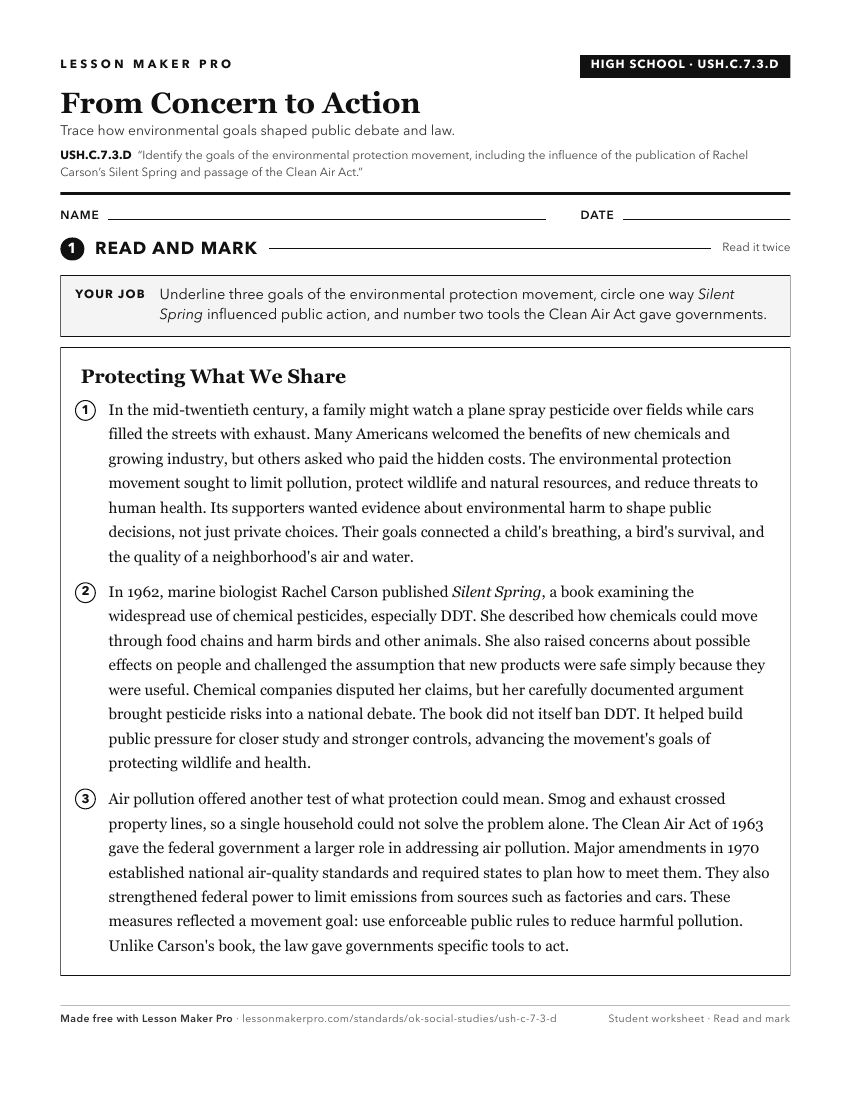
A ready-to-print activity worksheet aligned to USH.C.7.3.D, with an answer key for the teacher on its own page. No account needed.
PDF, US Letter, prints cleanly in black and white.
Download the worksheetKeep exploring
Related Standards
- 6.C.4.5
Evaluate the need to preserve resources, climate, and wildlife by creating public awareness, including the efforts of eco-tourism.
- 4.C.1.3.E
Summarize ways in which citizens are stewards of the nation’s environment by examining how natural resources can be managed wisely (e.g., recycling and anti-lit...
- 6.C.4.6
Describe the role of citizens as responsible stewards of natural resources and the environment (e.g., recycling campaigns, water conservation, national parks, p...
- 6.C.4.4
Identify environmental challenges (e.g., air pollution, acid rain, deforestation) and explain how they can impact a region (e.g., oil spills, Amazonia’s ranchin...
Turn this exact standard into a lesson
Grade, subject, topic, and the complete standard are prefilled. Create one free, no account needed.
Also for this standard:Make a WorksheetMake a QuizMake a Sub Lesson