Oklahoma Social Studies USH.C.7.2
Standard Cluster
- USH.C.7
- Analyze the cause and effects of significant domestic events and policies impacting the lives of American citizens.
Examine how the Civil Rights Movement intersected with various other movements for individual rights and liberties. Describe the goals of American Indian civil rights efforts by evaluating the strategies of the American Indian Movement and the leadership of Dennis Banks (e.g., occupations of Wounded Knee and Alcatraz) in response to federal mismanagement of Native affairs. Explain changes in tribal self-determination gained through legislation, such as the Indian Civil Rights Act of 1968, Indian Self Determination and Education Assistance Act, and the American Indian Religious Freedom Act. Describe how the League of the United Latin American Citizens (LULAC) challenged school segregation through landmark lawsuits and organized voter registration drives for Mexican Americans. Describe the goals and effectiveness of the United Farm Workers movement, including the leadership of César Chávez and Dolores Huerta to improve working conditions for migrant laborers. Compare the changing roles of women including the goals of the Women’s Liberation Movement and the National Organization of Women, comparing the views of Betty Friedan and Phyllis Schlafly. Examine perspectives on issues related to the debate over the Equal Rights Amendment and the Roe v. Wade decision.
Oklahoma Academic Standards for Social Studies (2026) · USH.C.7
Cluster contents
Standards in This Cluster
USH.C.7.2 is a cluster heading. These are the individual standards under it.
- USH.C.7.2.A
Describe the goals of American Indian civil rights efforts by evaluating the strategies of the American Indian Movement and the leadership of Dennis Banks (e.g....
- USH.C.7.2.B
Explain changes in Tribal self-determination gained through legislation, such as the Indian Civil Rights Act of 1968, Indian Self Determination and Education As...
- USH.C.7.2.C
Describe how the League of the United Latin American Citizens (LULAC) challenged school segregation through landmark lawsuits and organized voter registration d...
- USH.C.7.2.D
Describe the goals and effectiveness of the United Farm Workers movement, including the leadership of César Chávez and Dolores Huerta to improve working conditi...
- USH.C.7.2.E
Compare the changing roles of women including the goals of the Women’s Liberation Movement and the National Organization of Women, comparing the views of Betty ...
- USH.C.7.2.F
Examine perspectives on issues related to the debate over the Equal Rights Amendment and the Roe v. Wade decision.
Teacher's field guide
What This Cluster Means
What Students Need to Do
- Students explain how Native activists protested federal policy and how laws changed tribal rights and control. They describe how LULAC fought school segregation and organized voters, and how César Chávez and Dolores Huerta organized farmworkers. They compare Betty Friedan and Phyllis Schlafly on women's roles, the Equal Rights Amendment, and Roe v. Wade.
What Mastery Looks Like
- Students distinguish the Indians of All Tribes occupation of Alcatraz from Dennis Banks's role with AIM at Wounded Knee. They link the 1968, 1975, and 1978 laws to individual rights, tribal control of programs, and religious practice. They explain how a LULAC school lawsuit, voter drives, and UFW boycotts pursued change.
Common Misconceptions
- Students may credit AIM and Dennis Banks with Alcatraz, though Indians of All Tribes led that occupation. They may mistake the 1968 rights law for the later law that let tribes run federal programs. They may mix up Friedan's support for the Equal Rights Amendment with Schlafly's opposition, or treat Roe as an amendment.
How to Assess It
- Exit ticket: Compare AIM's action at Wounded Knee with the UFW grape boycott. Name each group's goal, one tactic, and one result.
Lesson moves
Ways to Teach It
Give pairs dated cards for Alcatraz, Wounded Knee, and the three federal laws; have them build a timeline and mark protest versus policy.
Post brief Friedan and Schlafly excerpts; ask students how each viewed the Equal Rights Amendment and abortion rights after Roe v. Wade.
Run a matching relay: pair LULAC with Delgado and voter drives, UFW with grape boycotts, and AIM with Wounded Knee.
Show a local school board election notice; ask how voter registration drives could change who has a voice in school policy.
Free download
Printable USH.C.7.2 Worksheet
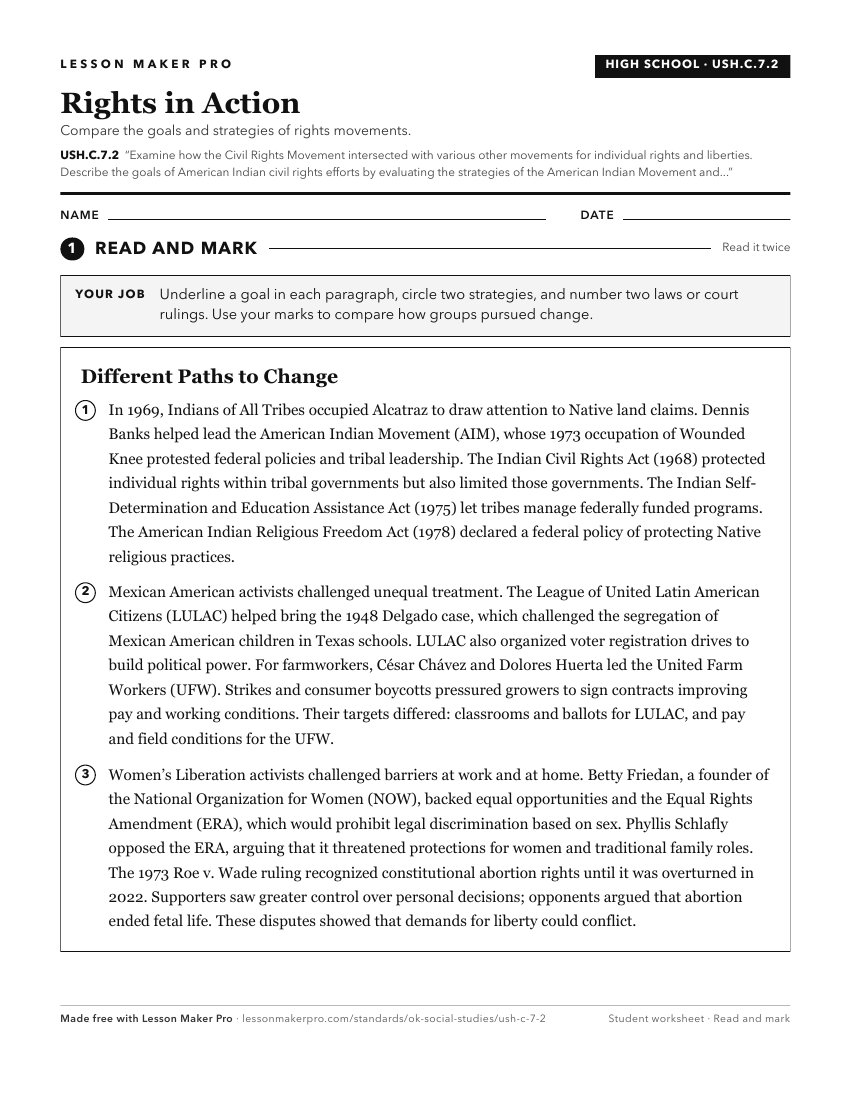
A ready-to-print activity worksheet aligned to USH.C.7.2, with an answer key for the teacher on its own page. No account needed.
PDF, US Letter, prints cleanly in black and white.
Download the worksheetKeep exploring
Related Standards
- USH.C.1.2
Analyze the post-Reconstruction civil rights struggles of African Americans.
- USH.C.7.1
Analyze the major events, personalities, tactics, and effects of the Civil Rights Movement.
- USG.C.6.4
Analyze the civil rights and civil liberties affirmed and guaranteed by the Bill of Rights.
- USH.C.7.1.E
Compare the viewpoints and influence of civil rights leadership (e.g., Dr. Martin Luther King, Jr. reflected in his I Have a Dream speech, the perspectives of M...
Turn this cluster into a lesson
Grade, subject, topic, and the complete cluster are prefilled. Create one free, no account needed.
Also for this cluster:Make a WorksheetMake a QuizMake a Sub Lesson