Oklahoma Social Studies USH.C.7.1.E
The Standard
- USH.C.7
- Analyze the cause and effects of significant domestic events and policies impacting the lives of American citizens.
- USH.C.7.1
- Analyze the major events, personalities, tactics, and effects of the Civil Rights Movement.
Compare the viewpoints and influence of civil rights leadership (e.g., Dr. Martin Luther King, Jr. reflected in his I Have a Dream speech, the perspectives of Malcolm X, and Robert Kennedy’s advocacy of civil rights legislation).
Oklahoma Academic Standards for Social Studies (2026) · USH.C.7.1
Teacher's field guide
What This Standard Means
What Students Need to Do
- Students compare what King, Malcolm X, and Robert Kennedy said about ending racial discrimination. They explain how each tried to influence people or policy, using evidence from speeches or public statements.
What Mastery Looks Like
- A student can identify King’s call for nonviolent protest, Malcolm X’s emphasis on Black self-determination and self-defense, and Kennedy’s push for federal legislation. They can explain how each approach influenced the civil rights movement.
Common Misconceptions
- Students may mistake Malcolm X’s support for self-defense as a call to start violence. They may treat King and Kennedy as having the same role, or miss how Malcolm X’s views changed over time.
How to Assess It
- Give students one short excerpt from each leader. Ask them to name each leader’s approach to change and explain one difference in how two leaders used their influence.
Lesson moves
Ways to Teach It
Give pairs source cards from King’s speech, Malcolm X’s 'The Ballot or the Bullet,' and Kennedy’s civil rights remarks; sort by proposed action.
Ask: How did King’s speech and Kennedy’s work on legislation tackle discrimination in different ways? Use one detail from each source.
Place nine claim cards under King, Malcolm X, or Kennedy, then have students defend two matches with source evidence.
Give students a sample housing discrimination complaint and ask how each leader might seek a remedy, using one source detail per leader.
Free download
Printable USH.C.7.1.E Worksheet
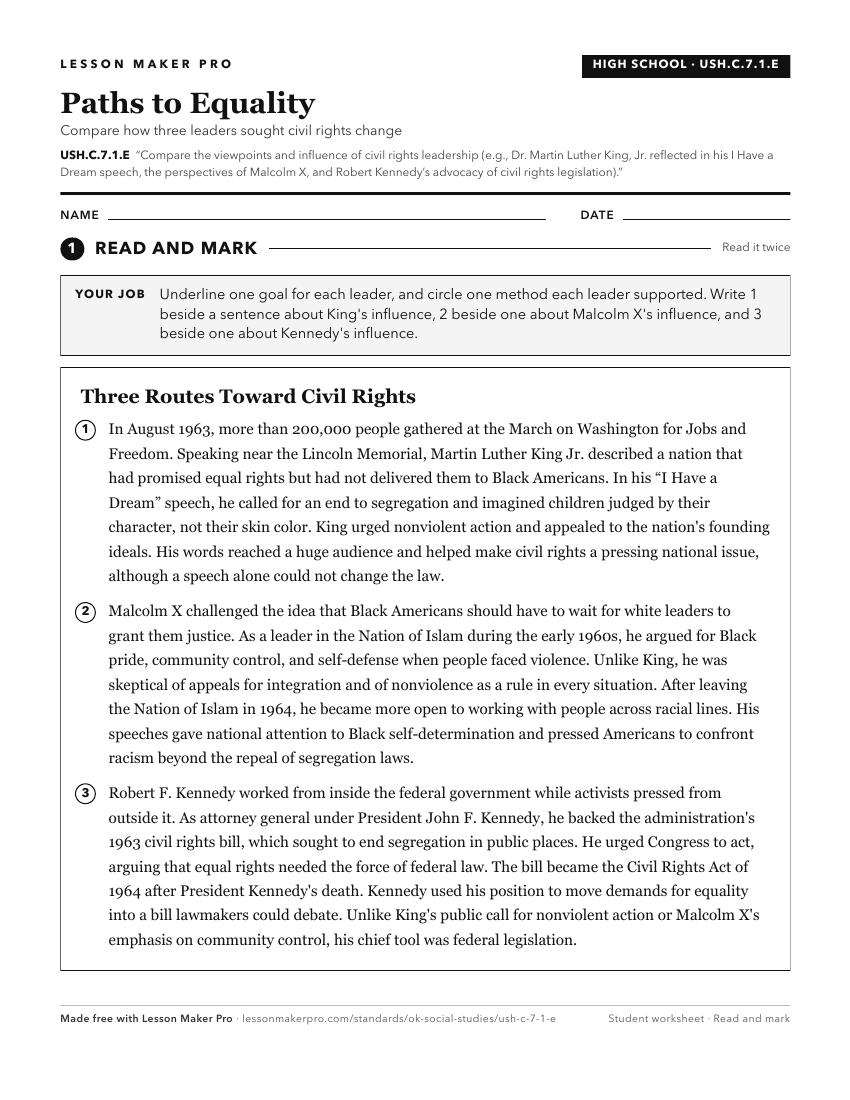
A ready-to-print activity worksheet aligned to USH.C.7.1.E, with an answer key for the teacher on its own page. No account needed.
PDF, US Letter, prints cleanly in black and white.
Download the worksheetKeep exploring
Related Standards
- USH.C.7.1.G
Describe the influence of American religion and prominent religious leaders on civil rights and human rights activism (e.g., Dr. Martin Luther King, Jr., Billy ...
- USH.C.7.1
Analyze the major events, personalities, tactics, and effects of the Civil Rights Movement.
- USH.C.7.2
Examine how the Civil Rights Movement intersected with various other movements for individual rights and liberties.
- USH.C.2.2.E
Compare the viewpoints of early civil right leaders, such as Booker T. Washington, W.E.B. DuBois, and Ida B. Wells, in response to rising racial tensions.
Turn this exact standard into a lesson
Grade, subject, topic, and the complete standard are prefilled. Create one free, no account needed.
Also for this standard:Make a WorksheetMake a QuizMake a Sub Lesson