Oklahoma Social Studies USH.C.7.1
Standard Cluster
- USH.C.7
- Analyze the cause and effects of significant domestic events and policies impacting the lives of American citizens.
Analyze the major events, personalities, tactics, and effects of the Civil Rights Movement. Explain how segregation took multiple forms by comparing de jure segregation (e.g., miscegenation laws, public transportation) and de facto segregation (e.g., redlining, loan practices) which maintained the policies of “separate but equal.” Describe the legal attacks on segregation by the NAACP and its attorney Thurgood Marshall, summarizing major Supreme Court’s rulings (e.g., Sipuel v. Board of Regents of the University of Oklahoma, Brown v. Board of Education, Topeka, Heart of Atlanta Motel, Inc. v. United States, and Loving v. Virginia). Describe violent responses to the Civil Rights Movement, including the Birmingham church bombing and the assassination of Dr. Martin Luther King, Jr. Identify the tactics used at different times to achieve racial equality (e.g., Montgomery Bus Boycott, desegregation of Little Rock Central High School, Oklahoma City lunch counter sit-ins, Freedom Rides coordinated by the Congress of Racial Equality [CORE], the marches on Washington and from Selma to Montgomery supported by the Student Nonviolent Coordinating Committee [SNCC]). Compare the viewpoints and influence of civil rights leadership (e.g., Dr. Martin Luther King, Jr. reflected in his I Have a Dream speech, the perspectives of Malcolm X, and Robert Kennedy’s advocacy of civil rights legislation). Identify legislative achievements arising from the Civil Rights Movement and their impact on African American political power and economic status, including the adoption of the 24th Amendment, passage of the Civil Rights Act of 1964 and the Voting Rights Act of 1965. Describe the influence of American religion and prominent religious leaders on civil rights and human rights activism (e.g., Dr. Martin Luther King, Jr., Billy Graham, Malcolm X).
Oklahoma Academic Standards for Social Studies (2026) · USH.C.7
Cluster contents
Standards in This Cluster
USH.C.7.1 is a cluster heading. These are the individual standards under it.
- USH.C.7.1.A
Explain how segregation took multiple forms by comparing de jure segregation (e.g., miscegenation laws, public transportation) and de facto segregation (e.g., r...
- USH.C.7.1.B
Describe the legal attacks on segregation by the NAACP and its attorney Thurgood Marshall, summarizing major Supreme Court’s rulings (e.g., Sipuel v. Board of R...
- USH.C.7.1.C
Describe violent responses to the Civil Rights Movement, including the Birmingham church bombing and the assassination of Dr. Martin Luther King, Jr.
- USH.C.7.1.D
Identify the tactics used at different times to achieve racial equality (e.g., Montgomery Bus Boycott, desegregation of Little Rock Central High School, Oklahom...
- USH.C.7.1.E
Compare the viewpoints and influence of civil rights leadership (e.g., Dr. Martin Luther King, Jr. reflected in his I Have a Dream speech, the perspectives of M...
- USH.C.7.1.F
Identify legislative achievements arising from the Civil Rights Movement and their impact on African American political power and economic status, including the...
- USH.C.7.1.G
Describe the influence of American religion and prominent religious leaders on civil rights and human rights activism (e.g., Dr. Martin Luther King, Jr., Billy ...
Teacher's field guide
What This Cluster Means
What Students Need to Do
- Students distinguish segregation set by law from segregation maintained through housing and lending practices. They trace how court rulings, protests, and federal laws changed access to schools, public places, and voting. They compare leaders’ arguments, religious influences, and violent responses.
What Mastery Looks Like
- Students explain how Brown challenged school segregation while redlining kept neighborhoods divided. They describe the tactics used in the Montgomery boycott, Freedom Rides, and Selma marches. They compare King’s and Malcolm X’s views and explain how the 24th Amendment and Voting Rights Act expanded access to voting.
Common Misconceptions
- Students may think segregation only came from written laws, missing redlining and biased loans. They may assume Brown ended school segregation at once. Some mistake nonviolent protest for a movement that faced no violence.
How to Assess It
- Exit ticket: Classify a marriage ban and a biased loan denial as segregation by law or practice. Name one court case that challenged segregation and one federal law that expanded civil rights.
Lesson moves
Ways to Teach It
Give pairs index cards labeled Sipuel, Brown, Montgomery boycott, Birmingham church bombing, Selma march, and Voting Rights Act; have them order and annotate each.
Read brief excerpts from King’s Birmingham jail letter and Malcolm X’s Ballot or the Bullet speech; discuss how faith shapes their arguments.
Play a sorting relay: teams place redlining, bus segregation laws, biased loans, and marriage bans under law or practice, then explain each choice.
Show a redlining map of a nearby city beside its current census income map; students note two patterns and one limit.
Free download
Printable USH.C.7.1 Worksheet
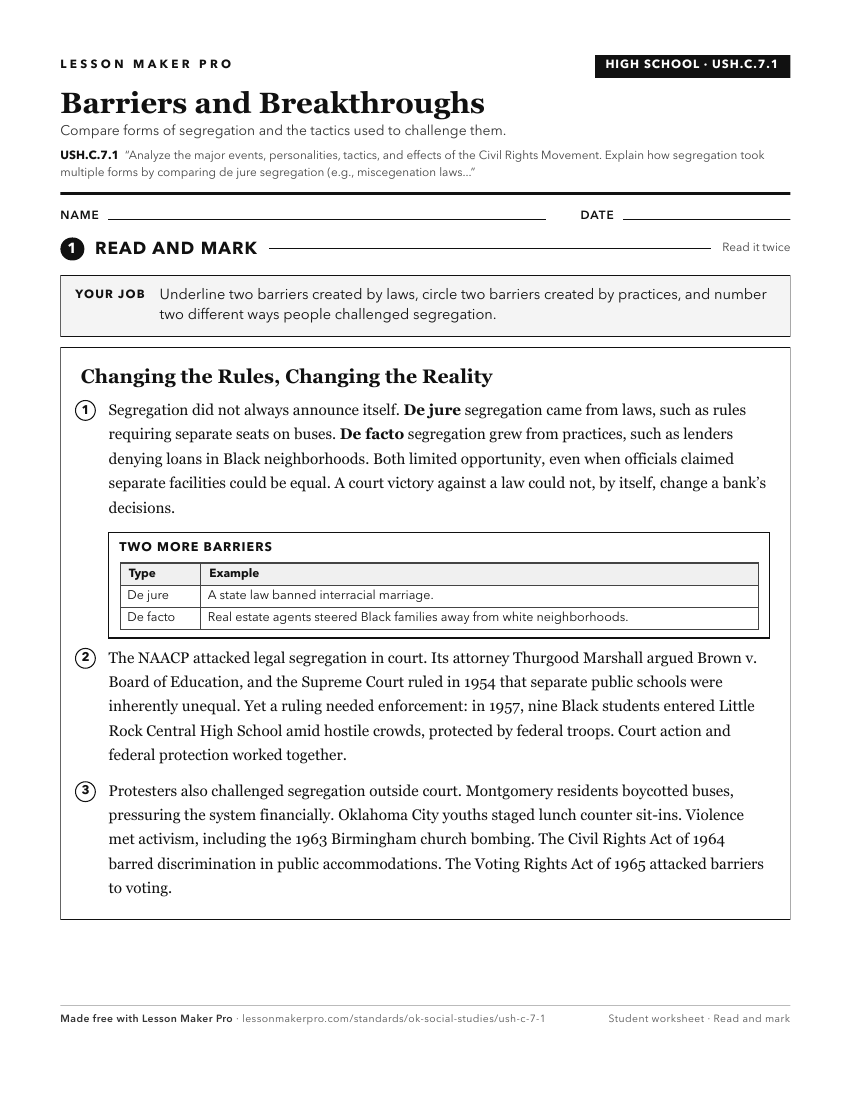
A ready-to-print activity worksheet aligned to USH.C.7.1, with an answer key for the teacher on its own page. No account needed.
PDF, US Letter, prints cleanly in black and white.
Download the worksheetKeep exploring
Related Standards
- USH.C.1.2
Analyze the post-Reconstruction civil rights struggles of African Americans.
- USH.C.7.2
Examine how the Civil Rights Movement intersected with various other movements for individual rights and liberties.
- OKH.C.8.1
Evaluate the progress of the Civil Rights Movement in Oklahoma by describing the goals, strategies, and accomplishments toward equality.
Turn this cluster into a lesson
Grade, subject, topic, and the complete cluster are prefilled. Create one free, no account needed.
Also for this cluster:Make a WorksheetMake a QuizMake a Sub Lesson