Oklahoma Social Studies OKH.C.8.1
Standard Cluster
- OKH.C.8
- Investigate how post-war social, political, and economic events continued to transform the state of Oklahoma from the 1950s through the present.
Evaluate the progress of the Civil Rights Movement in Oklahoma by describing the goals, strategies, and accomplishments toward equality. Examine judicial interpretation of the equal protection clause of the 14th Amendment. Describe issues and decisions of the landmark Supreme Court cases of Sipuel v. Board of Regents of the University of Oklahoma and McLaurin v. Oklahoma Board of Regents for Higher Education. Assess the leadership of Governor Raymond Gary in the integration of the public common and higher education systems. Explain the strategy and effectiveness of nonviolent lunch-counter sit-ins, such as those organized by Clara Luper, local churches, and the NAACP. Compare the consequences of Tulsa Public School’s voluntary desegregation initiated at Booker T. Washington High School to Oklahoma City Public Schools delayed compliance resolved by a lawsuit and subsequent rulings and enforcement.
Oklahoma Academic Standards for Social Studies (2026) · OKH.C.8
Cluster contents
Standards in This Cluster
OKH.C.8.1 is a cluster heading. These are the individual standards under it.
- OKH.C.8.1.A
Examine judicial interpretation of the equal protection clause of the 14th Amendment.
- OKH.C.8.1.B
Describe issues and decisions of the landmark Supreme Court cases of Sipuel v. Board of Regents of the University of Oklahoma and McLaurin v. Oklahoma Board of ...
- OKH.C.8.1.C
Assess the leadership of Governor Raymond Gary in the integration of the public common and higher education systems.
- OKH.C.8.1.D
Explain the strategy and effectiveness of nonviolent lunch-counter sit-ins, such as those organized by Clara Luper, local churches, and the NAACP.
- OKH.C.8.1.E
Compare the consequences of Tulsa Public School’s voluntary desegregation initiated at Booker T. Washington High School to Oklahoma City Public Schools delayed ...
Teacher's field guide
What This Cluster Means
What Students Need to Do
- Students trace how Oklahomans used lawsuits, sit-ins, and state action to challenge unequal access. They explain how equal protection shaped two university court cases. They examine Governor Gary’s role in school integration and compare Tulsa’s voluntary steps with Oklahoma City’s court-driven changes.
What Mastery Looks Like
- A student can explain why excluding Sipuel from legal education and isolating McLaurin after admission raised different equal protection issues. They can use evidence from Luper’s sit-ins, Gary’s actions, and both school districts to weigh progress against delays.
Common Misconceptions
- Students may think Sipuel and McLaurin received the same ruling, or that McLaurin was denied admission. Some assume one court decision ended segregation across Oklahoma. Others miss the difference between Tulsa’s voluntary steps and Oklahoma City’s delayed compliance.
How to Assess It
- Exit ticket: Why did the Court reject McLaurin’s separate seating? Name one tactic besides a lawsuit that Oklahomans used to challenge unequal access.
Lesson moves
Ways to Teach It
Give pairs six dated event cards on the lawsuits, Gary, sit-ins, and school desegregation; have them build a timeline and label each strategy.
Ask students to write: Why was admitting McLaurin not enough when he still faced separate seating? Use one detail from the ruling.
Hand out Sipuel and McLaurin claim cards; have partners match each claim to its ruling and explain the difference in one sentence.
Show a current school attendance map; ask how boundaries and bus routes can affect access, then connect responses to Oklahoma City’s delayed compliance.
Free download
Printable OKH.C.8.1 Worksheet
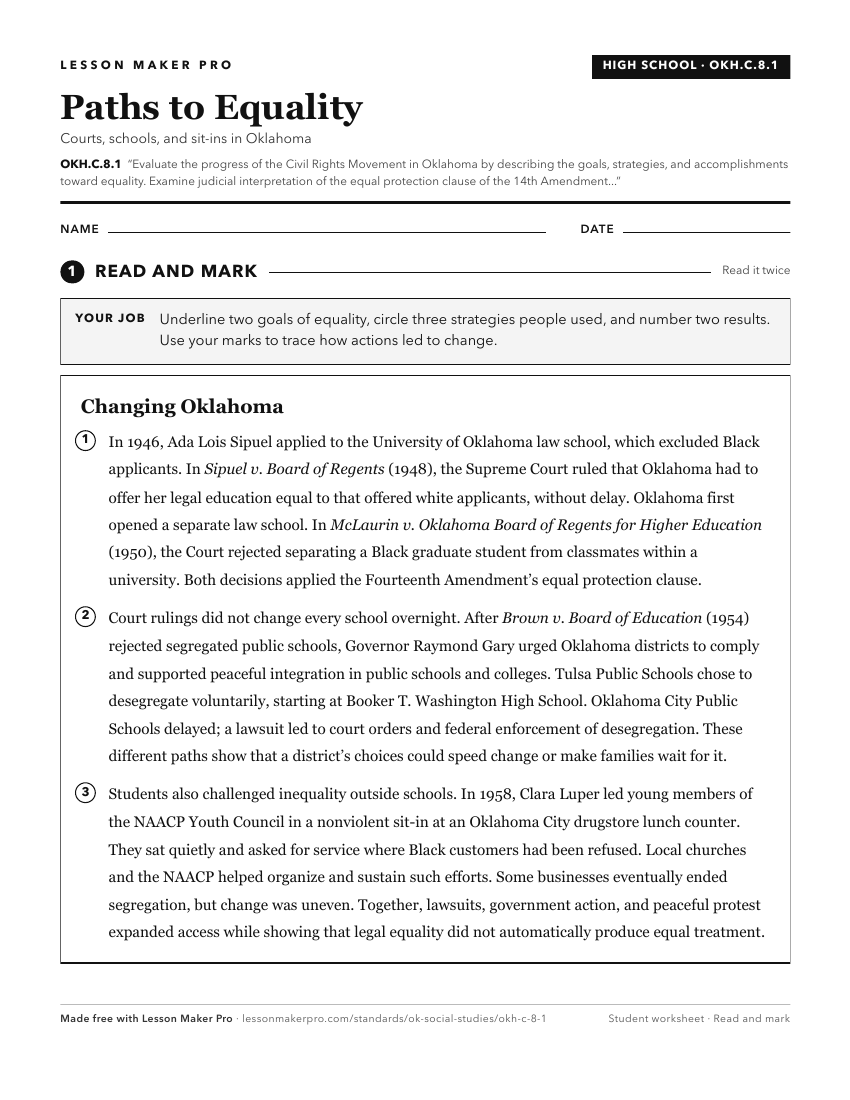
A ready-to-print activity worksheet aligned to OKH.C.8.1, with an answer key for the teacher on its own page. No account needed.
PDF, US Letter, prints cleanly in black and white.
Download the worksheetKeep exploring
Related Standards
- 3.C.3
Analyze the significant historical events and people contributing to the development of Oklahoma.
- OKH.C.6
Examine Oklahoma’s political, economic, and social history regarding race during the early decades following statehood.
- OKH.C.8
Investigate how post-war social, political, and economic events continued to transform the state of Oklahoma from the 1950s through the present.
- OKH.C.6.3
Examine the evolution of race relations in Oklahoma.
Turn this cluster into a lesson
Grade, subject, topic, and the complete cluster are prefilled. Create one free, no account needed.
Also for this cluster:Make a WorksheetMake a QuizMake a Sub Lesson