Oklahoma Social Studies OKH.C.6.3
Standard Cluster
- OKH.C.6
- Examine Oklahoma’s political, economic, and social history regarding race during the early decades following statehood.
Examine the evolution of race relations in Oklahoma. Analyze the intent and effect of Jim Crow laws initiated by the passage of Senate Bill 1. Explain the outcome of Oklahoma’s attempt to restrict suffrage rights through the grandfather clause (Guinn v. United States of America). Describe the continued growth of African American communities, including the emergence of “Black Wall Street” in Tulsa’s Greenwood District. Examine the rise of the Ku Klux Klan and its involvement in acts of intimidation and violence. Analyze the causes of the Tulsa Race Massacre, including its continued social and economic impact.
Oklahoma Academic Standards for Social Studies (2026) · OKH.C.6
Cluster contents
Standards in This Cluster
OKH.C.6.3 is a cluster heading. These are the individual standards under it.
- OKH.C.6.3.A
Analyze the intent and effect of Jim Crow laws initiated by the passage of Senate Bill 1.
- OKH.C.6.3.B
Explain the outcome of Oklahoma’s attempt to restrict suffrage rights through the grandfather clause (Guinn v. United States of America).
- OKH.C.6.3.C
Describe the continued growth of African American communities, including the emergence of “Black Wall Street” in Tulsa’s Greenwood District
- OKH.C.6.3.D
Examine the rise of the Ku Klux Klan and its involvement in acts of intimidation and violence.
- OKH.C.6.3.E
Analyze the causes of the Tulsa Race Massacre, including its continued social and economic impact.
Teacher's field guide
What This Cluster Means
What Students Need to Do
- Explain how segregated train cars and voting rules limited Black Oklahomans' rights. Describe Greenwood's growth and the Klan's use of threats and violence. Explain what led to the Tulsa Race Massacre and how it affected families and businesses afterward.
What Mastery Looks Like
- A student explains how the train law enforced segregation and how the grandfather clause tried to block Black voters. They explain why the Supreme Court struck down the clause in Guinn, then name Greenwood businesses and describe Klan intimidation. They distinguish the elevator rumor from the racism behind the white mob attack and trace the loss of lives, homes, and wealth.
Common Misconceptions
- Some students think the Guinn ruling ended voter suppression, though it struck down only the grandfather clause. Others assume Greenwood was poor or that the massacre was a spontaneous fight. Those views miss the district's thriving businesses, white mob violence, and lasting property losses.
How to Assess It
- Exit ticket: In three sentences, explain why Greenwood's prosperity did not protect it from the 1921 white mob attack. Name one lasting economic loss.
Lesson moves
Ways to Teach It
Sort printed cards for segregated railcars, the grandfather clause, Guinn, Greenwood businesses, Klan threats, and the massacre into law, growth, and violence.
Write four sentences: How did Greenwood businesses grow while segregation restricted Black residents, and what did the massacre destroy beyond buildings?
Play fact-or-myth: teams correct 'Guinn ended all voting barriers' and 'Greenwood was poor' using a ruling summary and business list.
Compare a massacre damage map with today's Greenwood map; mark lost blocks and discuss how destroyed property affects family wealth.
Free download
Printable OKH.C.6.3 Worksheet
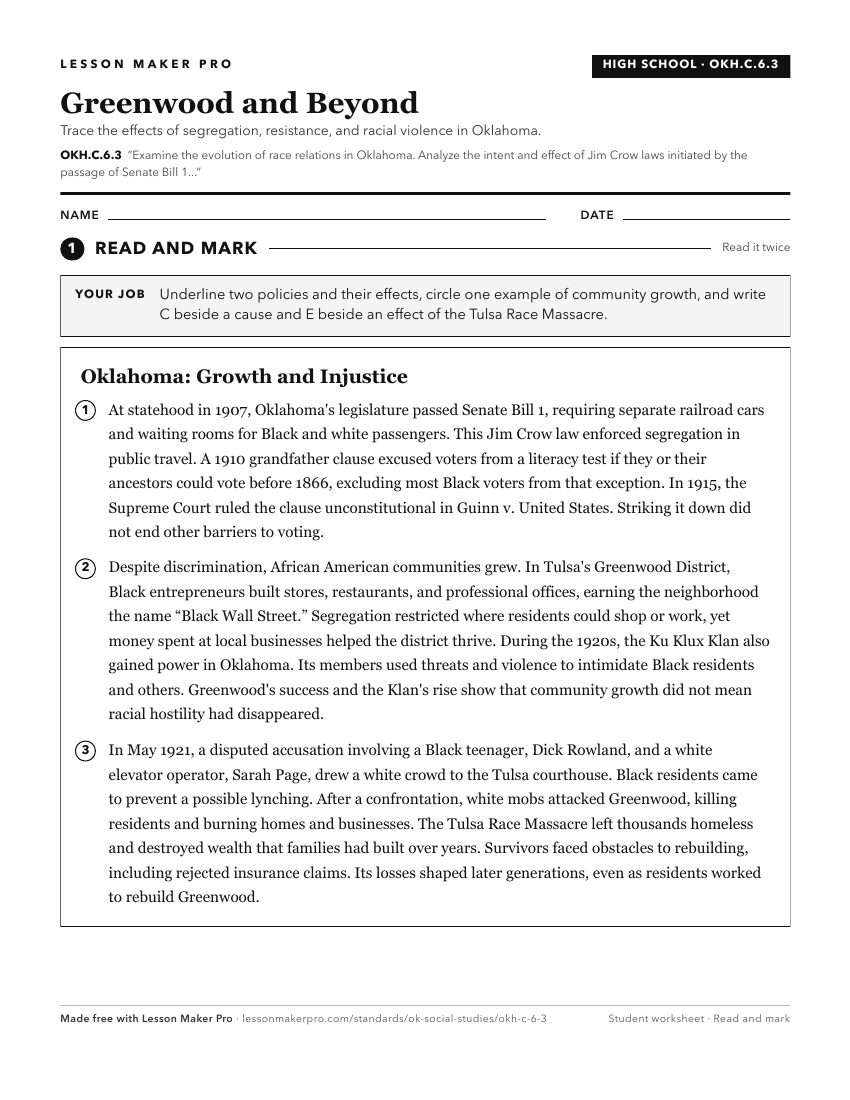
A ready-to-print activity worksheet aligned to OKH.C.6.3, with an answer key for the teacher on its own page. No account needed.
PDF, US Letter, prints cleanly in black and white.
Download the worksheetKeep exploring
Related Standards
- 3.C.3
Analyze the significant historical events and people contributing to the development of Oklahoma.
- OKH.C.6
Examine Oklahoma’s political, economic, and social history regarding race during the early decades following statehood.
- OKH.C.8
Investigate how post-war social, political, and economic events continued to transform the state of Oklahoma from the 1950s through the present.
- OKH.C.8.1
Evaluate the progress of the Civil Rights Movement in Oklahoma by describing the goals, strategies, and accomplishments toward equality.
Turn this cluster into a lesson
Grade, subject, topic, and the complete cluster are prefilled. Create one free, no account needed.
Also for this cluster:Make a WorksheetMake a QuizMake a Sub Lesson