Oklahoma Social Studies OKH.C.8
Standard Cluster
Investigate how post-war social, political, and economic events continued to transform the state of Oklahoma from the 1950s through the present. Evaluate the progress of the Civil Rights Movement in Oklahoma by describing the goals, strategies, and accomplishments toward equality. Examine judicial interpretation of the equal protection clause of the 14th Amendment. Describe issues and decisions of the landmark Supreme Court cases of Sipuel v. Board of Regents of the University of Oklahoma and McLaurin v. Oklahoma Board of Regents for Higher Education. Assess the leadership of Governor Raymond Gary in the integration of the public common and higher education systems. Explain the strategy and effectiveness of nonviolent lunch-counter sit-ins, such as those organized by Clara Luper, local churches, and the NAACP. Compare the consequences of Tulsa Public School’s voluntary desegregation initiated at Booker T. Washington High School to Oklahoma City Public Schools delayed compliance resolved by a lawsuit and subsequent rulings and enforcement. Analyze the impact of growth in various sectors of the state economy. Describe the value of agribusiness to the state economy, producing commodities, such as wheat and livestock, for the nation; examine water use issues impacting agribusiness. Examine the development of defense-related, aerospace, and aviation industries (e.g., Fort Sill, Tinker Air Force Base, FAA, weather research, and national disaster preparedness). Analyze recent oil and gas boom-and-bust cycles, such as new discoveries in the Anadarko Basin and the growth of alternative energy sources, such as wind power. Describe the state’s connection to international trade through construction of transportation infrastructures (e.g., interstate highway system, McClellan-Kerr Arkansas River Navigation System). Evaluate the impact of tourism as an industry, boosted by the construction of Route 66, state parks, and museums. Examine the growth of Tribal enterprises, their effects on the state’s economy and on the financial stability of American Indian Nations, including examples of state and Tribal cooperation (e.g., gaming compacts, cross-deputization agreements). Identify the causes and consequences of rural to urban to suburban migration, as well as urban renewal efforts (e.g., Oklahoma City’s MAPS Project). Analyze the historical and contemporary relationship between the State of Oklahoma and Oklahoma’s thirty-nine federally recognized Tribal governments. Explain how Tribal governments in Indian Territory were altered or disestablished by congressional acts prior to Oklahoma statehood, including the effects of allotment policies and the dissolution of many tribal governing institutions. Key context teachers could reference: Dawes Act, Curtis Act, Oklahoma Statehood. Describe concerns expressed by Tribal citizens during the transition to statehood, including the loss of land, self-government and legal jurisdiction. Explain how federal legislation in the twentieth century supported the reorganization or strengthening of Tribal governments and self-determination. Examples teachers may reference: Indian Reorganization Act, Oklahoma Indian Welfare Act, Indian Self-Determination and Education Assistance Act. Examine the structure and authority of modern Tribal governments, including constitutional or traditional governing systems and the powers exercised over Tribal citizens, lands, and resources. Analyze major court decisions affecting jurisdiction and sovereignty between Tribal, state, and federal governments. Examples teachers may reference: McGirt v. Oklahoma, Oklahoma v. Castro-Huerta. Students should understand how these rulings affect: criminal jurisdiction, state authority, tribal authority, citizens living within reservation boundaries. Explain the ongoing role of Tribal governments in preserving Native cultures, languages, and community institutions. Summarize the contributions of Oklahoma leadership in a changing political environment. Identify the contributions of contemporary politicians and public servants (e.g., Speaker Carl Albert, Ambassador Jeane Kirkpatrick, Principal Chief Wilma Mankiller, and educators/historians Eddie Faye Gates, Angie Debo). Describe trends in political realignment from dominance by the Democratic Party following the Great Depression to the emergence of the Republican Party, exemplified by the election of Governor Henry Bellmon. Analyze Oklahoma’s response to acts of domestic terrorism. Identify the effects of the domestic terrorist attack on the Alfred P. Murrah Federal Building in Oklahoma City. Describe the volunteerism and heroism of responding Oklahomans, exhibiting the “Oklahoma Standard.” Examine the purpose of the Oklahoma City National Memorial and how it continues to fulfill its mission of remembrance and education. Examine recent contributions by Oklahomans to the public’s quality of life. Describe migrations of recent cultural and ethnic groups to Oklahoma and their impact on the social and economic transformation of the modern state. Analyze the influence of Oklahomans in various fields, such as the arts, literature, and sports (e.g., Ralph Ellison, Jim Thorpe, Bill Mauldin, the Five Moons [Indian Ballerinas], Allan Houser, N. Scott Momaday, Reba McIntire, Joy Harjo, Te Ata). Explain changing perceptions, both internal and external, of the state and its citizens, comparing the images from Steinbeck’s The Grapes of Wrath, to the musical Oklahoma!, and the Oklahoma City Thunder.
Oklahoma Academic Standards for Social Studies (2026)
Cluster contents
Standards in This Cluster
OKH.C.8 is a cluster heading. These are the individual standards under it.
- OKH.C.8.1
Evaluate the progress of the Civil Rights Movement in Oklahoma by describing the goals, strategies, and accomplishments toward equality.
- OKH.C.8.1.A
Examine judicial interpretation of the equal protection clause of the 14th Amendment.
- OKH.C.8.1.B
Describe issues and decisions of the landmark Supreme Court cases of Sipuel v. Board of Regents of the University of Oklahoma and McLaurin v. Oklahoma Board of ...
- OKH.C.8.1.C
Assess the leadership of Governor Raymond Gary in the integration of the public common and higher education systems.
- OKH.C.8.1.D
Explain the strategy and effectiveness of nonviolent lunch-counter sit-ins, such as those organized by Clara Luper, local churches, and the NAACP.
- OKH.C.8.1.E
Compare the consequences of Tulsa Public School’s voluntary desegregation initiated at Booker T. Washington High School to Oklahoma City Public Schools delayed ...
- OKH.C.8.2
Analyze the impact of growth in various sectors of the state economy.
- OKH.C.8.2.A
Describe the value of agribusiness to the state economy, producing commodities, such as wheat and livestock, for the nation; examine water use issues impacting ...
- OKH.C.8.2.B
Examine the development of defense-related, aerospace, and aviation industries (e.g., Fort Sill, Tinker Air Force Base, FAA, weather research and national disas...
- OKH.C.8.2.C
Analyze recent oil and gas boom-and-bust cycles, such as new discoveries in the Anadarko Basin and the growth of alternative energy sources, such as wind power.
- OKH.C.8.2.D
Describe the state’s connection to international trade through construction of transportation infrastructures (e.g., interstate highway system, McClellan-Kerr A...
- OKH.C.8.2.E
Evaluate the impact of tourism as an industry, boosted by the construction of Route 66, state parks, and museums.
- OKH.C.8.2.F
Examine the growth of Tribal enterprises, their effects on the state’s economy and on the financial stability of American Indian Nations, including examples of ...
- OKH.C.8.2.G
Identify the causes and consequences of rural to urban to suburban migration, as well as urban renewal efforts (e.g., Oklahoma City’s MAPS Project).
- OKH.C.8.3
Analyze the historical and contemporary relationship between the State of Oklahoma and Oklahoma’s thirty-nine federally recognized Tribal governments.
- OKH.C.8.3.A
Explain how Tribal governments in Indian Territory were altered or disestablished by congressional acts prior to Oklahoma statehood, including the effects of al...
- OKH.C.8.3.B
Describe concerns expressed by Tribal citizens during the transition to statehood, including the loss of land, self-government and legal jurisdiction.
- OKH.C.8.3.C
Explain how federal legislation in the twentieth century supported the reorganization or strengthening of Tribal governments and self-determination. Examples te...
- OKH.C.8.3.D
Examine the structure and authority of modern Tribal governments, including constitutional or traditional governing systems and the powers exercised over Tribal...
- OKH.C.8.3.E
Analyze major court decisions affecting jurisdiction and sovereignty between Tribal, state, and federal governments. Examples teachers may reference: McGirt v. ...
- OKH.C.8.3.F
Explain the ongoing role of Tribal governments in preserving Native cultures, languages, and community institutions.
- OKH.C.8.4
Summarize the contributions of Oklahoma leadership in a changing political environment.
- OKH.C.8.4.A
Identify the contributions of contemporary politicians and public servants (e.g., Speaker Carl Albert, Ambassador Jeane Kirkpatrick, Principal Chief Wilma Manki...
- OKH.C.8.4.B
Describe trends in political realignment from dominance by the Democratic Party following the Great Depression to the emergence of the Republican Party, exempli...
- OKH.C.8.5
Analyze Oklahoma’s response to acts of domestic terrorism.
- OKH.C.8.5.A
Identify the effects of the domestic terrorist attack on the Alfred P. Murrah Federal Building in Oklahoma City.
- OKH.C.8.5.B
Describe the volunteerism and heroism of responding Oklahomans, exhibiting the “Oklahoma Standard.”
- OKH.C.8.5.C
Examine the purpose of the Oklahoma City National Memorial and how it continues to fulfill its mission of remembrance and education.
- OKH.C.8.6
Examine recent contributions by Oklahomans to the public’s quality of life.
- OKH.C.8.6.A
Describe migrations of recent cultural and ethnic groups to Oklahoma and their impact on the social and economic transformation of the modern state.
- OKH.C.8.6.B
Analyze the influence of Oklahomans in various fields, such as the arts, literature, and sports (e.g., Ralph Ellison, Jim Thorpe, Bill Mauldin, the Five Moons [...
- OKH.C.8.6.C
Explain changing perceptions, both internal and external, of the state and its citizens, comparing the images from Steinbeck’s The Grapes of Wrath, to the music...
Teacher's field guide
What This Cluster Means
What Students Need to Do
- Explain how court cases and protests changed school access and civil rights. Trace how laws and court rulings changed Tribal authority. Link jobs and migration to Oklahoma's economy, politics, response to the Murrah bombing, and public image.
What Mastery Looks Like
- A student can explain what Sipuel, McLaurin, and Clara Luper's sit-ins changed, without claiming they ended unequal treatment at once. They can trace Tribal authority from allotment through reorganization to McGirt and Castro-Huerta. They can use examples such as Tinker jobs or oil busts to explain changes in work and settlement.
Common Misconceptions
- Students may think Sipuel and McLaurin ended school segregation across Oklahoma overnight. Some assume reservations disappeared at statehood or that McGirt sent every criminal case to Tribal court. Others think oil is Oklahoma's only major industry or that the Murrah bombing was an attack from abroad.
How to Assess It
- Exit ticket: Name one barrier Clara Luper's sit-ins challenged, one effect of McGirt on criminal jurisdiction, and one job supported by Tinker Air Force Base.
Lesson moves
Ways to Teach It
Mark Tinker Air Force Base, the Anadarko Basin, and the Port of Catoosa on a blank Oklahoma map; add a job each supports.
Read short excerpts from the Sipuel and McLaurin rulings; write which barrier each addressed and one barrier that remained.
Put Dawes Act, Oklahoma Indian Welfare Act, McGirt, and Castro-Huerta cards in date order; label each change in Tribal authority.
Compare Cherokee Nation and Oklahoma State Department of Health service pages; list one shared service and who each page says it serves.
Free download
Printable OKH.C.8 Worksheet
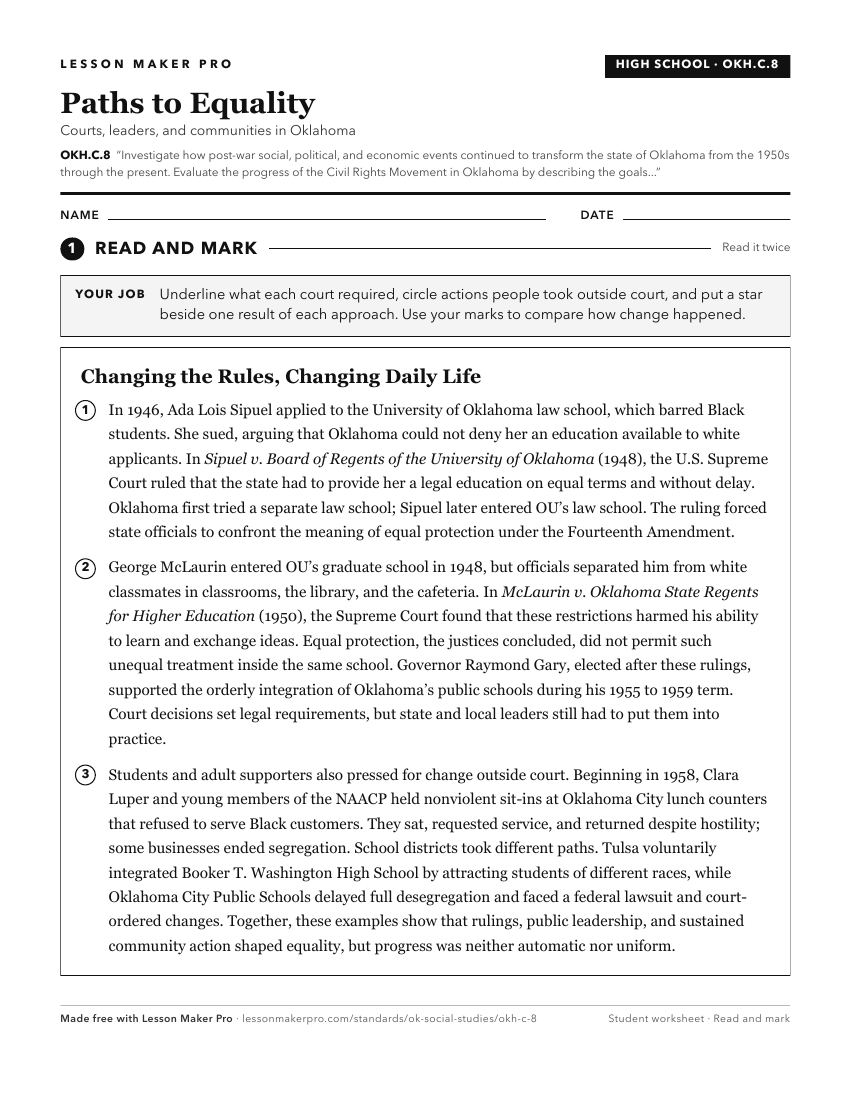
A ready-to-print activity worksheet aligned to OKH.C.8, with an answer key for the teacher on its own page. No account needed.
PDF, US Letter, prints cleanly in black and white.
Download the worksheetKeep exploring
Related Standards
- 3.C.3
Analyze the significant historical events and people contributing to the development of Oklahoma.
- OKH.C.6
Examine Oklahoma’s political, economic, and social history regarding race during the early decades following statehood.
- OKH.C.7
Examine the challenges and accomplishments of Oklahomans as they encountered periods of economic depression and engagement in world conflict.
- OKH.C.6.3
Examine the evolution of race relations in Oklahoma.
Turn this cluster into a lesson
Grade, subject, topic, and the complete cluster are prefilled. Create one free, no account needed.
Also for this cluster:Make a WorksheetMake a QuizMake a Sub Lesson