Oklahoma Social Studies OKH.C.7
Standard Cluster
Examine the challenges and accomplishments of Oklahomans as they encountered periods of economic depression and engagement in world conflict. Identify local and national economic conditions which contributed to the Great Depression and were characterized by mass unemployment and human suffering. Describe the environmental devastation known as the Dust Bowl by analyzing the impact of environmental conditions and human mismanagement of natural resources which resulted in the migration of the farm workers and families, popularly referred to as “Okies.” Examine the effects of the Great Depression on Oklahomans and evaluate the effectiveness of governmental response. Summarize policies of Governor William H. Murray which impacted the goals of the New Deal in Oklahoma. Describe New Deal programs and projects (e.g., Agricultural Adjustment Act, Tennessee Valley Authority, Works Progress Administration, Civilian Conservation Corps) which addressed specific needs of Oklahomans in both employment and the conservation of natural resources. Analyze how various segments of Oklahoma’s economy and society, such as agriculture, mining, and state politics were influenced by organized labor and socialist movements. Describe the changing relations between the federal government and American Indian Nations as influenced by the Meriam Report and reflected in the Indian Reorganization Act (“Indian New Deal”) and the Oklahoma Indian Welfare Act, including consequences on Tribal government and sovereignty. Describe the contributions of Oklahomans, including the political and social commentaries of Will Rogers and Woody Guthrie, Wiley Post’s aviation milestones, the artwork of the Kiowa Six, and African American jazz musicians. Summarize and analyze the impact of Oklahoma’s mobilization and engagement in World War II including establishment of military bases and prisoner of war installations contributions to the war effort by military personnel and specific units, including the American Indian Code Talkers and the 45th Infantry Division.
Oklahoma Academic Standards for Social Studies (2026)
Cluster contents
Standards in This Cluster
OKH.C.7 is a cluster heading. These are the individual standards under it.
- OKH.C.7.1
Identify local and national economic conditions which contributed to the Great Depression and were characterized by mass unemployment and human suffering.
- OKH.C.7.2
Describe the environmental devastation known as the Dust Bowl by analyzing the impact of environmental conditions and human mismanagement of natural resources w...
- OKH.C.7.3
Examine the effects of the Great Depression on Oklahomans and evaluate the effectiveness of governmental response.
- OKH.C.7.3.A
Summarize policies of Governor William H. Murray which impacted the goals of the New Deal in Oklahoma.
- OKH.C.7.3.B
Describe New Deal programs and projects (e.g., Agricultural Adjustment Act, Tennessee Valley Authority, Works Progress Administration, Civilian Conservation Cor...
- OKH.C.7.3.C
Analyze how various segments of Oklahoma’s economy and society, such as agriculture, mining, and state politics, were influenced by organized labor and socialis...
- OKH.C.7.4
Describe the changing relations between the federal government and American Indian Nations as influenced by the Meriam Report and reflected in the Indian Reorga...
- OKH.C.7.5
Describe the contributions of Oklahomans, including the political and social commentaries of Will Rogers and Woody Guthrie, Wiley Post’s aviation milestones, th...
- OKH.C.7.6
Summarize and analyze the impact of Oklahoma’s mobilization and engagement in World War II including
- OKH.C.7.6.A
establishment of military bases and prisoner of war installations
- OKH.C.7.6.B
contributions to the war effort by military personnel and specific units, including the American Indian Code Talkers and the 45th Infantry Division.
Teacher's field guide
What This Cluster Means
What Students Need to Do
- Students explain how bank failures, falling crop prices, drought, and poor land use affected Oklahoma families. They compare New Deal programs, Governor Murray’s decisions, labor organizing, and changes to tribal government. They identify Oklahoma contributions to culture, aviation, and World War II.
What Mastery Looks Like
- A student can use a migration map to explain why families left Oklahoma and judge whether a government project addressed the cause. They can distinguish farm aid, paid work programs, and laws affecting tribal self-government. They can explain a specific contribution by an Oklahoma artist, aviator, military unit, or wartime site.
Common Misconceptions
- Students may blame the Dust Bowl on drought alone and leave out plowing and soil loss. They may confuse farm payments with wages for public work. Some assume the Indian Reorganization Act applied to Oklahoma tribes in the same way it did elsewhere, overlooking the Oklahoma Indian Welfare Act.
How to Assess It
- Show a Dust Bowl migration map and a captioned photo of CCC soil-conservation work. Ask: “How did farming practices push migration, and how did this project respond?”
Lesson moves
Ways to Teach It
Pour water onto trays of bare and grass-covered soil, then compare the runoff and connect it to lost topsoil.
Read a 1930s newspaper excerpt on Governor Murray’s response to federal relief; write whether his choice helped jobless Oklahomans, citing one detail.
Sort AAA, WPA, CCC, Oklahoma Indian Welfare Act, and Code Talkers cards into farm aid, paid work, tribal government, or wartime service.
Find the nearest WPA-era building or former military base on an Oklahoma historic-sites map, then identify who used it and why.
Free download
Printable OKH.C.7 Worksheet
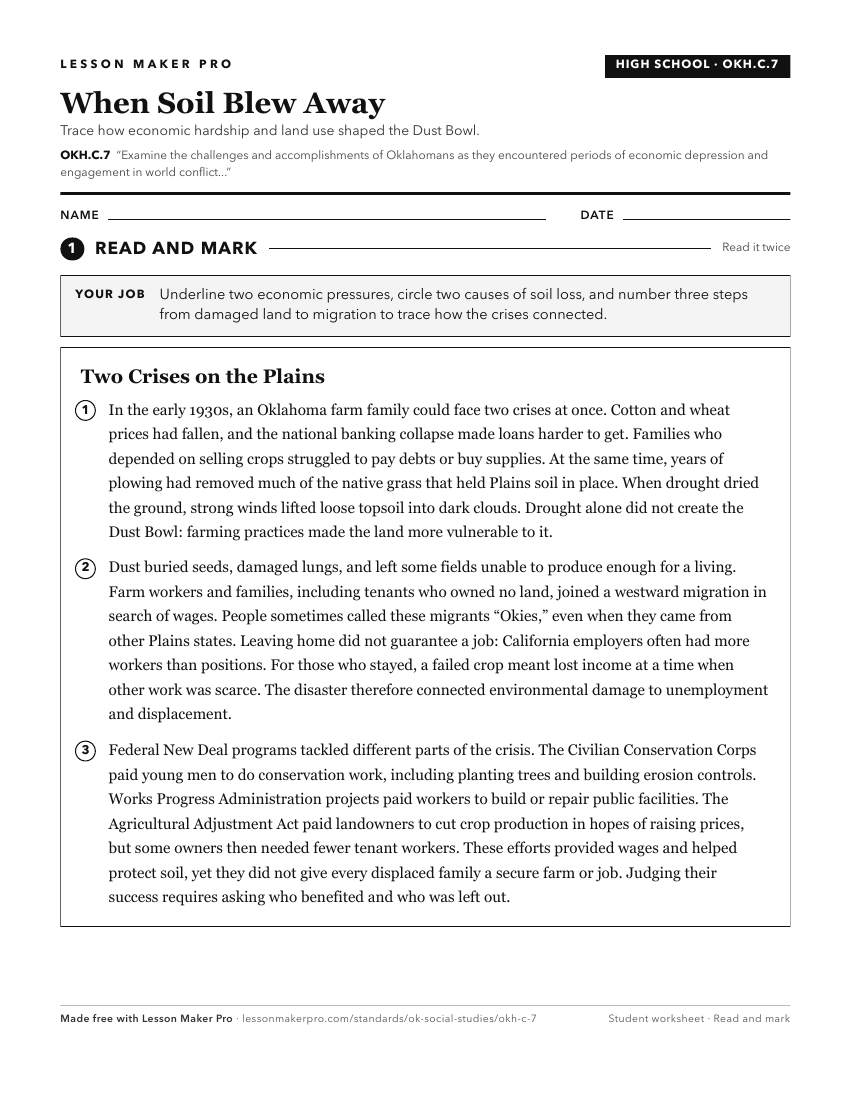
A ready-to-print activity worksheet aligned to OKH.C.7, with an answer key for the teacher on its own page. No account needed.
PDF, US Letter, prints cleanly in black and white.
Download the worksheetKeep exploring
Related Standards
- OKH.C.6
Examine Oklahoma’s political, economic, and social history regarding race during the early decades following statehood.
- OKH.C.8
Investigate how post-war social, political, and economic events continued to transform the state of Oklahoma from the 1950s through the present.
- OKH.C.6.5
Examine how agricultural conditions and practices were precursors to the Great Depression by describing the boom-and-bust cycle of Oklahoma’s agricultural outpu...
Turn this cluster into a lesson
Grade, subject, topic, and the complete cluster are prefilled. Create one free, no account needed.
Also for this cluster:Make a WorksheetMake a QuizMake a Sub Lesson