Oklahoma Social Studies OKH.C.6
Standard Cluster
Examine Oklahoma’s political, economic, and social history regarding race during the early decades following statehood. Examine how the development of the oil industry affected major sectors of employment and the development of communities, including the role of entrepreneurs (e.g., Frank Phillips, E.W. Marland, Thomas Gilcrease) and the designation of Tulsa as the “Oil Capital of the World.” Examine government policies impacting American Indian identity, culture, economy, Tribal government, and sovereignty. Analyze the effects of federal policy to forcibly assimilate Native children through the establishment of Indian boarding schools (e.g., Riverside Indian School, Chilocco Indian Agricultural School) on Native culture. Examine the judicial decision of Dorothy Sunrise v. Cache Consolidated School District regarding integrated access to public education by American Indians. Explain the justification for passage of the Indian Citizenship Act of 1924 and the concept of dual citizenship. Examine the Bureau of Indian Affairs’ guardianship of American Indian resources, lands, trust accounts and head rights, exemplified by the Osage Allotment Act and exploitation of Osage mineral wealth. Identify the intent of the Indian Relocation Act as it relates to vocational training and assimilation policies, as well as its effect on Tribal communities. Explain the impact of the Code of Indian Offenses of 1883 on Tribal religious and cultural practices. Examine the evolution of race relations in Oklahoma. Analyze the intent and effect of Jim Crow laws initiated by the passage of Senate Bill 1. Explain the outcome of Oklahoma’s attempt to restrict suffrage rights through the grandfather clause (Guinn v. United States of America). Describe the continued growth of African American communities, including the emergence of “Black Wall Street” in Tulsa’s Greenwood District. Examine the rise of the Ku Klux Klan and its involvement in acts of intimidation and violence. Analyze the causes of the Tulsa Race Massacre, including its continued social and economic impact. Summarize Oklahoma’s role in World War I, including agricultural exports and the contributions of Oklahoma armed forces and military units, including the Choctaw code talkers. Examine how agricultural conditions and practices were precursors to the Great Depression by describing the boom-and-bust cycle of Oklahoma’s agricultural output to meet the needs of World War I followed by post-war overproduction.
Oklahoma Academic Standards for Social Studies (2026)
Cluster contents
Standards in This Cluster
OKH.C.6 is a cluster heading. These are the individual standards under it.
- OKH.C.6.1
Examine how the development of the oil industry affected major sectors of employment and the development of communities, including the role of entrepreneurs (e....
- OKH.C.6.2
Examine government policies impacting American Indian identity, culture, economy, Tribal government, and sovereignty.
- OKH.C.6.2.A
Analyze the effects of federal policy to forcibly assimilate Native children through the establishment of Indian boarding schools (e.g., Riverside Indian School...
- OKH.C.6.2.B
Examine the judicial decision of Dorothy Sunrise v. Cache Consolidated School District regarding integrated access to public education by American Indians.
- OKH.C.6.2.C
Explain the justification for passage of the Indian Citizenship Act of 1924 and the concept of dual citizenship.
- OKH.C.6.2.D
Examine the Bureau of Indian Affairs’ guardianship of American Indian resources, lands, trust accounts and head rights, exemplified by the Osage Allotment Act a...
- OKH.C.6.2.E
Identify the intent of the Indian Relocation Act as it relates to vocational training and assimilation policies, as well as its effect on Tribal communities.
- OKH.C.6.2.F
Explain the impact of the Code of Indian Offenses of 1883 on Tribal religious and cultural practices.
- OKH.C.6.3
Examine the evolution of race relations in Oklahoma.
- OKH.C.6.3.A
Analyze the intent and effect of Jim Crow laws initiated by the passage of Senate Bill 1.
- OKH.C.6.3.B
Explain the outcome of Oklahoma’s attempt to restrict suffrage rights through the grandfather clause (Guinn v. United States of America).
- OKH.C.6.3.C
Describe the continued growth of African American communities, including the emergence of “Black Wall Street” in Tulsa’s Greenwood District
- OKH.C.6.3.D
Examine the rise of the Ku Klux Klan and its involvement in acts of intimidation and violence.
- OKH.C.6.3.E
Analyze the causes of the Tulsa Race Massacre, including its continued social and economic impact.
- OKH.C.6.4
Summarize Oklahoma’s role in World War I, including agricultural exports and the contributions of Oklahoma armed forces and military units, including the Chocta...
- OKH.C.6.5
Examine how agricultural conditions and practices were precursors to the Great Depression by describing the boom-and-bust cycle of Oklahoma’s agricultural outpu...
Teacher's field guide
What This Cluster Means
What Students Need to Do
- Students trace how oil growth and World War I changed Oklahoma jobs, towns, and farming. They explain how policies shaped Native citizenship, Tribal sovereignty, culture, and schooling. They examine how segregation, the Klan, and the Tulsa Race Massacre affected Black communities.
What Mastery Looks Like
- A student can connect Phillips or Marland to oil jobs and Tulsa's growth. They can explain why Native citizenship did not erase Tribal citizenship or barriers to schooling. They can link wartime crop demand to postwar overproduction, and Jim Crow laws to violence against Greenwood.
Common Misconceptions
- Students may think the 1924 citizenship law replaced Tribal citizenship or ended discrimination. They may assume federal guardianship protected Osage wealth from exploitation. Some mistake the Tulsa Race Massacre for a conflict between equal sides or think Greenwood never rebuilt.
How to Assess It
- Exit ticket: Why did the 1924 citizenship law not, by itself, guarantee Native students equal access to public schools? Use the Dorothy Sunrise case in your answer.
Lesson moves
Ways to Teach It
On an Oklahoma map, mark Phillips in Bartlesville, Marland in Ponca City, and Tulsa's oil offices; draw arrows showing jobs and town growth.
Ask: How did Senate Bill 1 and Klan intimidation shape conditions before the Tulsa Race Massacre, and how did Greenwood rebuild afterward?
Deal cards labeled boarding schools, Osage headrights, citizenship, relocation, the Code of Indian Offenses, and Sunrise; match each to an effect card.
Find today's Oklahoma wheat price on a commodity report; explain how a large harvest might lower the price farmers receive.
Free download
Printable OKH.C.6 Worksheet
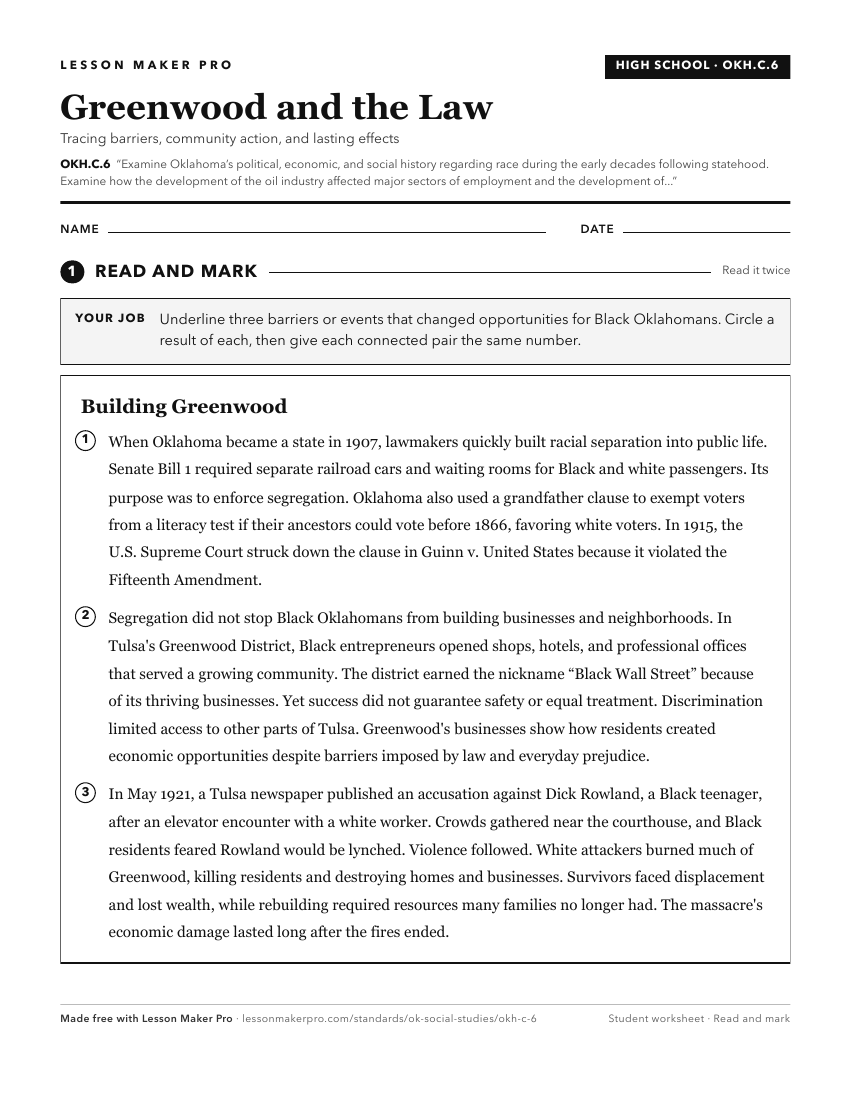
A ready-to-print activity worksheet aligned to OKH.C.6, with an answer key for the teacher on its own page. No account needed.
PDF, US Letter, prints cleanly in black and white.
Download the worksheetKeep exploring
Related Standards
- 3.C.3
Analyze the significant historical events and people contributing to the development of Oklahoma.
- OKH.C.8
Investigate how post-war social, political, and economic events continued to transform the state of Oklahoma from the 1950s through the present.
- OKH.C.7
Examine the challenges and accomplishments of Oklahomans as they encountered periods of economic depression and engagement in world conflict.
Turn this cluster into a lesson
Grade, subject, topic, and the complete cluster are prefilled. Create one free, no account needed.
Also for this cluster:Make a WorksheetMake a QuizMake a Sub Lesson