Oklahoma Social Studies OKH.C.6.2
Standard Cluster
- OKH.C.6
- Examine Oklahoma’s political, economic, and social history regarding race during the early decades following statehood.
Examine government policies impacting American Indian identity, culture, economy, Tribal government, and sovereignty. Analyze the effects of federal policy to forcibly assimilate Native children through the establishment of Indian boarding schools (e.g., Riverside Indian School, Chilocco Indian Agricultural School) on Native culture. Examine the judicial decision of Dorothy Sunrise v. Cache Consolidated School District regarding integrated access to public education by American Indians. Explain the justification for passage of the Indian Citizenship Act of 1924 and the concept of dual citizenship. Examine the Bureau of Indian Affairs’ guardianship of American Indian resources, lands, trust accounts and head rights, exemplified by the Osage Allotment Act and exploitation of Osage mineral wealth. Identify the intent of the Indian Relocation Act as it relates to vocational training and assimilation policies, as well as its effect on Tribal communities. Explain the impact of the Code of Indian Offenses of 1883 on Tribal religious and cultural practices.
Oklahoma Academic Standards for Social Studies (2026) · OKH.C.6
Cluster contents
Standards in This Cluster
OKH.C.6.2 is a cluster heading. These are the individual standards under it.
- OKH.C.6.2.A
Analyze the effects of federal policy to forcibly assimilate Native children through the establishment of Indian boarding schools (e.g., Riverside Indian School...
- OKH.C.6.2.B
Examine the judicial decision of Dorothy Sunrise v. Cache Consolidated School District regarding integrated access to public education by American Indians.
- OKH.C.6.2.C
Explain the justification for passage of the Indian Citizenship Act of 1924 and the concept of dual citizenship.
- OKH.C.6.2.D
Examine the Bureau of Indian Affairs’ guardianship of American Indian resources, lands, trust accounts and head rights, exemplified by the Osage Allotment Act a...
- OKH.C.6.2.E
Identify the intent of the Indian Relocation Act as it relates to vocational training and assimilation policies, as well as its effect on Tribal communities.
- OKH.C.6.2.F
Explain the impact of the Code of Indian Offenses of 1883 on Tribal religious and cultural practices.
Teacher's field guide
What This Cluster Means
What Students Need to Do
- Students trace how federal policies changed Native schooling, religious practice, land control, and moves to cities. They explain how the Sunrise ruling addressed public school access and why Congress extended U.S. citizenship in 1924. They distinguish U.S. citizenship from Tribal citizenship.
What Mastery Looks Like
- A student can connect boarding schools to language loss and the 1883 Code to restrictions on ceremonies. They can explain how federal oversight affected Osage head rights and how relocation affected Tribal communities. They can describe how the Sunrise ruling changed school access without claiming it ended other barriers.
Common Misconceptions
- Students may assume Native people gave up Tribal citizenship when they became U.S. citizens. They may think federal oversight protected Osage mineral income from exploitation. They may treat forced boarding school attendance and job training offered through relocation as the same kind of choice.
How to Assess It
- Exit ticket: Choose the 1883 Code or the relocation program. State its goal, one effect on Native culture, and whether it gave Tribal communities more control over their decisions.
Lesson moves
Ways to Teach It
Give pairs six event cards and six impact cards on Chilocco, Sunrise, Osage head rights, relocation, citizenship, and the 1883 Code to match.
Ask students to write: How could the 1924 citizenship law recognize Native people while federal rules still restricted Tribal self-rule?
Read 'punished ceremonies,' 'training for city jobs,' and 'mineral head rights'; teams name the policy behind each clue.
Project Cherokee Nation citizenship requirements and a U.S. passport application; students identify the separate proof each government asks for.
Free download
Printable OKH.C.6.2 Worksheet
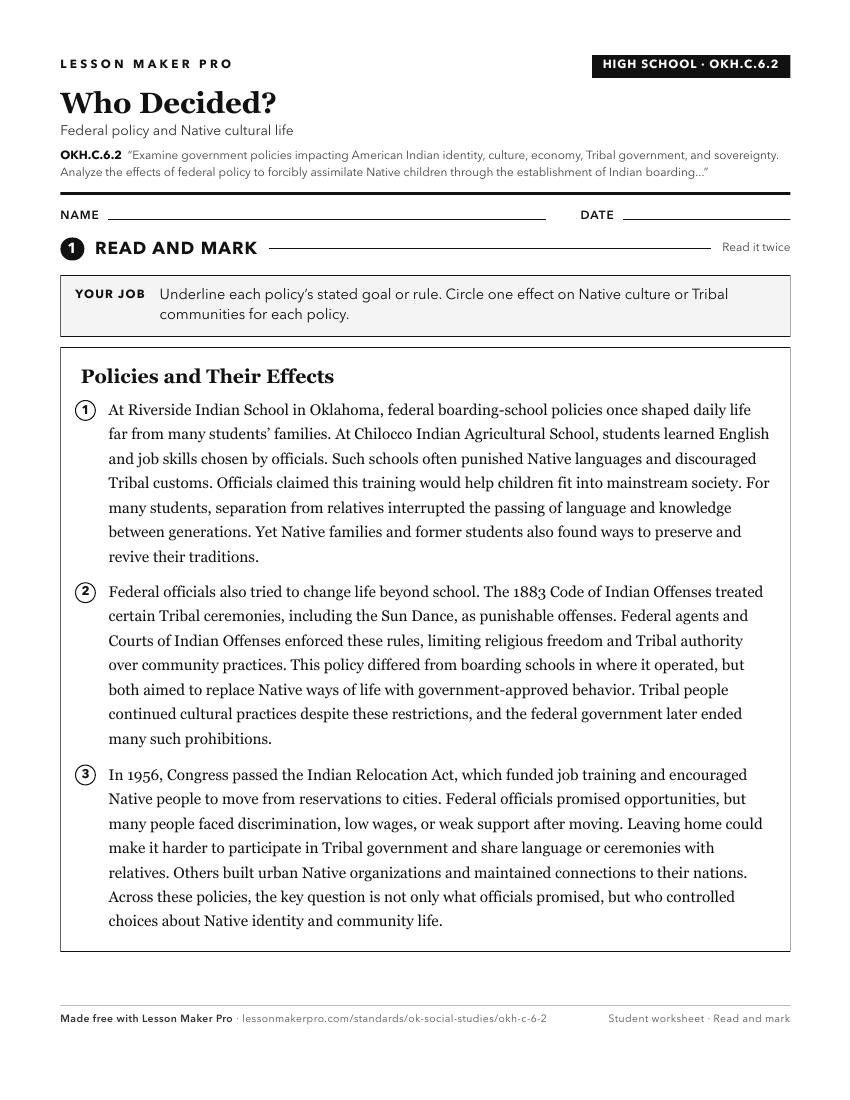
A ready-to-print activity worksheet aligned to OKH.C.6.2, with an answer key for the teacher on its own page. No account needed.
PDF, US Letter, prints cleanly in black and white.
Download the worksheetKeep exploring
Related Standards
- OKH.C.8.3.D
Examine the structure and authority of modern Tribal governments, including constitutional or traditional governing systems and the powers exercised over Tribal...
- 8.C.5.1.C
Examine Washington’s attempt to develop a cohesive American Indian policy through treaties, assimilation, and the delineation of Tribal lands.
- OKH.C.3.1
Examine the impact of the Civil War and Reconstruction Treaties on American Indian peoples, territories, and Tribal sovereignty.
- OKH.C.8.2.F
Examine the growth of Tribal enterprises, their effects on the state’s economy and on the financial stability of American Indian Nations, including examples of ...
Turn this cluster into a lesson
Grade, subject, topic, and the complete cluster are prefilled. Create one free, no account needed.
Also for this cluster:Make a WorksheetMake a QuizMake a Sub Lesson