Oklahoma Social Studies OKH.C.3.1
Standard Cluster
- OKH.C.3
- Evaluate the major political and economic events that transformed the land and its people in the post-Civil War era to statehood.
Examine the impact of the Civil War and Reconstruction Treaties on American Indian peoples, territories, and Tribal sovereignty. Describe the effect of intertribal division related to Tribal support of the Union or Confederacy, as exemplified by Opothleyahola and the Trail of Blood on Ice. Explain conditions of the Reconstruction Treaties of 1866 (e.g., land cessions, the abolition of slavery, and the required Tribal enrollment of the Freedman). Summarize the intent of President Grant’s Peace Policy on the displacement of American Indians from their homelands. Describe the period known as the Second Indian Removal, comparing experiences of Tribal Nations, and explain justifications made for establishing the reservation system. Examine the purpose for western military posts, such as Fort Sill, and the role of military regiments, such as the Buffalo Soldiers, in implementing Indian policy. Describe the confinement of American Indians to reservations, including the significance of the Washita Massacre and explain the impact of the reservation policy. Explain the significance of the Standing Bear v. Crook decision as it relates to the personhood of American Indians and their rights under federal law.
Oklahoma Academic Standards for Social Studies (2026) · OKH.C.3
Cluster contents
Standards in This Cluster
OKH.C.3.1 is a cluster heading. These are the individual standards under it.
- OKH.C.3.1.A
Describe the effect of intertribal division related to Tribal support of the Union or Confederacy, as exemplified by Opothleyahola and the Trail of Blood on Ice...
- OKH.C.3.1.B
Explain conditions of the Reconstruction Treaties of 1866 (e.g., land cessions, the abolition of slavery, and the required Tribal enrollment of the Freedman).
- OKH.C.3.1.C
Summarize the intent of President Grant’s Peace Policy on the displacement of American Indians from their homelands.
- OKH.C.3.1.D
Describe the period known as the Second Indian Removal, comparing experiences of Tribal Nations, and explain justifications made for establishing the reservatio...
- OKH.C.3.1.E
Examine the purpose for western military posts, such as Fort Sill, and the role of military regiments, such as the Buffalo Soldiers, in implementing Indian poli...
- OKH.C.3.1.F
Describe the confinement of American Indians to reservations, including the significance of the Washita Massacre and explain the impact of the reservation polic...
- OKH.C.3.1.G
Explain the significance of the Standing Bear v. Crook decision as it relates to the personhood of American Indians and their rights under federal law.
Teacher's field guide
What This Cluster Means
What Students Need to Do
- Trace how Civil War alliances split Tribal Nations and led to Opothleyahola’s deadly winter flight. Explain treaty land losses, the end of slavery, and Freedmen’s status. Compare later removals and reservation confinement, using Grant’s policy, Fort Sill, Buffalo Soldiers, Washita, and Standing Bear’s case.
What Mastery Looks Like
- Students can compare the Ponca Nation’s forced move with Cheyenne confinement after Washita. They can explain how 1866 treaty terms and military enforcement limited Tribal control. They can explain that Standing Bear’s ruling recognized legal personhood but did not grant citizenship to all Native Americans.
Common Misconceptions
- Students may assume everyone in a Tribal Nation backed the same Civil War side, or confuse Opothleyahola’s winter flight with the Trail of Tears. They may think Grant’s Peace Policy ended forced removal or that Freedmen received equal treatment as soon as treaties were signed. Some mistake Standing Bear’s ruling for a grant of citizenship to all Native Americans.
How to Assess It
- Exit ticket: “How did the Cherokee Nation’s 1866 land cession and the Ponca Nation’s later forced move each limit control of land? State one difference.”
Lesson moves
Ways to Teach It
Give pairs a blank map and cards for Opothleyahola’s flight, an 1866 land cession, Ponca removal, and Fort Sill; have them draw routes.
Ask students: “What changed between the Washita attack and Grant’s later Peace Policy, and what federal goal stayed the same?”
Play treaty sort: students match 1866 clauses on land, slavery, and Freedmen to their effects, then explain each match.
Compare the Cherokee Nation’s current citizenship rules with its 1866 Freedmen treaty provision using the nation’s website and a treaty excerpt.
Free download
Printable OKH.C.3.1 Worksheet
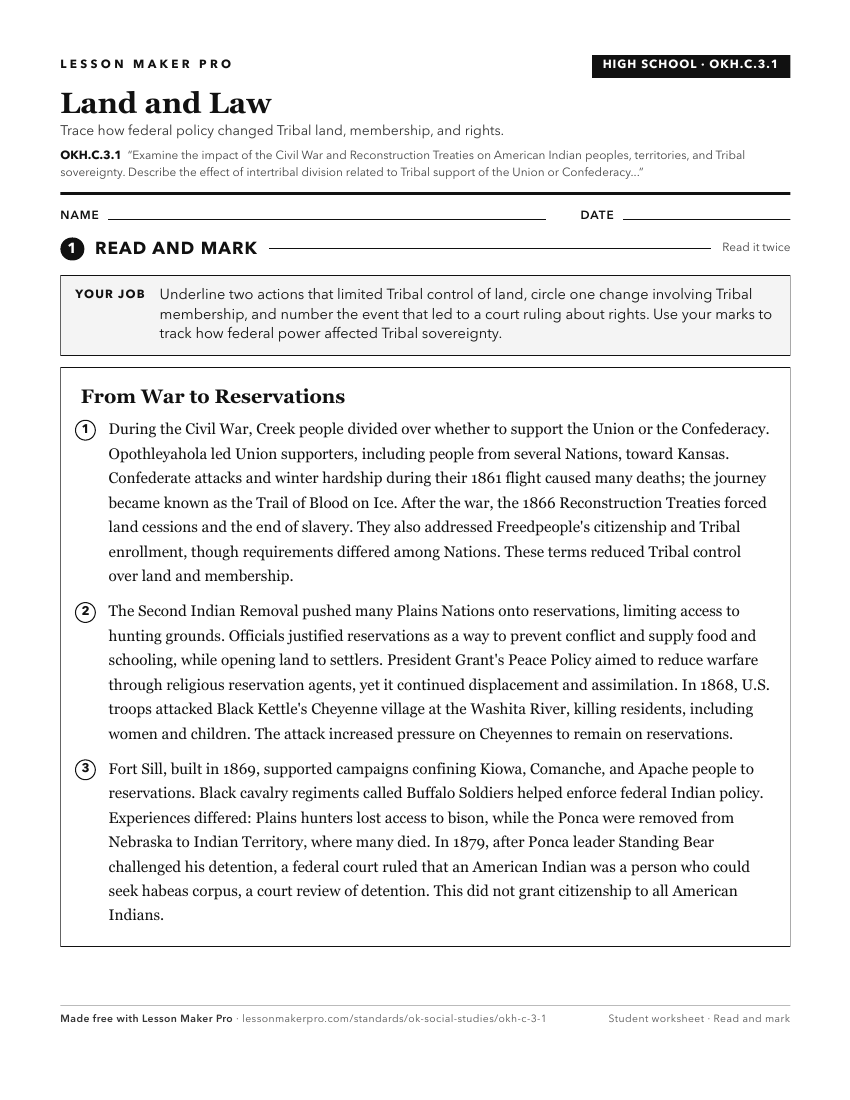
A ready-to-print activity worksheet aligned to OKH.C.3.1, with an answer key for the teacher on its own page. No account needed.
PDF, US Letter, prints cleanly in black and white.
Download the worksheetKeep exploring
Related Standards
- 8.C.8.3
Analyze the impact of President Andrew Jackson’s policies concerning American Indian Nations and their sovereignty during the early nineteenth century.
- OKH.C.6.2
Examine government policies impacting American Indian identity, culture, economy, Tribal government, and sovereignty.
- 8.C.5.1.C
Examine Washington’s attempt to develop a cohesive American Indian policy through treaties, assimilation, and the delineation of Tribal lands.
- OKH.C.2.2.C
Examine the consequences of Indian Removal on intertribal relationships among Tribal groups historically residing in Indian Territory and those relocated there.
Turn this cluster into a lesson
Grade, subject, topic, and the complete cluster are prefilled. Create one free, no account needed.
Also for this cluster:Make a WorksheetMake a QuizMake a Sub Lesson