Oklahoma Social Studies OKH.C.8.3.A
The Standard
- OKH.C.8
- Investigate how post-war social, political, and economic events continued to transform the state of Oklahoma from the 1950s through the present.
- OKH.C.8.3
- Analyze the historical and contemporary relationship between the State of Oklahoma and Oklahoma’s thirty-nine federally recognized Tribal governments.
Explain how Tribal governments in Indian Territory were altered or disestablished by congressional acts prior to Oklahoma statehood, including the effects of allotment policies and the dissolution of many tribal governing institutions. Key context teachers could reference: Dawes Act, Curtis Act, Oklahoma Statehood.
Oklahoma Academic Standards for Social Studies (2026) · OKH.C.8.3
Teacher's field guide
What This Standard Means
What Students Need to Do
- Students explain how allotment divided tribal lands into individual parcels. They trace how congressional acts cut back tribal control over courts and other parts of government before Oklahoma became a state.
What Mastery Looks Like
- A student can explain that the original Dawes Act did not cover the Five Tribes, but later laws brought allotment to them. They can describe how the Curtis Act ended tribal courts for the Five Tribes without claiming tribal nations disappeared.
Common Misconceptions
- Students may think the Dawes Act immediately applied to every tribe in Indian Territory. They may also think allotment changed only land ownership, or that statehood ended tribal nations.
How to Assess It
- Exit ticket: Explain one way allotment changed tribal landholding and one way the Curtis Act changed tribal courts before 1907.
Lesson moves
Ways to Teach It
Give pairs a paper land map and allotment cards; have them divide communal land into individual parcels.
Ask students to write: How might losing a tribal court change who makes decisions in a community?
Have students match cards for the Dawes Act, Curtis Act, and statehood with dates, affected groups, and effects.
Open the Cherokee Nation court website and compare its current role with the limits the Curtis Act placed on tribal courts.
Free download
Printable OKH.C.8.3.A Worksheet
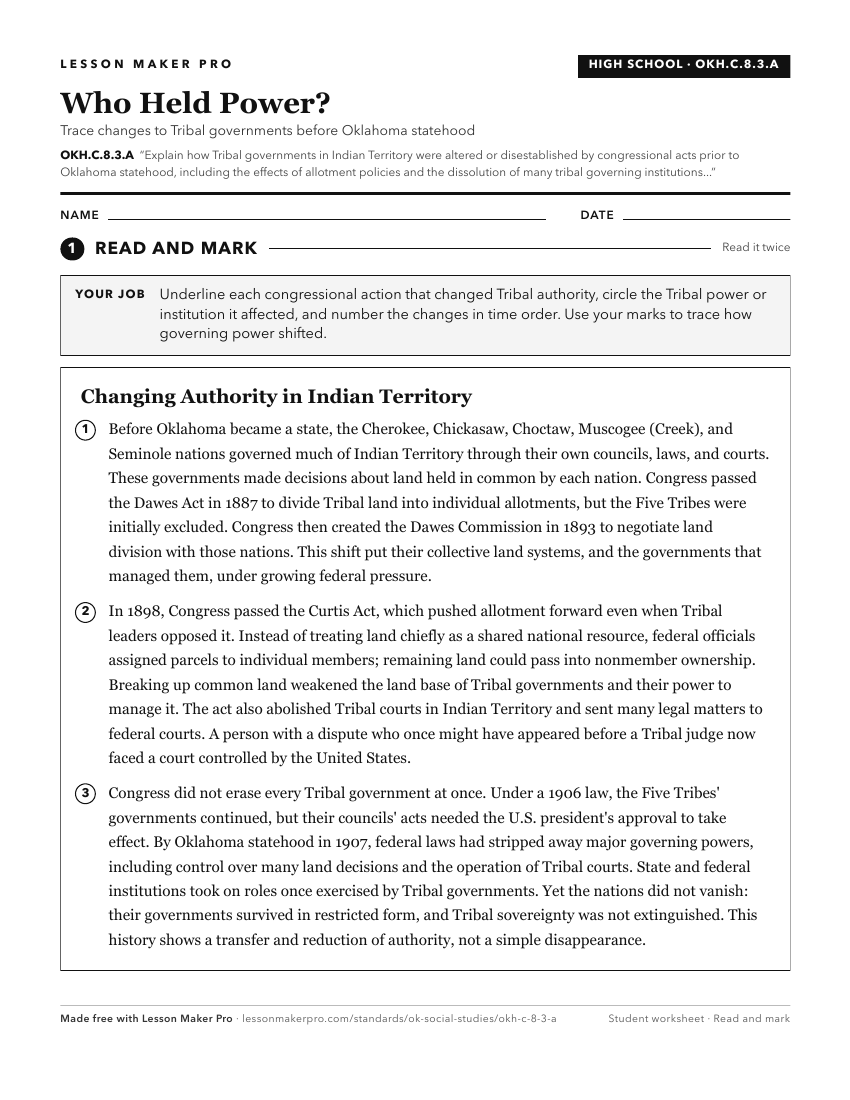
A ready-to-print activity worksheet aligned to OKH.C.8.3.A, with an answer key for the teacher on its own page. No account needed.
PDF, US Letter, prints cleanly in black and white.
Download the worksheetKeep exploring
Related Standards
- USH.C.4.3.F
Explain how the Indian Reorganization Act intended to reverse federal policy by restoring lands to Tribal trust status and endorsing Tribal constitutions, which...
- OKH.C.4.1
Describe the effects of the Curtis Act of 1898 and evaluate the outcome of the Indian-led movement to secure a separate statehood for Indian Territory, summariz...
- OKH.C.8.3.C
Explain how federal legislation in the twentieth century supported the reorganization or strengthening of Tribal governments and self-determination. Examples te...
- USH.C.1.3.E
Explain how federal policies such as allotment and assimilation contributed to the restructuring of Tribal governments and land ownership in Indian Territory pr...
Turn this exact standard into a lesson
Grade, subject, topic, and the complete standard are prefilled. Create one free, no account needed.
Also for this standard:Make a WorksheetMake a QuizMake a Sub Lesson