Oklahoma Social Studies USH.C.1.3.E
The Standard
- USH.C.1
- Analyze the transformation of the United States of America through its civil rights struggles, immigrant experiences, and settlement of the American West during the Post Civil War Era.
- USH.C.1.3
- Analyze the causes and effects of the continuing westward migration and territorial growth after the Civil War.
Explain how federal policies such as allotment and assimilation contributed to the restructuring of Tribal governments and land ownership in Indian Territory prior to Oklahoma statehood.
Oklahoma Academic Standards for Social Studies (2026) · USH.C.1.3
Teacher's field guide
What This Standard Means
What Students Need to Do
- Students explain how allotment divided land held by Tribal nations into individual parcels and made other land available to non-Native buyers. They connect federal assimilation policies and limits on Tribal courts to changes in Tribal self-government before Oklahoma statehood.
What Mastery Looks Like
- A student can use a map to show how allotment changed land ownership. They can explain how limits on Tribal courts reduced governing power without claiming that Tribal governments disappeared.
Common Misconceptions
- Students may think allotment only gave land to Tribal citizens, missing how land passed to outsiders. They may assume the 1887 Dawes Act immediately covered the Five Tribes or that Tribal governments ended all at once. Some describe boarding schools as ordinary schools rather than a tool of forced assimilation.
How to Assess It
- Exit ticket: In three sentences, explain how allotment changed land ownership, how the Curtis Act affected Tribal courts, and why boarding schools were part of assimilation.
Lesson moves
Ways to Teach It
Give pairs a 10-square paper land grid; have them mark land held by a Tribal nation, individual allotments, and land sold to outsiders.
Read a short Curtis Act excerpt, then ask: Who gained power over Tribal courts, and what changed for Tribal self-government?
Match cards labeled allotment, land sales, boarding schools, and Curtis Act to cards describing their effects; check answers with a partner.
Compare a current Cherokee Nation court webpage with a Curtis Act excerpt; ask students who runs Cherokee Nation courts today.
Free download
Printable USH.C.1.3.E Worksheet
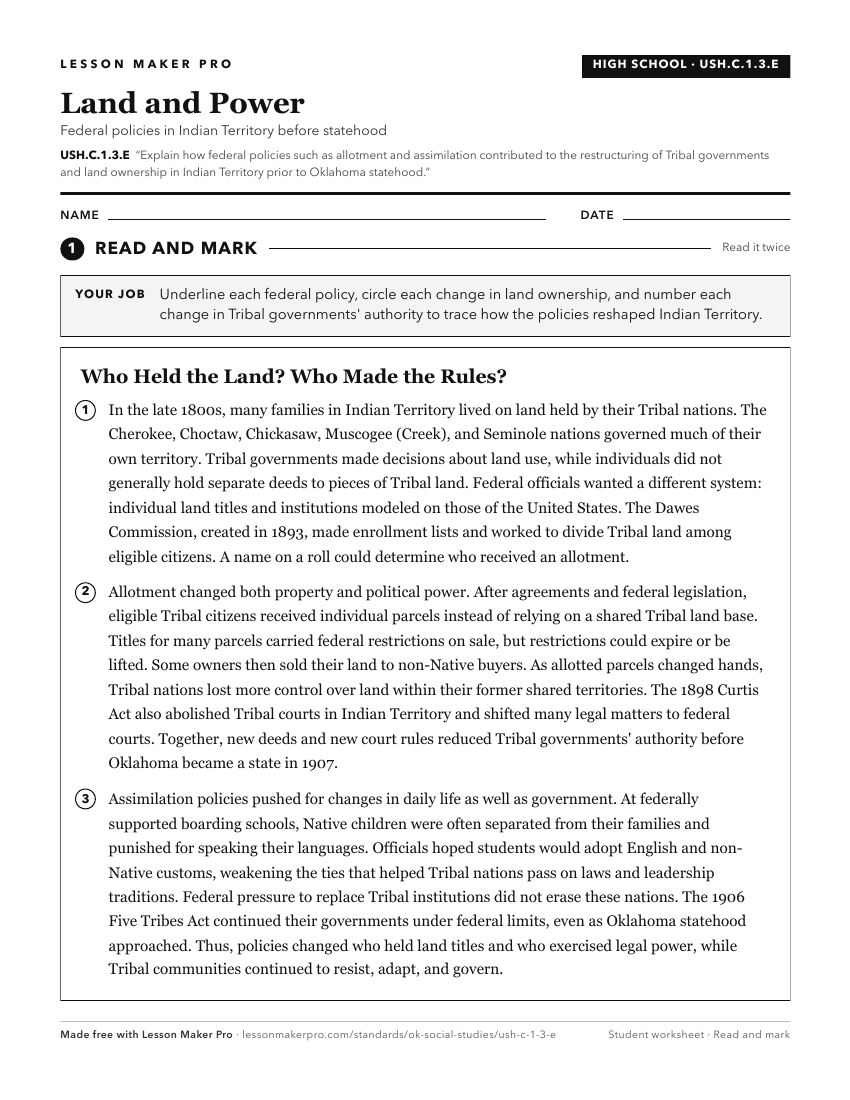
A ready-to-print activity worksheet aligned to USH.C.1.3.E, with an answer key for the teacher on its own page. No account needed.
PDF, US Letter, prints cleanly in black and white.
Download the worksheetKeep exploring
Related Standards
- USH.C.4.3.F
Explain how the Indian Reorganization Act intended to reverse federal policy by restoring lands to Tribal trust status and endorsing Tribal constitutions, which...
- OKH.C.8.3
Analyze the historical and contemporary relationship between the State of Oklahoma and Oklahoma’s thirty-nine federally recognized Tribal governments.
- OKH.C.8.3.A
Explain how Tribal governments in Indian Territory were altered or disestablished by congressional acts prior to Oklahoma statehood, including the effects of al...
- OKH.C.4.3
Explain how the Organic Act of 1890 and Enabling Act paved the way for the admission of Oklahoma and Indian territories into the Union as a single state.
Turn this exact standard into a lesson
Grade, subject, topic, and the complete standard are prefilled. Create one free, no account needed.
Also for this standard:Make a WorksheetMake a QuizMake a Sub Lesson