Oklahoma Social Studies OKH.C.8.2
Standard Cluster
- OKH.C.8
- Investigate how post-war social, political, and economic events continued to transform the state of Oklahoma from the 1950s through the present.
Analyze the impact of growth in various sectors of the state economy. Describe the value of agribusiness to the state economy, producing commodities, such as wheat and livestock, for the nation; examine water use issues impacting agribusiness. Examine the development of defense-related, aerospace, and aviation industries (e.g., Fort Sill, Tinker Air Force Base, FAA, weather research, and national disaster preparedness). Analyze recent oil and gas boom-and-bust cycles, such as new discoveries in the Anadarko Basin and the growth of alternative energy sources, such as wind power. Describe the state’s connection to international trade through construction of transportation infrastructures (e.g., interstate highway system, McClellan-Kerr Arkansas River Navigation System). Evaluate the impact of tourism as an industry, boosted by the construction of Route 66, state parks, and museums. Examine the growth of Tribal enterprises, their effects on the state’s economy and on the financial stability of American Indian Nations, including examples of state and Tribal cooperation (e.g., gaming compacts, cross-deputization agreements). Identify the causes and consequences of rural to urban to suburban migration, as well as urban renewal efforts (e.g., Oklahoma City’s MAPS Project).
Oklahoma Academic Standards for Social Studies (2026) · OKH.C.8
Cluster contents
Standards in This Cluster
OKH.C.8.2 is a cluster heading. These are the individual standards under it.
- OKH.C.8.2.A
Describe the value of agribusiness to the state economy, producing commodities, such as wheat and livestock, for the nation; examine water use issues impacting ...
- OKH.C.8.2.B
Examine the development of defense-related, aerospace, and aviation industries (e.g., Fort Sill, Tinker Air Force Base, FAA, weather research and national disas...
- OKH.C.8.2.C
Analyze recent oil and gas boom-and-bust cycles, such as new discoveries in the Anadarko Basin and the growth of alternative energy sources, such as wind power.
- OKH.C.8.2.D
Describe the state’s connection to international trade through construction of transportation infrastructures (e.g., interstate highway system, McClellan-Kerr A...
- OKH.C.8.2.E
Evaluate the impact of tourism as an industry, boosted by the construction of Route 66, state parks, and museums.
- OKH.C.8.2.F
Examine the growth of Tribal enterprises, their effects on the state’s economy and on the financial stability of American Indian Nations, including examples of ...
- OKH.C.8.2.G
Identify the causes and consequences of rural to urban to suburban migration, as well as urban renewal efforts (e.g., Oklahoma City’s MAPS Project).
Teacher's field guide
What This Cluster Means
What Students Need to Do
- Students explain how farming, defense, aviation, energy, tourism, and Tribal businesses affect Oklahoma jobs and revenue. They trace how water, transport routes, and oil price swings shape those industries and connect Oklahoma to overseas buyers. They explain why people moved from farms to cities and suburbs, and how MAPS changed Oklahoma City.
What Mastery Looks Like
- With a map and charts, students can link wheat exports to water use and river shipping, then compare oil booms with wind growth. They can explain how Tinker, FAA aviation work, Route 66, and Tribal gaming compacts affect jobs or revenue. They can trace a move from a farm to a city to a suburb and judge one MAPS project using evidence.
Common Misconceptions
- Students may think an oil discovery guarantees permanent jobs or that wind power has replaced oil and gas. They may mistake Tribal gaming revenue for state tax revenue. They may assume people moved to suburbs for the same reasons they first left farms.
How to Assess It
- Give students an Oklahoma map marked with Tinker, an oil field, Route 66, a Tribal casino, and the Port of Catoosa. Ask them to choose two sites and explain one job or trade effect and one effect on migration or revenue.
Lesson moves
Ways to Teach It
Pairs place wheat, Tinker, oil, wind, Route 66, and Tribal enterprise cards on an Oklahoma map, then draw job and trade arrows.
Ask: Should Oklahoma farms pump more water to grow wheat for export? Students write a claim with one benefit and one cost.
Run a card sort matching oil discoveries, falling prices, wind growth, and job moves to likely effects on Oklahoma towns.
Trace a wheat shipment from an Oklahoma farm through the Port of Catoosa to an overseas buyer using a highway and river map.
Free download
Printable OKH.C.8.2 Worksheet
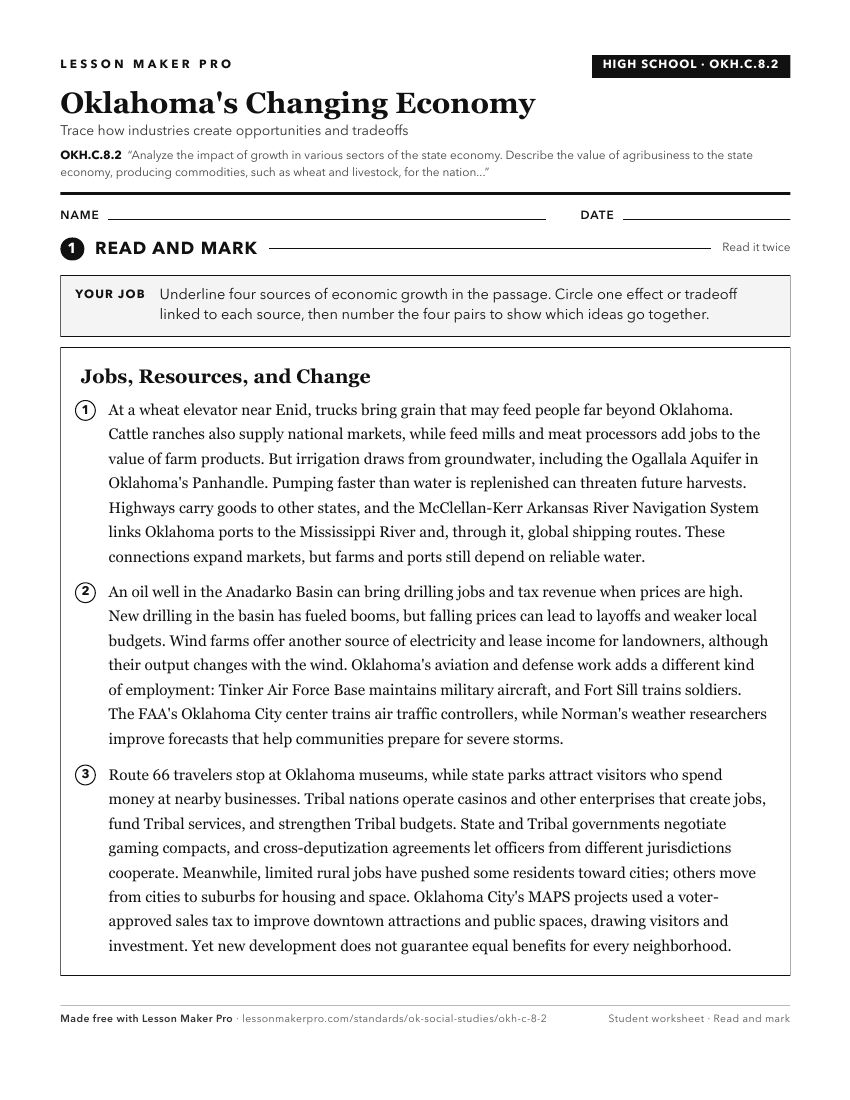
A ready-to-print activity worksheet aligned to OKH.C.8.2, with an answer key for the teacher on its own page. No account needed.
PDF, US Letter, prints cleanly in black and white.
Download the worksheetKeep exploring
Related Standards
- 3.C.4.2
Examine how entrepreneurs have contributed to the state’s economy.
- 3.C.4.3.B
Examine how the development of recent economic activities has contributed to the state’s economy, identifying examples of goods and services provided by local b...
- E.C.10
Identify the potential economic impact of government policy.
- 7.C.7.3
Evaluate how the major sectors of economic activities contribute to the development of a country or region:
Turn this cluster into a lesson
Grade, subject, topic, and the complete cluster are prefilled. Create one free, no account needed.
Also for this cluster:Make a WorksheetMake a QuizMake a Sub Lesson