Oklahoma Social Studies E.C.10
Standard Cluster
Identify the potential economic impact of government policy. Compare fiscal and monetary policy and evaluate the impact each has on economic growth, employment, and price stability. Explain how changes in federal spending and taxation can affect budget deficits, surpluses, and the national debt, and describe how different tax structures (progressive, proportional, and regressive) distribute tax burdens among earners. Analyze the costs and benefits of government economic policies, including how political and social goals may influence economic decision-making. Describe the organization and functions of the Federal Reserve System, including its role in promoting price stability, maximum employment, and financial stability. Analyze how the Federal Reserve uses monetary policy tools (e.g., changes in the discount rate, reserve requirements, money supply) to influence economic conditions.
Oklahoma Academic Standards for Social Studies (2026)
Cluster contents
Standards in This Cluster
E.C.10 is a cluster heading. These are the individual standards under it.
- E.C.10.1
Compare fiscal and monetary policy and evaluate the impact each has on economic growth, employment, and price stability.
- E.C.10.2
Explain how changes in federal spending and taxation can affect budget deficits, surpluses, and the national debt, and describe how different tax structures (pr...
- E.C.10.3
Analyze the costs and benefits of government economic policies, including how political and social goals may influence economic decision-making.
- E.C.10.4
Describe the organization and functions of the Federal Reserve System, including its role in promoting price stability, maximum employment, and financial stabil...
- E.C.10.5
Analyze how the Federal Reserve uses monetary policy tools (e.g., changes in the discount rate, reserve requirements, money supply) to influence economic condit...
Teacher's field guide
What This Cluster Means
What Students Need to Do
- Students compare how spending, taxes, and Federal Reserve actions affect growth, jobs, prices, and the federal budget. They compare tax burdens under progressive, proportional, and regressive taxes, and separate yearly deficits from total debt. They identify the Fed's parts and tools, then weigh economic effects against political and social goals.
What Mastery Looks Like
- Given a recession, a student chooses a spending, tax, or Fed action and predicts its effects on jobs, growth, and prices. They calculate a surplus or deficit, explain how repeated deficits add to debt, and compare tax bills as shares of income. They name the Fed's Board, regional banks, and policy committee and explain how a policy tool affects borrowing.
Common Misconceptions
- Students often treat the deficit and debt as the same number. They may assume a higher tax bill always means a higher tax rate, or that a sales tax takes the same share of everyone's income. Some think the Fed sets tax rates, or that lower interest rates always reduce inflation.
How to Assess It
- Exit ticket: A recession hits, and Congress raises spending by $50 billion while tax revenue stays fixed. Name the policy type, predict what happens to jobs and the deficit, and explain how one Fed tool could also respond.
Lesson moves
Ways to Teach It
Give pairs paper tokens for tax revenue and spending; have them build two yearly budgets and track the deficit and debt.
Ask, 'Should lawmakers cut spending when prices rise but unemployment is high? Who gains, who loses, and whose goals shape the choice?'
Run a three-round Fed meeting game: teams choose a discount rate, reserve requirement, or bond purchase, then predict jobs, prices, and borrowing.
Use a federal budget chart and a local sales tax receipt; students compare what gets funded, who pays, and how deficits affect debt.
Free download
Printable E.C.10 Worksheet
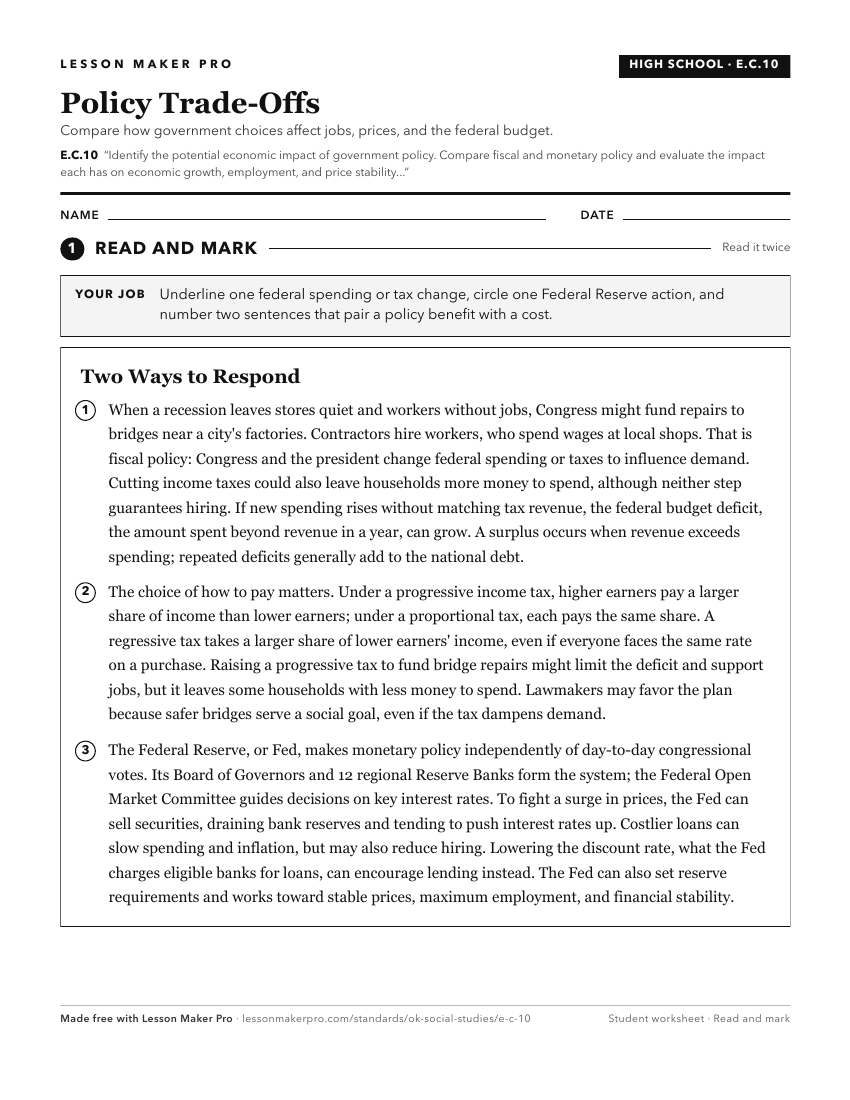
A ready-to-print activity worksheet aligned to E.C.10, with an answer key for the teacher on its own page. No account needed.
PDF, US Letter, prints cleanly in black and white.
Download the worksheetKeep exploring
Related Standards
- E.P.2.4.C
Evaluate the impact, both intended and unintended, of government policies on market outcomes at national and global levels, past and present.
- USG.P.2.4.C
Evaluate the impact, both intended and unintended, of government policies on market outcomes at national and global levels, past and present.
- WG.P.2.4.C
Evaluate the impact, both intended and unintended, of government policies on market outcomes at national and global levels, past and present.
Turn this cluster into a lesson
Grade, subject, topic, and the complete cluster are prefilled. Create one free, no account needed.
Also for this cluster:Make a WorksheetMake a QuizMake a Sub Lesson