Oklahoma Social Studies USH.C.7.3
Standard Cluster
- USH.C.7
- Analyze the cause and effects of significant domestic events and policies impacting the lives of American citizens.
Analyze the ongoing social and political transformations within the United States of America , affecting domestic and foreign policy. Examine the role of the Warren Court’s application of the due process clause of the 14th Amendment (Incorporation Doctrine) which applies the Bill of Rights to the states, thereby securing and further defining individual rights and civil liberties. Assess the rise of liberalism in the 1960s and the lasting impact of President Lyndon Johnson’s War on Poverty and the Great Society by expanding the role of the federal government in economic and social issues. Describe the changing immigration policy, with emphasis on how the Immigration Act of 1965 began to transform American society through removal of an origins quota system. Identify the goals of the environmental protection movement, including the influence of the publication of Rachel Carson’s Silent Spring and passage of the Clean Air Act. Analyze the political and economic impact of President Nixon’s foreign policies including détente and the opening of China. Describe the election of Richard Nixon, including his appeal to “the silent majority” and the effects of the Watergate Scandal (e.g., public distrust of government, investigative role of the media, Pentagon Papers, first use of the 25th Amendment, President Ford’s pardon).
Oklahoma Academic Standards for Social Studies (2026) · USH.C.7
Cluster contents
Standards in This Cluster
USH.C.7.3 is a cluster heading. These are the individual standards under it.
- USH.C.7.3.A
Examine the role of the Warren Court’s application of the due process clause of the 14th Amendment (Incorporation Doctrine) which applies the Bill of Rights to ...
- USH.C.7.3.B
Assess the rise of liberalism in the 1960s and the lasting impact of President Lyndon Johnson’s War on Poverty and the Great Society by expanding the role of th...
- USH.C.7.3.C
Describe the changing immigration policy, with emphasis on how the Immigration Act of 1965 began to transform American society through removal of an origins quo...
- USH.C.7.3.D
Identify the goals of the environmental protection movement, including the influence of the publication of Rachel Carson’s Silent Spring and passage of the Clea...
- USH.C.7.3.E
Analyze the political and economic impact of President Nixon’s foreign policies including détente and the opening of China.
- USH.C.7.3.F
Describe the election of Richard Nixon, including his appeal to “the silent majority” and the effects of the Watergate Scandal (e.g., public distrust of governm...
Teacher's field guide
What This Cluster Means
What Students Need to Do
- Students explain how court rulings applied federal rights to states and how Johnson's programs, immigration laws, and pollution rules changed federal policy. They link Silent Spring to environmental action and Nixon's détente and China visit to foreign policy. They explain Nixon's silent-majority appeal and connect the Pentagon Papers, Watergate, Ford's pardon, and the 25th Amendment to trust and succession.
What Mastery Looks Like
- A student can explain how Gideon required lawyers for poor felony defendants and how Head Start expanded federal aid to children. They can link the 1965 immigration law to new migration patterns and Silent Spring to calls for pollution rules. They can explain how détente and the China opening changed diplomacy, and why Watergate and Ford's pardon affected public trust.
Common Misconceptions
- Students may think the Warren Court wrote the Bill of Rights, rather than applying its protections to state governments. They may assume the 1965 immigration law ended all entry limits or that Johnson's programs ended poverty. They may confuse the Pentagon Papers with the Watergate break-in or think the 25th Amendment removed Nixon.
How to Assess It
- Exit ticket: Explain how Gideon changed state courts and how Nixon's China visit changed U.S. foreign policy. Include one fact about each.
Lesson moves
Ways to Teach It
Give pairs a Silent Spring excerpt and a Clean Air Act excerpt; have them label Carson's concern and the law's target.
Ask students whether the Pentagon Papers or Watergate did more to damage trust, using one fact from a short account of each.
Play a card match game pairing Gideon, Head Start, the 1965 immigration law, and Nixon's China visit with their effects.
Give students a current Medicare enrollment flyer and ask them to trace the program to Johnson's Great Society.
Free download
Printable USH.C.7.3 Worksheet
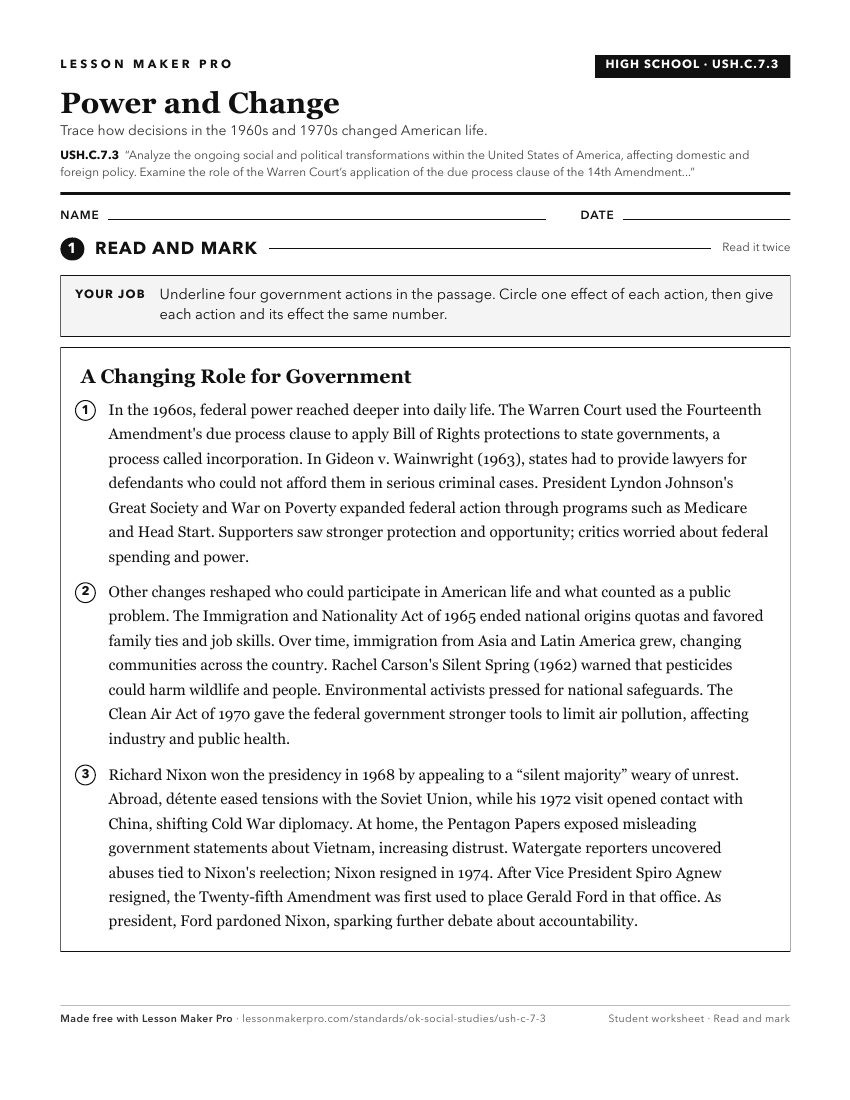
A ready-to-print activity worksheet aligned to USH.C.7.3, with an answer key for the teacher on its own page. No account needed.
PDF, US Letter, prints cleanly in black and white.
Download the worksheetKeep exploring
Related Standards
- USG.C.7
Analyze the processes and implementation of public policy in the United States of America.
- USH.C.9
Analyze contemporary turning points of 21st century American society.
- USH.C.7
Analyze the cause and effects of significant domestic events and policies impacting the lives of American citizens.
- 4.C.2.3
Analyze the human characteristics of the United States of America.
Turn this cluster into a lesson
Grade, subject, topic, and the complete cluster are prefilled. Create one free, no account needed.
Also for this cluster:Make a WorksheetMake a QuizMake a Sub Lesson