Oklahoma Social Studies USH.C.9
Standard Cluster
Analyze contemporary turning points of 21st century American society. Assess the significant events of the George W. Bush administration. Summarize the terrorist attacks of September 11, 2001, including examples of heroism and efforts to combat terrorism (e.g., creation of the Department of Homeland Security, passage of the PATRIOT Act). Describe the consequences of United States engagement in the Afghanistan and Iraqi wars. Evaluate the environmental and human crisis created by Hurricane Katrina, including the response by FEMA. Identify the roots of the Great Recession, beginning with the housing bubble’s burst, the global financial crisis, and aggressive responses by the Federal Reserve. Analyze the significant events during the Barack Obama administration. Describe the economic philosophy of the Tea Party movement and how its ideas currently influence political party systems. Assess the goals and management of military engagements (e.g., wars in Afghanistan and Iraq). Describe the goals of the Affordable Care Act (Obamacare), explaining challenges to its enactment. Explain the intent and outcome of the DACA (Deferred Action for Childhood Arrivals) program. Identify the outcome of the grassroots protests of the Dakota Access Pipeline and its potential impact on Tribal water resources and cultural sites. Examine the significant events during the first Donald J. Trump administration. Analyze the Trump administration’s policies and the effects they had on the United States of America and the rest of the world. Examine the significant events during the Joseph R. Biden administration. Analyze the Biden administration’s policies and the effects they had on the United States of America and the rest of the world.
Oklahoma Academic Standards for Social Studies (2026)
Cluster contents
Standards in This Cluster
USH.C.9 is a cluster heading. These are the individual standards under it.
- USH.C.9.1
Assess the significant events of the George W. Bush administration.
- USH.C.9.1.A
Summarize the terrorist attacks of September 11, 2001, including examples of heroism and efforts to combat terrorism (e.g., creation of the Department of Homela...
- USH.C.9.1.B
Describe the consequences of United States engagement in the Afghanistan and Iraqi wars.
- USH.C.9.1.C
Evaluate the environmental and human crisis created by Hurricane Katrina, including the response by FEMA.
- USH.C.9.1.D
Identify the roots of the Great Recession, beginning with the housing bubble’s burst, the global financial crisis, and aggressive responses by the Federal Reser...
- USH.C.9.2
Analyze the significant events during the Barack Obama administration.
- USH.C.9.2.A
Describe the economic philosophy of the Tea Party movement and how its ideas currently influence political party systems.
- USH.C.9.2.B
Assess the goals and management of military engagements (e.g., wars in Afghanistan and Iraq).
- USH.C.9.2.C
Describe the goals of the Affordable Care Act (Obamacare), explaining challenges to its enactment.
- USH.C.9.2.D
Explain the intent and outcome of the DACA (Deferred Action for Childhood Arrivals) program.
- USH.C.9.2.E
Identify the outcome of the grassroots protests of the Dakota Access Pipeline and its potential impact on Tribal water resources and cultural sites.
- USH.C.9.3
Examine the significant events during the first Donald J. Trump administration. Analyze the Trump administration’s policies and the effects they had on the Unit...
- USH.C.9.4
Examine the significant events during the Joseph R. Biden administration. Analyze the Biden administration’s policies and the effects they had on the United Sta...
Teacher's field guide
What This Cluster Means
What Students Need to Do
- Students explain the causes and effects of 9/11, the wars, Katrina, and the Great Recession, including the Federal Reserve's response. They compare actions under Bush, Obama, Trump's first term, and Biden on health care, immigration, Tribal land, the economy, and foreign policy. They use evidence to judge results and explain how Tea Party ideas shaped party politics.
What Mastery Looks Like
- A student can put key events in order and link each one to a government action and an outcome. They can distinguish the goals and costs of the Afghanistan and Iraq wars. They can support a judgment about a policy, such as DACA or the Affordable Care Act, with evidence.
Common Misconceptions
- Students may assume Iraq carried out the 9/11 attacks or treat the Afghanistan and Iraq wars as one war. They may mistake DACA for citizenship or think protests permanently stopped the Dakota Access Pipeline. They may blame the recession only on borrowers, missing risky lending and financial markets.
How to Assess It
- Exit ticket: Choose two events from different presidencies. For each, name a cause, a federal action, and an effect, using one fact from class notes.
Lesson moves
Ways to Teach It
Give pairs dated cards for 9/11, Katrina, the housing crash, DACA, and the Dakota Access Pipeline protests; have them build a timeline.
Ask students to write: How did U.S. goals in Afghanistan change from 2001 to 2021? What did the withdrawal show? Cite two sources.
Post four administration names; read cards for DHS creation, the Affordable Care Act, 2017 tax cuts, and the 2021 infrastructure law; students move to match.
Have students check HealthCare.gov's page on preexisting conditions and explain how that rule could affect a family shopping for coverage.
Free download
Printable USH.C.9 Worksheet
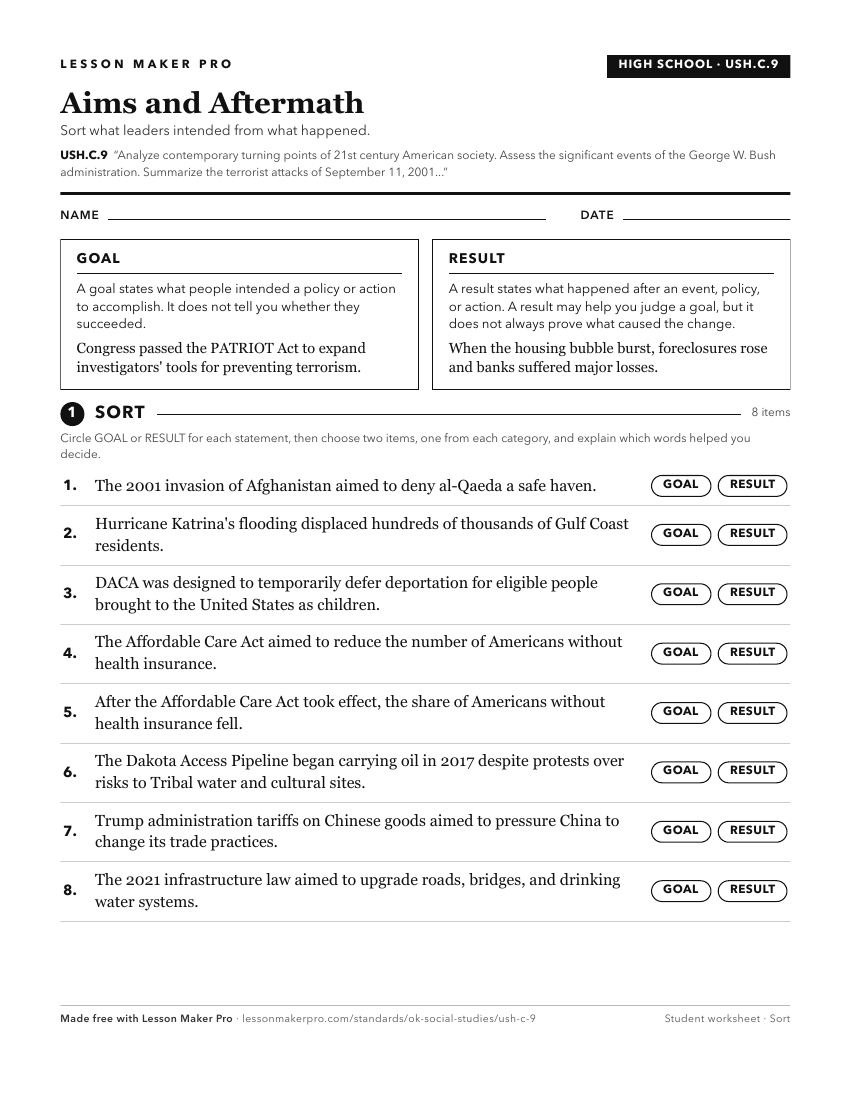
A ready-to-print activity worksheet aligned to USH.C.9, with an answer key for the teacher on its own page. No account needed.
PDF, US Letter, prints cleanly in black and white.
Download the worksheetKeep exploring
Related Standards
- USH.C.7.3
Analyze the ongoing social and political transformations within the United States of America , affecting domestic and foreign policy.
- USH.C.8
Analyze the rationale and impact of foreign and domestic policies of the late 20th century.
- USH.C.7
Analyze the cause and effects of significant domestic events and policies impacting the lives of American citizens.
- USH.C.4
Analyze the cycles of economic boom and bust of the 1920s and 1930s on the transformation of the United States of America’s government and society.
Turn this cluster into a lesson
Grade, subject, topic, and the complete cluster are prefilled. Create one free, no account needed.
Also for this cluster:Make a WorksheetMake a QuizMake a Sub Lesson