Oklahoma Social Studies USH.C.4
Standard Cluster
Analyze the cycles of economic boom and bust of the 1920s and 1930s on the transformation of the United States of America’s government and society. Examine the transformations between the World Wars. Explain how the era reflected change, characterized by clashes between modern and traditional values, exemplified by the passage of the 18th and 21st Amendments, the Scopes Trial, issues of women’s rights, and the efforts of Carrie Chapman Catt and Alice Paul resulting in the ratification of the 19th Amendment. Describe the transition from wartime to peace under the Harding Administration, including the demobilization of drafted soldiers, federal budget cuts, and amnesty for political prisoners. Examine the presidency of President Calvin Coolidge and his philosophy of limited government and debates over immigration policy, including the impact of the Immigration Act of 1924, which established national quotas related to origin. Describe Calvin Coolidge’s reflections in his 1926 address on the 150th anniversary of the United States of America’s independence regarding the principles of the Declaration of Independence, natural rights, equality, and the moral foundations of American self-government. Identify new forms of cultural expression (e.g., radio, Hollywood films, comic books), including the significant impact of African American culture as exhibited by the Harlem Renaissance and the Jazz Age. Describe the rising racial tensions in American society, resulting in the resurgence of the Ku Klux Klan, lynchings, violence typified by the Tulsa Race Massacre, and the continued efforts to disenfranchise African Americans, including responses by African American leadership, such as Marcus Garvey. Describe the purpose of the Anti-Defamation League in response to antisemitism in the early 20th Century. Assess the effects of the Indian Citizenship Act of 1924 on the status of Tribal citizens with regards to dual citizenship, the divided Tribal reaction regarding sovereignty concerns, and efforts by some states to deny voting rights. Analyze the prosperity of the Roaring Twenties and the collapse of the United States of America’s economy, leading to the Great Depression. Describe the booming economy based upon access to easy credit through installment buying and a return to laissez-faire economics during the Harding and Coolidge Administrations. Examine the various factors contributing to and exacerbating the global depression, including German reparations, Allied war debts, United States of America loans to Europe, and the Smoot-Hawley Tariff’s strain on international trade. Identify causes contributing to an unstable economy including the overproduction of agriculture products, greater speculation in the stock market and buying on margin, and laissez faire policies. Examine the role of monetary policy and the expansion of credit in the 1920’s including the creation and actions of the Federal Reserve System and their relationship to speculation, investment, and economic instability. Examine the role of the Stock Market Crash and bank failures in weakening both the agricultural and manufacturing sectors of the economy as well as decimating the savings of middle class families. Explain growing labor unrest and industry’s reactions by describing the use of sit-down strikes and court injunctions and examining why socialism and communism appealed to labor. Analyze points of view regarding the economic and social impact of the Great Depression on individuals, families, and the nation. Analyze how President Herbert Hoover’s philosophy of “rugged individualism,” public works projects, and restrictive monetary policies attempted to address massive unemployment; describe examples of public reaction to such measures (e.g., Bonus Army March, Hoovervilles, presidential election of 1932). Analyze the impact of the New Deal in addressing the challenges of the Great Depression by transforming the federal government’s role in domestic economic policies. Assess changing viewpoints regarding the expanding role of government as expressed in President Franklin Roosevelt’s First Inaugural Address. Describe how national policies, based upon John Maynard Keynes’ theory of deficit spending, addressed the economic crisis, and evaluate the critiques of centralized economic planning and management. Analyze the controversies arising from New Deal economic policies, including charges of socialism and the effect of President Roosevelt’s court packing plan on the future of the New Deal. Summarize the goals and effectiveness of new federal agencies to address conditions of the Great Depression (e.g., Social Security Administration, Federal Deposit Insurance Corporation [FDIC], Works Progress Administration [WPA], Civilian Conservation Corps [CCC], Tennessee Valley Authority [TVA]). Identify the natural and man-made factors resulting in the environmental disaster known as the Dust Bowl, analyzing its effects on agricultural production, migration, and the national economy, as well as New Deal response (e.g., Farm Security Administration). Explain how the Indian Reorganization Act intended to reverse federal policy by restoring lands to Tribal trust status and endorsing Tribal constitutions, which affected the thirty-nine Tribes of Oklahoma. Describe the extent that New Deal programs provided relief for African- Americans, including the influence of the “Black Cabinet” and educator Mary McLeod Bethune. Explain how the Great Depression and the New Deal affected American politics by the emergence of the New Deal Coalition.
Oklahoma Academic Standards for Social Studies (2026)
Cluster contents
Standards in This Cluster
USH.C.4 is a cluster heading. These are the individual standards under it.
- USH.C.4.1
Examine the transformations between the World Wars.
- USH.C.4.1.A
Explain how the era reflected change, characterized by clashes between modern and traditional values, exemplified by the passage of the 18th and 21st Amendments...
- USH.C.4.1.B
Describe the transition from wartime to peace under the Harding Administration, including the demobilization of drafted soldiers, federal budget cuts, and amnes...
- USH.C.4.1.C
Examine the presidency of President Calvin Coolidge and his philosophy of limited government and debates over immigration policy, including the impact of the Im...
- USH.C.4.1.D
Describe Calvin Coolidge’s reflections in his 1926 address on the 150th anniversary of the United States of America’s independence regarding the principles of t...
- USH.C.4.1.E
Identify new forms of cultural expression (e.g., radio, Hollywood films, comic books), including the significant impact of African American culture as exhibited...
- USH.C.4.1.F
Describe the rising racial tensions in American society, resulting in the resurgence of the Ku Klux Klan, lynchings, violence typified by the Tulsa Race Massacr...
- USH.C.4.1.G
Describe the purpose of the Anti-Defamation League in response to antisemitism in the early 20th Century.
- USH.C.4.1.H
Assess the effects of the Indian Citizenship Act of 1924 on the status of Tribal citizens with regards to dual citizenship, the divided Tribal reaction regardin...
- USH.C.4.2
Analyze the prosperity of the Roaring Twenties and the collapse of the United States of America’s economy, leading to the Great Depression.
- USH.C.4.2.A
Describe the booming economy based upon access to easy credit through installment buying and a return to laissez-faire economics during the Harding and Coolidge...
- USH.C.4.2.B
Examine the various factors contributing to and exacerbating the global depression, including German reparations, Allied war debts, United States of America loa...
- USH.C.4.2.C
Identify causes contributing to an unstable economy including the overproduction of agriculture products, greater speculation in the stock market and buying on ...
- USH.C.4.2.D
Examine the role of monetary policy and the expansion of credit in the 1920’s including the creation and actions of the Federal Reserve System and their relatio...
- USH.C.4.2.E
Examine the role of the Stock Market Crash and bank failures in weakening both the agricultural and manufacturing sectors of the economy as well as decimating t...
- USH.C.4.2.F
Explain growing labor unrest and industry’s reactions by describing the use of sit-down strikes and court injunctions and examining why socialism and communism ...
- USH.C.4.2.G
Analyze points of view regarding the economic and social impact of the Great Depression on individuals, families, and the nation.
- USH.C.4.2.H
Analyze how President Herbert Hoover’s philosophy of “rugged individualism,” public works projects, and restrictive monetary policies attempted to address massi...
- USH.C.4.3
Analyze the impact of the New Deal in addressing the challenges of the Great Depression by transforming the federal government’s role in domestic economic polic...
- USH.C.4.3.A
Assess changing viewpoints regarding the expanding role of government as expressed in President Franklin Roosevelt’s First Inaugural Address.
- USH.C.4.3.B
Describe how national policies, based upon John Maynard Keynes’ theory of deficit spending, addressed the economic crisis, and evaluate the critiques of central...
- USH.C.4.3.C
Analyze the controversies arising from New Deal economic policies, including charges of socialism and the effect of President Roosevelt’s court packing plan on ...
- USH.C.4.3.D
Summarize the goals and effectiveness of new federal agencies to address conditions of the Great Depression (e.g., Social Security Administration, Federal Depos...
- USH.C.4.3.E
Identify the natural and man-made factors resulting in the environmental disaster known as the Dust Bowl, analyzing its effects on agricultural production, migr...
- USH.C.4.3.F
Explain how the Indian Reorganization Act intended to reverse federal policy by restoring lands to Tribal trust status and endorsing Tribal constitutions, which...
- USH.C.4.3.G
Describe the extent that New Deal programs provided relief for African- Americans, including the influence of the “Black Cabinet” and educator Mary McLeod Bethu...
- USH.C.4.3.H
Explain how the Great Depression and the New Deal affected American politics by the emergence of the New Deal Coalition.
Teacher's field guide
What This Cluster Means
What Students Need to Do
- Trace how easy credit, farm overproduction, global debts, and bank failures deepened the Depression. Explain how disputes over voting, immigration, race, Tribal sovereignty, and culture changed society. Compare Hoover's approach with New Deal programs and assess the federal government's larger role.
What Mastery Looks Like
- Students can draw a cause chain linking buying on margin, bank failures, lost savings, and unemployment. They can explain why citizenship did not guarantee Tribal citizens the right to vote in every state. They can match a New Deal agency to a problem it addressed and explain one criticism or gap.
Common Misconceptions
- Students often blame the Depression only on the stock market crash, missing farm losses and global debt. Some assume voting amendments and citizenship laws gave everyone equal access to the ballot. Others think New Deal programs helped every group equally or ended the Depression on their own.
How to Assess It
- Exit ticket: In four sentences, explain two causes of the Depression, one way it changed a group's daily life, and how one New Deal program responded.
Lesson moves
Ways to Teach It
Give groups cards labeled installment buying, farm overproduction, bank failures, and FDIC; have them arrange and explain a cause-and-response chain.
Read short excerpts from Carrie Chapman Catt and Alice Paul; ask students which voting rights strategies differed and whose access to voting remained restricted.
Run a card sort with CCC, FDIC, Social Security, and WPA; have students match each program to its goal and defend one match.
Show a current bank's FDIC sign and a photo of a 1930s bank line; ask what problem deposit insurance was meant to prevent.
Free download
Printable USH.C.4 Worksheet
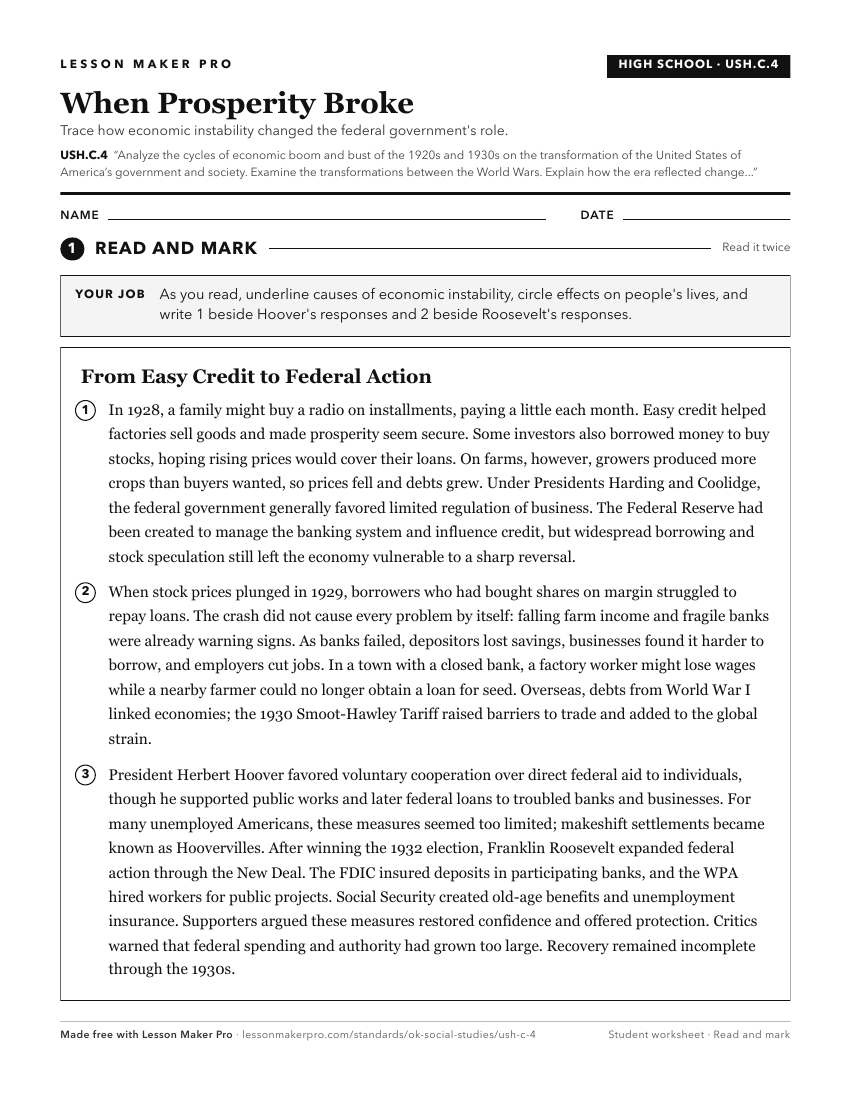
A ready-to-print activity worksheet aligned to USH.C.4, with an answer key for the teacher on its own page. No account needed.
PDF, US Letter, prints cleanly in black and white.
Download the worksheetKeep exploring
Related Standards
- USH.C.7.3
Analyze the ongoing social and political transformations within the United States of America , affecting domestic and foreign policy.
- USH.C.2.1
Evaluate the transformation of American society, economy, politics, and culture during the American Industrial Revolution.
- USH.C.2
Analyze the social, economic, and political changes that occurred during the American Industrial Revolution, the Gilded Age, and reform movements.
Turn this cluster into a lesson
Grade, subject, topic, and the complete cluster are prefilled. Create one free, no account needed.
Also for this cluster:Make a WorksheetMake a QuizMake a Sub Lesson