Oklahoma Social Studies USH.C.4.3
Standard Cluster
- USH.C.4
- Analyze the cycles of economic boom and bust of the 1920s and 1930s on the transformation of the United States of America’s government and society.
Analyze the impact of the New Deal in addressing the challenges of the Great Depression by transforming the federal government’s role in domestic economic policies. Assess changing viewpoints regarding the expanding role of government as expressed in President Franklin Roosevelt’s First Inaugural Address. Describe how national policies, based upon John Maynard Keynes’ theory of deficit spending, addressed the economic crisis, and evaluate the critiques of centralized economic planning and management. Analyze the controversies arising from New Deal economic policies, including charges of socialism and the effect of President Roosevelt’s court packing plan on the future of the New Deal. Summarize the goals and effectiveness of new federal agencies to address conditions of the Great Depression (e.g., Social Security Administration, Federal Deposit Insurance Corporation [FDIC], Works Progress Administration [WPA], Civilian Conservation Corps [CCC], Tennessee Valley Authority [TVA]). Identify the natural and man-made factors resulting in the environmental disaster known as the Dust Bowl, analyzing its effects on agricultural production, migration, and the national economy, as well as New Deal response (e.g., Farm Security Administration). Explain how the Indian Reorganization Act intended to reverse federal policy by restoring lands to Tribal trust status and endorsing Tribal constitutions, which affected the thirty-nine Tribes of Oklahoma. Describe the extent that New Deal programs provided relief for African- Americans, including the influence of the “Black Cabinet” and educator Mary McLeod Bethune. Explain how the Great Depression and the New Deal affected American politics by the emergence of the New Deal Coalition.
Oklahoma Academic Standards for Social Studies (2026) · USH.C.4
Cluster contents
Standards in This Cluster
USH.C.4.3 is a cluster heading. These are the individual standards under it.
- USH.C.4.3.A
Assess changing viewpoints regarding the expanding role of government as expressed in President Franklin Roosevelt’s First Inaugural Address.
- USH.C.4.3.B
Describe how national policies, based upon John Maynard Keynes’ theory of deficit spending, addressed the economic crisis, and evaluate the critiques of central...
- USH.C.4.3.C
Analyze the controversies arising from New Deal economic policies, including charges of socialism and the effect of President Roosevelt’s court packing plan on ...
- USH.C.4.3.D
Summarize the goals and effectiveness of new federal agencies to address conditions of the Great Depression (e.g., Social Security Administration, Federal Depos...
- USH.C.4.3.E
Identify the natural and man-made factors resulting in the environmental disaster known as the Dust Bowl, analyzing its effects on agricultural production, migr...
- USH.C.4.3.F
Explain how the Indian Reorganization Act intended to reverse federal policy by restoring lands to Tribal trust status and endorsing Tribal constitutions, which...
- USH.C.4.3.G
Describe the extent that New Deal programs provided relief for African- Americans, including the influence of the “Black Cabinet” and educator Mary McLeod Bethu...
- USH.C.4.3.H
Explain how the Great Depression and the New Deal affected American politics by the emergence of the New Deal Coalition.
Teacher's field guide
What This Cluster Means
What Students Need to Do
- Students explain how jobs programs, bank insurance, and retirement payments changed the federal government's role during the Depression. They connect drought and poor farming to Dust Bowl migration. They compare Roosevelt's call for action with objections to spending and federal control, then explain how New Deal policies changed politics.
What Mastery Looks Like
- Students match the WPA, CCC, TVA, FDIC, and Social Security to the problems each addressed and name a limit of each. They use Roosevelt's First Inaugural Address to explain his case for action, then explain deficit spending, charges of socialism, and opposition to his court plan. They describe the Farm Security Administration's response to the Dust Bowl, Bethune and the Black Cabinet's work, changes in policy toward Oklahoma Tribes, and the New Deal voting coalition.
Common Misconceptions
- Students may think deficit spending means using money the government already has, rather than borrowing. They may blame the Dust Bowl on drought alone or assume New Deal aid reached Black families equally. They may confuse the court plan with a relief program and miss why it raised concerns about presidential power.
How to Assess It
- Give students the line from Roosevelt's First Inaugural Address, “Our greatest primary task is to put people to work.” Ask them to name one program that answered that call, explain how it worked, and give one objection a critic might raise.
Lesson moves
Ways to Teach It
Give pairs drought and migration maps; have them trace a route from Oklahoma and label one Farm Security Administration response.
Read an inaugural excerpt and a court plan criticism; ask students to write whether Roosevelt's approach helped or threatened democracy.
Run a card sort matching WPA, CCC, TVA, FDIC, and Social Security to a problem, an action, and a limit.
Show an FDIC sticker beside a 1930s bank-run photo; ask how insurance might change a depositor's decision.
Free download
Printable USH.C.4.3 Worksheet
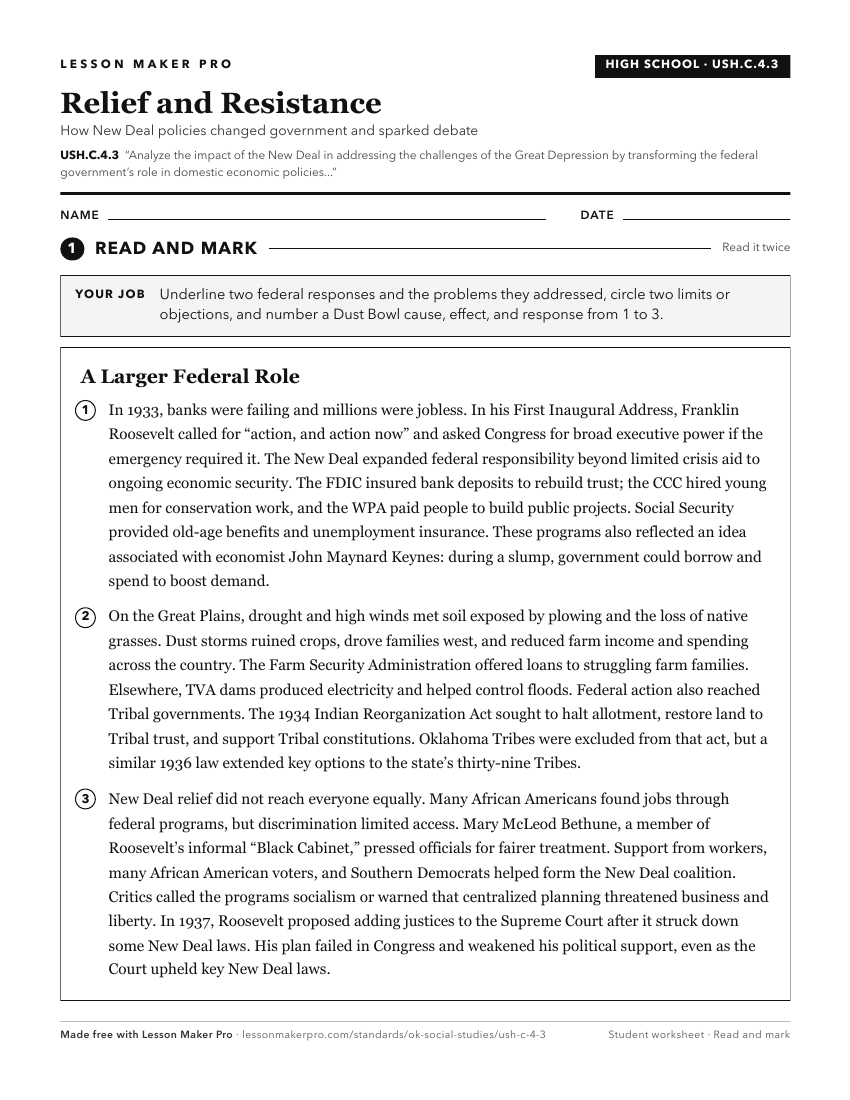
A ready-to-print activity worksheet aligned to USH.C.4.3, with an answer key for the teacher on its own page. No account needed.
PDF, US Letter, prints cleanly in black and white.
Download the worksheetKeep exploring
Related Standards
Turn this cluster into a lesson
Grade, subject, topic, and the complete cluster are prefilled. Create one free, no account needed.
Also for this cluster:Make a WorksheetMake a QuizMake a Sub Lesson