Oklahoma Social Studies USH.C.4.3.E
The Standard
- USH.C.4
- Analyze the cycles of economic boom and bust of the 1920s and 1930s on the transformation of the United States of America’s government and society.
- USH.C.4.3
- Analyze the impact of the New Deal in addressing the challenges of the Great Depression by transforming the federal government’s role in domestic economic policies.
Identify the natural and man-made factors resulting in the environmental disaster known as the Dust Bowl, analyzing its effects on agricultural production, migration, and the national economy, as well as New Deal response (e.g., Farm Security Administration).
Oklahoma Academic Standards for Social Studies (2026) · USH.C.4.3
Teacher's field guide
What This Standard Means
What Students Need to Do
- Students explain how drought, strong winds, and plowing prairie grass exposed soil to erosion. They trace crop losses to migration, falling farm income, and trouble for banks and businesses. They describe how New Deal programs helped farm families.
What Mastery Looks Like
- A student can explain why drought alone did not cause the dust storms: plowing removed grasses that held soil in place. They can link failed crops to moves west, unpaid loans, and lost sales for businesses. They can name Farm Security Administration loans as one response.
Common Misconceptions
- Students often blame drought alone and miss the role of plowing. They may think only farmers were affected, overlooking banks and town businesses. Some assume the Farm Security Administration stopped the storms rather than helped farm families.
How to Assess It
- Exit ticket: Explain how drought and plowing prairie grass caused dust storms. Name one effect each on crops, migration, and the economy, plus one Farm Security Administration response.
Lesson moves
Ways to Teach It
Cover one soil tray with grass clippings, leave another bare, blow both outdoors with a fan, and compare soil loss.
Show a 1930s dust storm photograph and ask students to write which farming choices made the drought worse.
Give pairs cards labeled drought, plowing, dust, failed crops, migration, and farm loans; have them arrange a cause chain and response.
Compare a current U.S. Drought Monitor map with a Dust Bowl map, then list one way farmers today keep soil covered.
Free download
Printable USH.C.4.3.E Worksheet
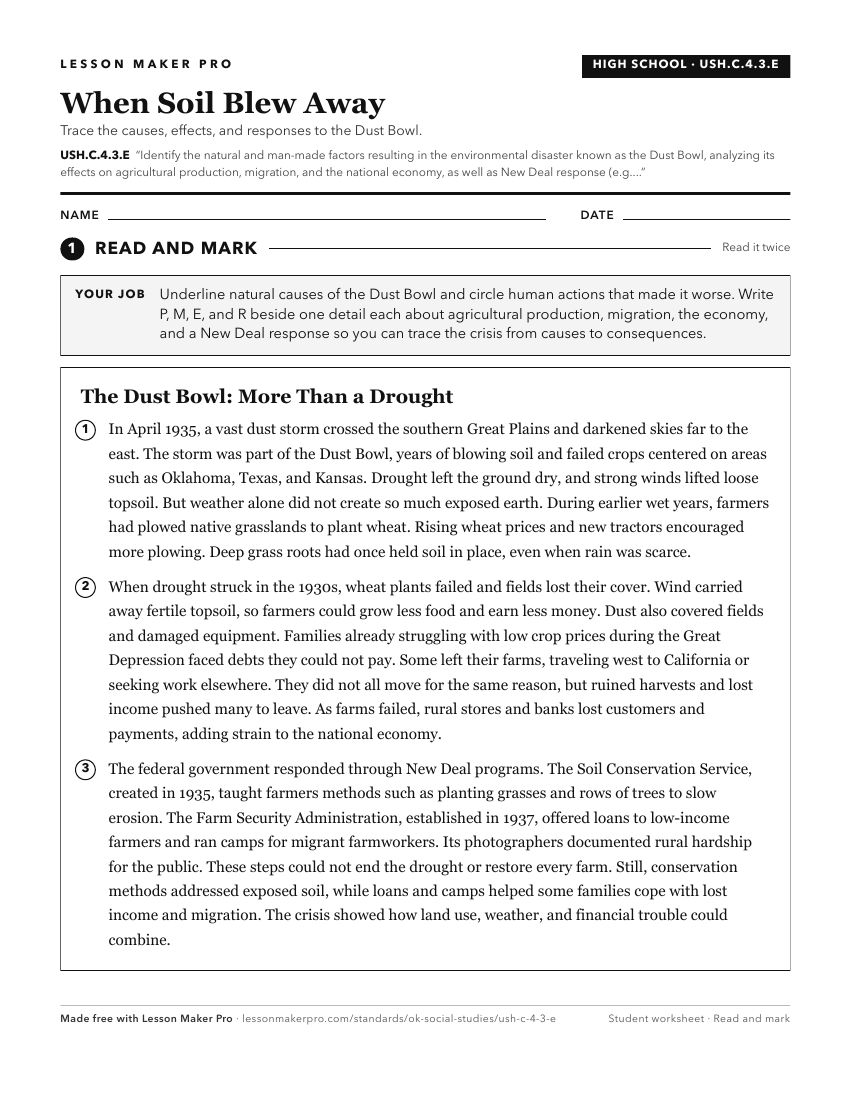
A ready-to-print activity worksheet aligned to USH.C.4.3.E, with an answer key for the teacher on its own page. No account needed.
PDF, US Letter, prints cleanly in black and white.
Download the worksheetKeep exploring
Related Standards
- OKH.C.6.5
Examine how agricultural conditions and practices were precursors to the Great Depression by describing the boom-and-bust cycle of Oklahoma’s agricultural outpu...
- OKH.C.7.2
Describe the environmental devastation known as the Dust Bowl by analyzing the impact of environmental conditions and human mismanagement of natural resources w...
- OKH.C.7.3
Examine the effects of the Great Depression on Oklahomans and evaluate the effectiveness of governmental response.
- 3.C.3.2.E
Describe challenges faced by citizens during the Dust Bowl, focusing on how Oklahomans adapted to harsh environmental conditions and survived economic hardships...
Turn this exact standard into a lesson
Grade, subject, topic, and the complete standard are prefilled. Create one free, no account needed.
Also for this standard:Make a WorksheetMake a QuizMake a Sub Lesson