Oklahoma Social Studies USH.C.4.3.C
The Standard
- USH.C.4
- Analyze the cycles of economic boom and bust of the 1920s and 1930s on the transformation of the United States of America’s government and society.
- USH.C.4.3
- Analyze the impact of the New Deal in addressing the challenges of the Great Depression by transforming the federal government’s role in domestic economic policies.
Analyze the controversies arising from New Deal economic policies, including charges of socialism and the effect of President Roosevelt’s court packing plan on the future of the New Deal.
Oklahoma Academic Standards for Social Studies (2026) · USH.C.4.3
Teacher's field guide
What This Standard Means
What Students Need to Do
- Students compare arguments for and against New Deal programs such as Social Security. They explain why Roosevelt wanted to add Supreme Court justices, why Congress resisted, and what happened to New Deal laws afterward.
What Mastery Looks Like
- A student can explain a critic's charge of socialism and a supporter's reply using Social Security as an example. They can explain that Roosevelt's court plan failed and weakened his support, even as the Court upheld major New Deal laws.
Common Misconceptions
- Some students think Roosevelt planned to replace every justice or that Congress approved his plan. Others treat the charge of socialism as proof that the New Deal ended private business. They may also assume the plan alone changed the Court's rulings.
How to Assess It
- Exit ticket: Why did some critics call Social Security socialism? Explain how Roosevelt's court plan ended and name one effect on his political support or New Deal laws.
Lesson moves
Ways to Teach It
Give pairs dated cards for the court plan, Social Security rulings, Senate committee opposition, and the plan's collapse, then have them build a timeline.
Read an excerpt from Roosevelt's March 1937 fireside chat and an opposing cartoon; debate whether adding justices threatened judicial independence.
Play a claim-and-evidence match using socialism charges, defenses of Social Security, and excerpts from the 1937 Senate report on the court plan.
Present a fictional school board proposal to add voting members after a lost vote; students write one similarity to Roosevelt's plan and one difference.
Free download
Printable USH.C.4.3.C Worksheet
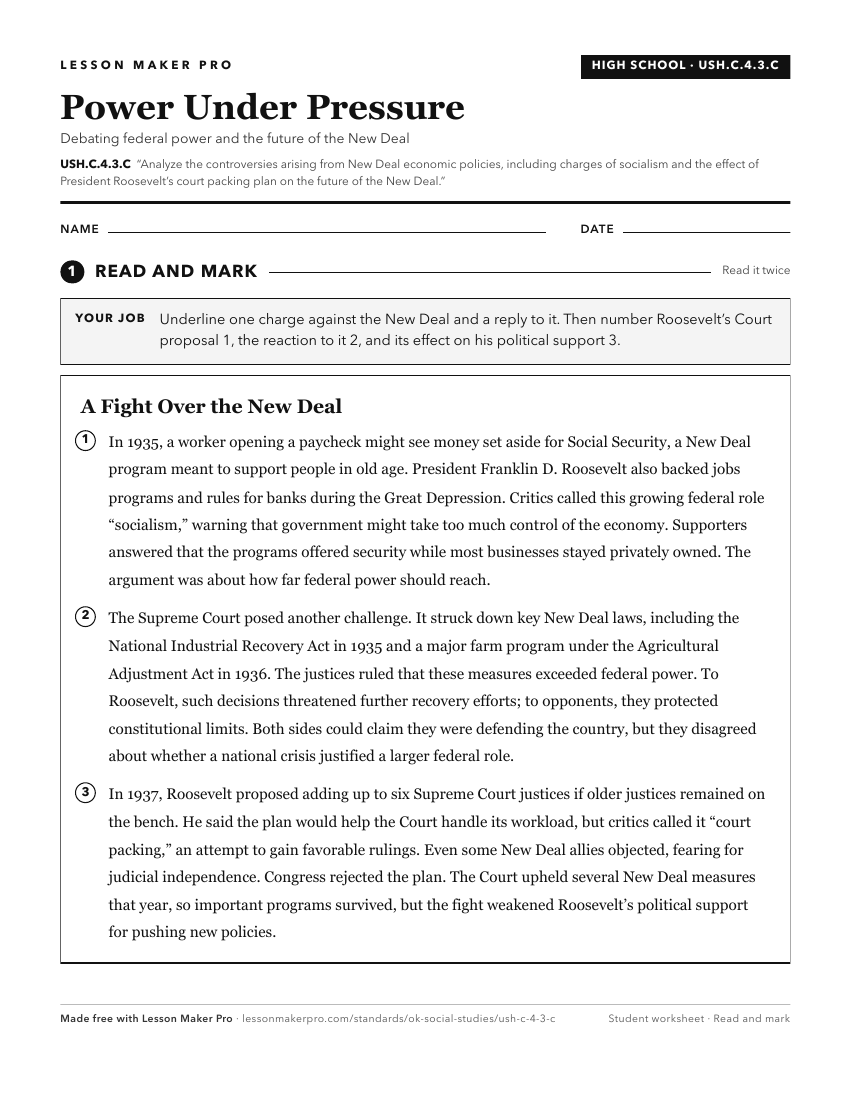
A ready-to-print activity worksheet aligned to USH.C.4.3.C, with an answer key for the teacher on its own page. No account needed.
PDF, US Letter, prints cleanly in black and white.
Download the worksheetKeep exploring
Related Standards
- USH.C.2.4.C
Evaluate the significance of the 1912 presidential election, including the rise of Roosevelt's Bull Moose Party and the viability of Eugene V. Debs’ Socialist P...
- USH.C.4.3
Analyze the impact of the New Deal in addressing the challenges of the Great Depression by transforming the federal government’s role in domestic economic polic...
- USH.C.4.2.H
Analyze how President Herbert Hoover’s philosophy of “rugged individualism,” public works projects, and restrictive monetary policies attempted to address massi...
- USH.C.4.3.A
Assess changing viewpoints regarding the expanding role of government as expressed in President Franklin Roosevelt’s First Inaugural Address.
Turn this exact standard into a lesson
Grade, subject, topic, and the complete standard are prefilled. Create one free, no account needed.
Also for this standard:Make a WorksheetMake a QuizMake a Sub Lesson