Oklahoma Social Studies USH.C.4.2.A
The Standard
- USH.C.4
- Analyze the cycles of economic boom and bust of the 1920s and 1930s on the transformation of the United States of America’s government and society.
- USH.C.4.2
- Analyze the prosperity of the Roaring Twenties and the collapse of the United States of America’s economy, leading to the Great Depression.
Describe the booming economy based upon access to easy credit through installment buying and a return to laissez-faire economics during the Harding and Coolidge Administrations.
Oklahoma Academic Standards for Social Studies (2026) · USH.C.4.2
Teacher's field guide
What This Standard Means
What Students Need to Do
- Students explain how installment plans let families buy goods before saving the full price. They describe how lower taxes and fewer business rules under Harding and Coolidge helped businesses grow during the 1920s.
What Mastery Looks Like
- Given a radio ad, students can explain why buyers might use credit and how more sales could lead to more factory orders. They can connect business-friendly policies to growth and name a risk of unpaid debt.
Common Misconceptions
- Students may think installment buying made goods cheaper, rather than spreading payments over time, sometimes with added charges. They may think laissez-faire meant no government action at all, or that every American shared in the boom.
How to Assess It
- Exit ticket: A family buys a radio on monthly payments in 1925. Explain how the sale could help a factory and how lower taxes or fewer business rules might help it too.
Lesson moves
Ways to Teach It
Give pairs a 1920s radio ad, a cash price, and six monthly payments; have them calculate total cost and list one benefit and risk.
Ask: Why would a family buy a radio on installments, and why might Harding and Coolidge favor fewer rules for its manufacturer?
Have partners sort cards into causes, effects, and risks: installment plans, tax cuts, more buyers, larger factory orders, and unpaid bills.
Show a phone installment offer; compare its full cost with the cash price, then ask how a 1920s radio buyer faced similar risks.
Free download
Printable USH.C.4.2.A Worksheet
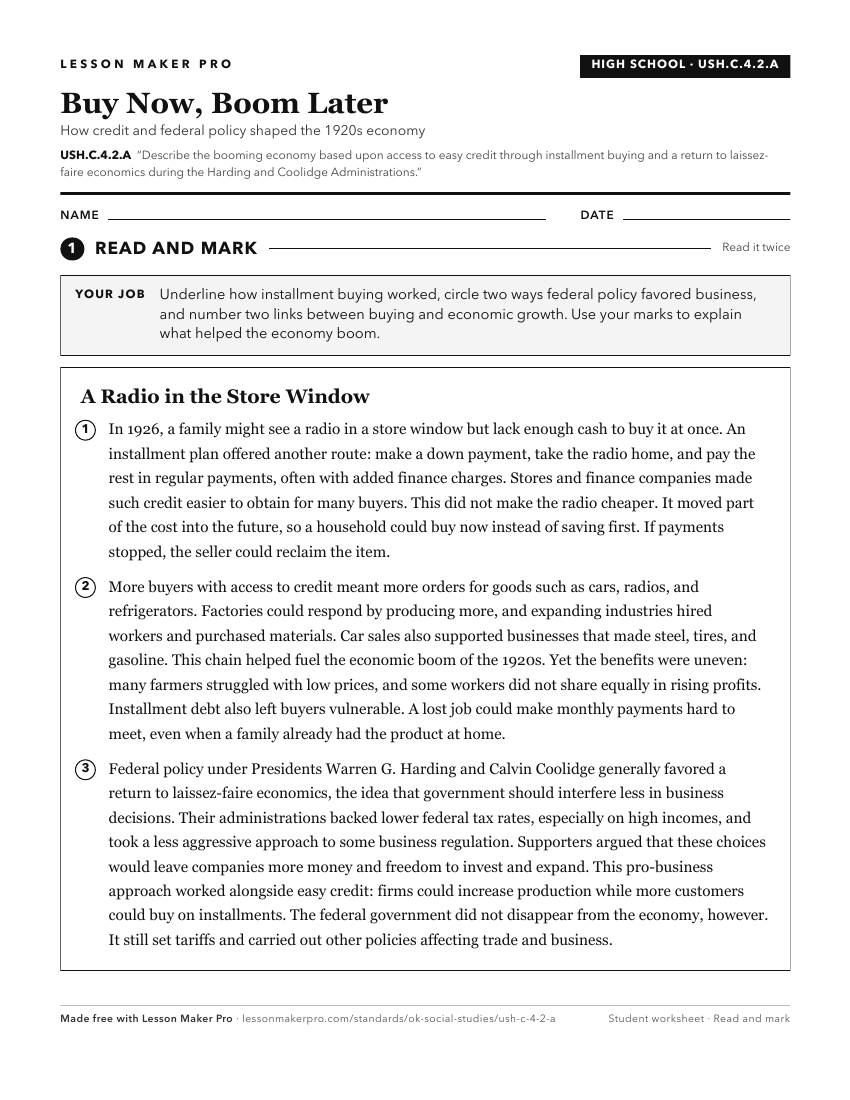
A ready-to-print activity worksheet aligned to USH.C.4.2.A, with an answer key for the teacher on its own page. No account needed.
PDF, US Letter, prints cleanly in black and white.
Download the worksheetKeep exploring
Related Standards
- USH.C.4.2.D
Examine the role of monetary policy and the expansion of credit in the 1920’s including the creation and actions of the Federal Reserve System and their relatio...
- USH.C.4.1.B
Describe the transition from wartime to peace under the Harding Administration, including the demobilization of drafted soldiers, federal budget cuts, and amnes...
- USH.C.4.2.H
Analyze how President Herbert Hoover’s philosophy of “rugged individualism,” public works projects, and restrictive monetary policies attempted to address massi...
- USH.C.4.2.C
Identify causes contributing to an unstable economy including the overproduction of agriculture products, greater speculation in the stock market and buying on ...
Turn this exact standard into a lesson
Grade, subject, topic, and the complete standard are prefilled. Create one free, no account needed.
Also for this standard:Make a WorksheetMake a QuizMake a Sub Lesson