Oklahoma Social Studies USH.C.4.2.D
The Standard
- USH.C.4
- Analyze the cycles of economic boom and bust of the 1920s and 1930s on the transformation of the United States of America’s government and society.
- USH.C.4.2
- Analyze the prosperity of the Roaring Twenties and the collapse of the United States of America’s economy, leading to the Great Depression.
Examine the role of monetary policy and the expansion of credit in the 1920’s including the creation and actions of the Federal Reserve System and their relationship to speculation, investment, and economic instability.
Oklahoma Academic Standards for Social Studies (2026) · USH.C.4.2
Teacher's field guide
What This Standard Means
What Students Need to Do
- Explain why the Federal Reserve was created in 1913 and how its rate decisions affected borrowing in the 1920s. Trace how borrowed money could fund businesses or stock purchases, and why heavy debt made a downturn more dangerous.
What Mastery Looks Like
- A student can place the Fed’s creation before the 1920s, then identify its 1927 rate cut and later rate increases. They can explain how buying stocks with borrowed money raised both possible gains and possible losses.
Common Misconceptions
- Students may think the Fed was created after the 1929 crash. They may also treat every loan as stock speculation, or assume easy credit alone caused the crash.
How to Assess It
- Give students this prompt: “Why was the Fed created, and how could its rate decisions and stock loans make the 1920s economy less stable?” Ask for three linked sentences.
Lesson moves
Ways to Teach It
Give pairs $20 in paper cash and an $80 paper loan to buy a $100 stock; lower its price to $80 and calculate what remains.
Ask students to write: “How might cheaper loans help a factory but also encourage risky stock purchases?”
Have teams sort cards labeled 1913 Fed creation, 1927 rate cut, 1928 rate increases, and 1929 crash into order, then explain two links.
Compare a car installment loan with a 1920s stock margin loan on a two-column sheet; record what borrowers owe if the asset loses value.
Free download
Printable USH.C.4.2.D Worksheet
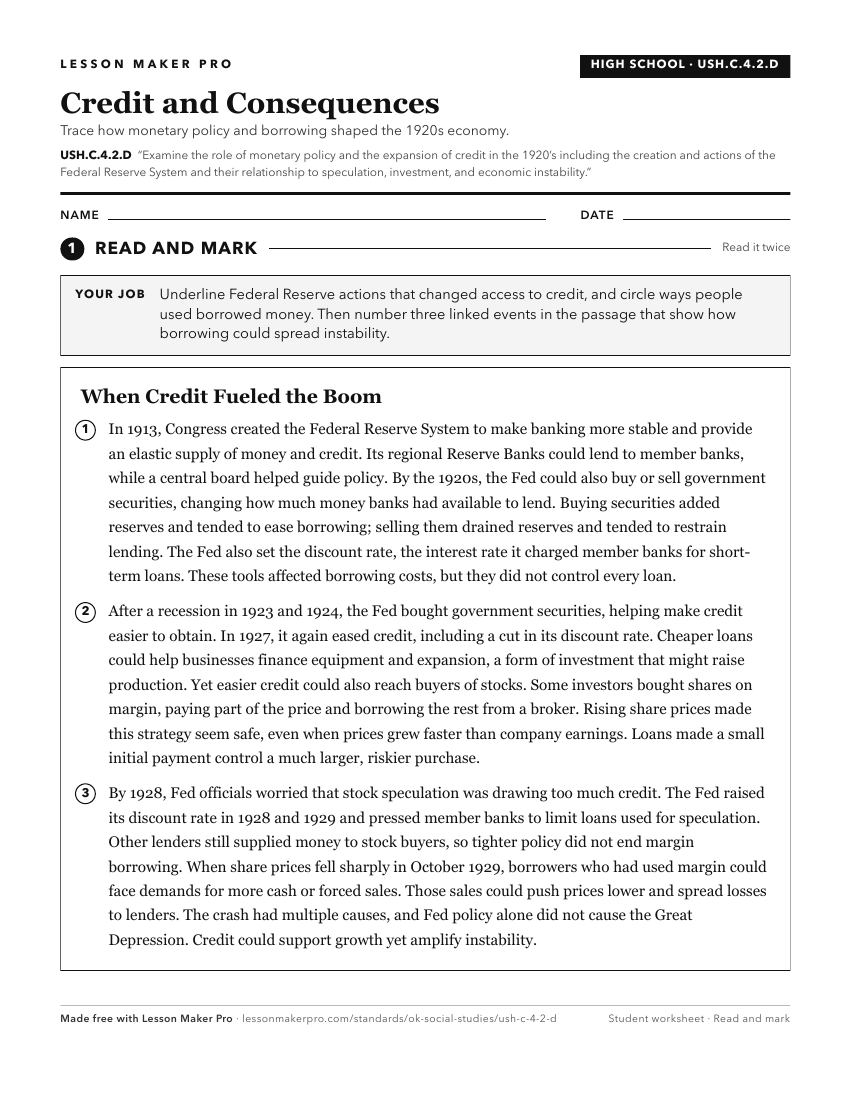
A ready-to-print activity worksheet aligned to USH.C.4.2.D, with an answer key for the teacher on its own page. No account needed.
PDF, US Letter, prints cleanly in black and white.
Download the worksheetKeep exploring
Related Standards
- USG.C.7.1.D
Examine how the government can influence the stability and growth of the economy through fiscal and monetary policy.
- E.C.5
Examine the origin, function, and evolution of money and monetary systems within modern economies, including trading, borrowing, investing, and the effects of m...
- E.C.10.5
Analyze how the Federal Reserve uses monetary policy tools (e.g., changes in the discount rate, reserve requirements, money supply) to influence economic condit...
- USH.C.4
Analyze the cycles of economic boom and bust of the 1920s and 1930s on the transformation of the United States of America’s government and society.
Turn this exact standard into a lesson
Grade, subject, topic, and the complete standard are prefilled. Create one free, no account needed.
Also for this standard:Make a WorksheetMake a QuizMake a Sub Lesson