Oklahoma Social Studies E.C.5
Standard Cluster
Examine the origin, function, and evolution of money and monetary systems within modern economies, including trading, borrowing, investing, and the effects of monetary expansion and contraction. Explain the emergence of money as a solution to the limitations of barter and describe its evolution from commodity money to modern monetary systems. Explain how individuals, businesses, and the overall economy benefits from the various uses of money (e.g., trading, borrowing, investing, and diversifying) versus saving money. Identify the characteristics (e.g., divisibility, durability, acceptability, scarcity, portability) and functions (e.g., store of value, unit of account, and medium of exchange) of money. Define inflation as a sustained increase in the general price level and explain its relationship to changes in the money supply, aggregate demand, and aggregate supply. Compare inflation, deflation,hyperinflation, and stagflation, and evaluate how each affects households, businesses, and governments. Determine how inflation is measured, including the impact it has on different sectors of the United States of America economy.
Oklahoma Academic Standards for Social Studies (2026)
Cluster contents
Standards in This Cluster
E.C.5 is a cluster heading. These are the individual standards under it.
- E.C.5.1
Explain the emergence of money as a solution to the limitations of barter and describe its evolution from commodity money to modern monetary systems.
- E.C.5.2
Explain how individuals, businesses, and the overall economy benefits from the various uses of money (e.g., trading, borrowing, investing, and diversifying) ver...
- E.C.5.3
Identify the characteristics (e.g., divisibility, durability, acceptability, scarcity, portability) and functions (e.g., store of value, unit of account, and me...
- E.C.5.4
Define inflation as a sustained increase in the general price level and explain its relationship to changes in the money supply, aggregate demand, and aggregate...
Teacher's field guide
What This Cluster Means
What Students Need to Do
- Explain why barter can stall and how money changed from commodities to cash and bank balances. Describe what makes money useful as payment, a price measure, and a way to store value. Compare saving with trading, borrowing, investing, and spreading investments across assets.
What Mastery Looks Like
- Calculate the price change for a fixed basket and distinguish inflation, deflation, hyperinflation, and stagflation. Explain how changes in the money supply, demand, or production affect prices, households, businesses, and governments. Explain when someone might save, borrow, invest, or spread risk across investments.
Common Misconceptions
- Students may think one price increase is inflation, or that slower inflation means prices are falling. They may assume money must be physical and that increasing the money supply always raises prices immediately. They often treat saving and investing as identical.
How to Assess It
- Exit ticket: A fixed basket rises from $50 to $55 while bank lending grows. Calculate the inflation rate, name another possible cause, and explain one effect on a saver.
Lesson moves
Ways to Teach It
Hand out goods cards for a two-minute barter round, then repeat with paper money tokens and tally completed trades.
Compare a bank lending slowdown with a crop failure: Which changes spending, which changes production, and what might happen to prices?
Play four-corner scenario sort with falling prices, rapid price jumps, rising prices with high unemployment, and steady price rises.
Use two months of BLS food and shelter price data to calculate each percent change, then discuss effects on renters and restaurants.
Free download
Printable E.C.5 Worksheet
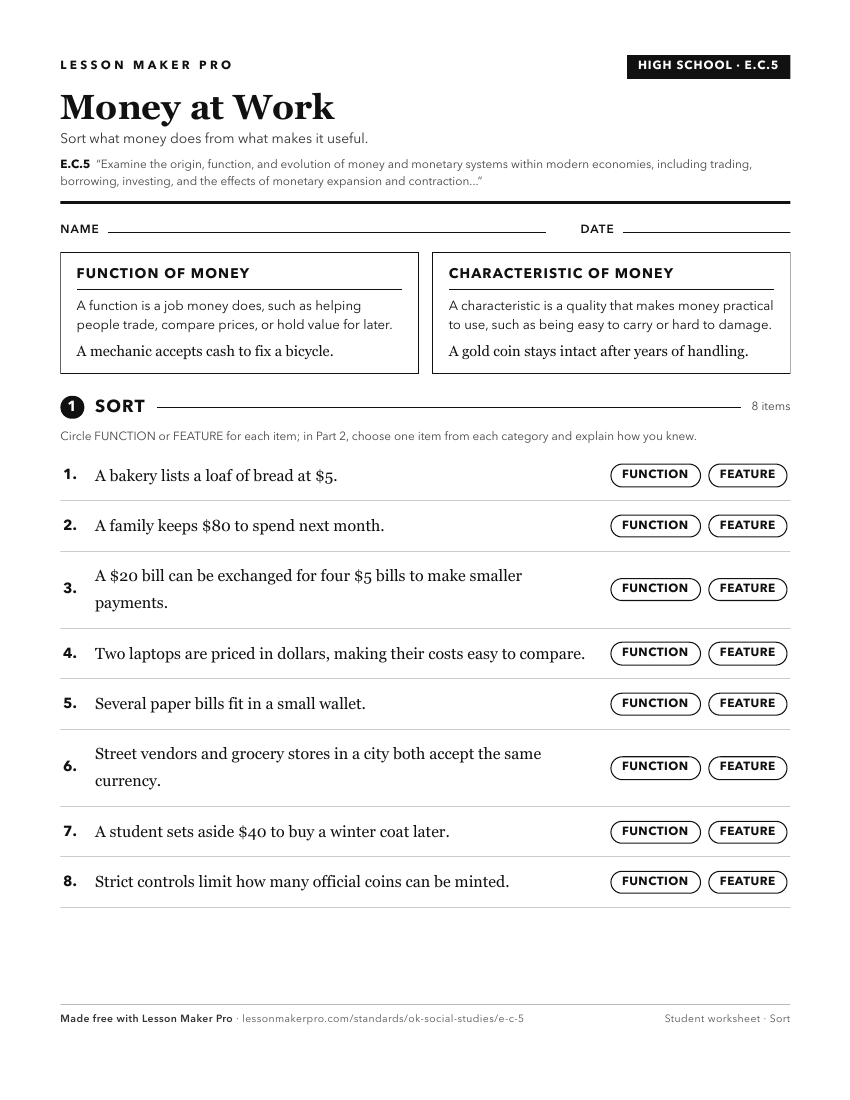
A ready-to-print activity worksheet aligned to E.C.5, with an answer key for the teacher on its own page. No account needed.
PDF, US Letter, prints cleanly in black and white.
Download the worksheetKeep exploring
Related Standards
- USH.C.4.2.D
Examine the role of monetary policy and the expansion of credit in the 1920’s including the creation and actions of the Federal Reserve System and their relatio...
- USG.C.7.1.D
Examine how the government can influence the stability and growth of the economy through fiscal and monetary policy.
Turn this cluster into a lesson
Grade, subject, topic, and the complete cluster are prefilled. Create one free, no account needed.
Also for this cluster:Make a WorksheetMake a QuizMake a Sub Lesson