Oklahoma Social Studies E.C.5.4
The Standard
- E.C.5
- Examine the origin, function, and evolution of money and monetary systems within modern economies, including trading, borrowing, investing, and the effects of monetary expansion and contraction.
Define inflation as a sustained increase in the general price level and explain its relationship to changes in the money supply, aggregate demand, and aggregate supply. Compare inflation, deflation,hyperinflation, and stagflation, and evaluate how each affects households, businesses, and governments. Determine how inflation is measured, including the impact it has on different sectors of the United States of America economy.
Oklahoma Academic Standards for Social Studies (2026) · E.C.5
Teacher's field guide
What This Standard Means
What Students Need to Do
- Students spot a lasting rise in overall prices, not just a price jump for one item. They explain how the money supply, total spending, and available goods affect prices. They compare falling prices, runaway price rises, and rising prices with weak output, then describe effects on households, businesses, and governments.
What Mastery Looks Like
- A student calculates the percent change in a fixed basket of goods and explains how a price index measures inflation. They connect higher demand or lower supply to rising prices without assuming every price changes equally. They explain effects on buying power, business costs, and government budgets.
Common Misconceptions
- Students may call a jump in gas prices inflation even when most prices stay steady. They may think adding money always raises prices right away. They may confuse deflation with slower inflation, or stagflation with an ordinary recession.
How to Assess It
- Exit ticket: A fixed basket costs $100 last year and $108 this year, while output falls and unemployment rises. Calculate the inflation rate, name the price pattern, and give one effect on a household and one business.
Lesson moves
Ways to Teach It
Give groups price tags for the same five groceries in two years; have them build a fixed basket and calculate its price change.
Ask students to write who loses buying power when prices rise 8 percent but wages rise 3 percent, and why.
Sort scenario cards into inflation, deflation, hyperinflation, and stagflation; have students underline the price and output clues on each card.
Use a recent Consumer Price Index release to compare rent and food prices; ask why families with different spending baskets feel inflation differently.
Free download
Printable E.C.5.4 Worksheet
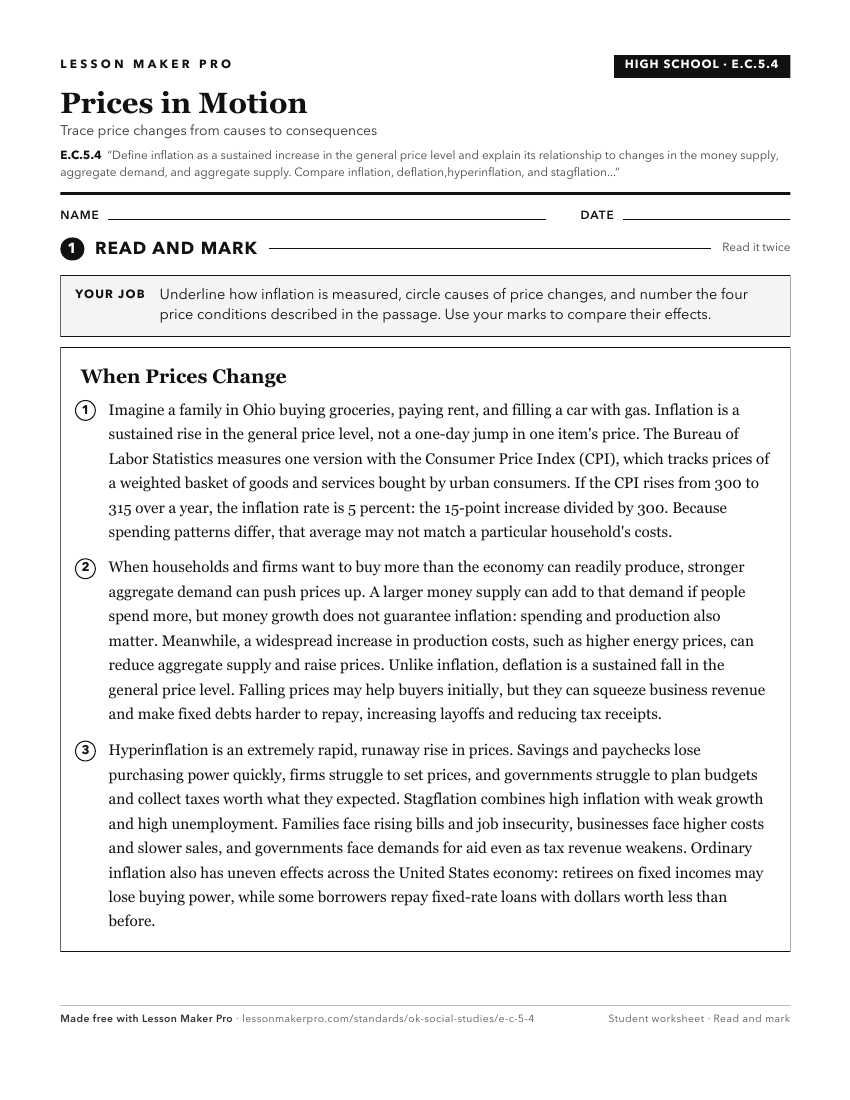
A ready-to-print activity worksheet aligned to E.C.5.4, with an answer key for the teacher on its own page. No account needed.
PDF, US Letter, prints cleanly in black and white.
Download the worksheetKeep exploring
Related Standards
- E.C.8.4
Describe the causes and different types of unemployment, how unemployment is measured, and the impact of unemployment on different sectors of the United States ...
- E.C.8
Examine the impact of the global economy on domestic conditions within the United States of America’s economy.
- E.C.8.1
Describe how current economic conditions can be affected by many factors (e.g., unemployment, Consumer Price Index (CPI), individual savings and debt, governmen...
- E.C.3.2
Explain what causes shortages and surpluses (e.g., government-imposed price floors, price ceilings, and other government regulations) and describe their impact ...
Turn this exact standard into a lesson
Grade, subject, topic, and the complete standard are prefilled. Create one free, no account needed.
Also for this standard:Make a WorksheetMake a QuizMake a Sub Lesson