Oklahoma Social Studies USH.C.2.1
Standard Cluster
- USH.C.2
- Analyze the social, economic, and political changes that occurred during the American Industrial Revolution, the Gilded Age, and reform movements.
Evaluate the transformation of American society, economy, politics, and culture during the American Industrial Revolution. Explain how the United States was transformed from an agrarian to an increasingly industrial, urbanized society and how this transformation created both new economic opportunities, as well as societal problems. Describe the changing role of the American farmer, including the establishment of the Granger movement. Analyze the impact of capitalism and laissez-faire policy on business practices, such as monopolies, the characterization of “robber barons” and the role of industrialists in economic growth, as well as philanthropy (e.g., Cornelius Vanderbilt, J.P. Morgan, John D. Rockefeller, and Andrew Carnegie, including his Gospel of Wealth essay on society). Identify the impact of new inventions and industrial production methods on the growth of the American economy and standard of living (e.g., technologies developed by Thomas Edison, Alexander G. Bell, Henry Ford, and the Bessemer Process). Examine the complex conditions that characterized the Gilded Age (e.g., rapidly expanding economy, concentration of wealth, corrupt politics, poverty). Evaluate the role of muckrakers and social reformers (e.g., Jane Addams, Ida Tarbell, Jacob Riis, Upton Sinclair) on increased awareness of business practices and societal concerns, including child labor, working conditions, and the regulation of big business. Assess the significance of the Labor Movement, including the leadership of Samuel Gompers and Eugene V. Debs, by comparing its early goals (e.g., formation of trade unions,favorable legislation) to repercussions following the Pullman Strike and the Haymarket Affair .
Oklahoma Academic Standards for Social Studies (2026) · USH.C.2
Cluster contents
Standards in This Cluster
USH.C.2.1 is a cluster heading. These are the individual standards under it.
- USH.C.2.1.A
Explain how the United States was transformed from an agrarian to an increasingly industrial, urbanized society and how this transformation created both new eco...
- USH.C.2.1.B
Describe the changing role of the American farmer, including the establishment of the Granger movement.
- USH.C.2.1.C
Analyze the impact of capitalism and laissez-faire policy on business practices, such as monopolies, the characterization of “robber barons” and the role of ind...
- USH.C.2.1.D
Identify the impact of new inventions and industrial production methods on the growth of the American economy and standard of living (e.g., technologies develop...
- USH.C.2.1.E
Examine the complex conditions that characterized the Gilded Age (e.g., rapidly expanding economy, concentration of wealth, corrupt politics, poverty).
- USH.C.2.1.F
Evaluate the role of muckrakers and social reformers (e.g., Jane Addams, Ida Tarbell, Jacob Riis, Upton Sinclair) on increased awareness of business practices a...
- USH.C.2.1.G
Assess the significance of the Labor Movement, including the leadership of Samuel Gompers and Eugene V. Debs, by comparing its early goals (e.g., formation of t...
Teacher's field guide
What This Cluster Means
What Students Need to Do
- Students explain how inventions and factories shifted work from farms to cities and changed daily life. They weigh new jobs and wealth against monopoly power, corrupt politics, poverty, and unsafe work. They explain why farmers formed the Grange and how reporters, reformers, and unions pushed for change.
What Mastery Looks Like
- A student links the Bessemer process and Ford's assembly line to cheaper goods and changing jobs. They use a Grange complaint and Carnegie's essay to explain who gained wealth and who faced costs. They explain what Gompers and Debs sought for workers and why Haymarket and Pullman brought backlash.
Common Misconceptions
- Students may think most farmers became factory workers overnight or that the Grange organized factory workers. They may label every industrialist either a hero or a thief, missing both business growth and monopoly abuses. They may assume strikes always succeeded or that muckrakers passed laws themselves.
How to Assess It
- Show a Jacob Riis tenement photograph and a short description of the Bessemer process. Ask students to name one economic gain, one social cost, and one response to that cost, using a detail from each source.
Lesson moves
Ways to Teach It
Give pairs 10 counters for a wheat sale, collect 3 for rail freight, then have them draft a Grange complaint.
Read a paragraph each from Carnegie's Gospel of Wealth and Tarbell on Standard Oil, then write which claim each source supports.
Match Bessemer steel, Bell's telephone, Edison's electric light, and Ford's assembly line to specific changes in work or daily life.
Bring a warehouse job posting with pay and hours, then compare it to a Pullman Strike account and name one worker demand.
Free download
Printable USH.C.2.1 Worksheet
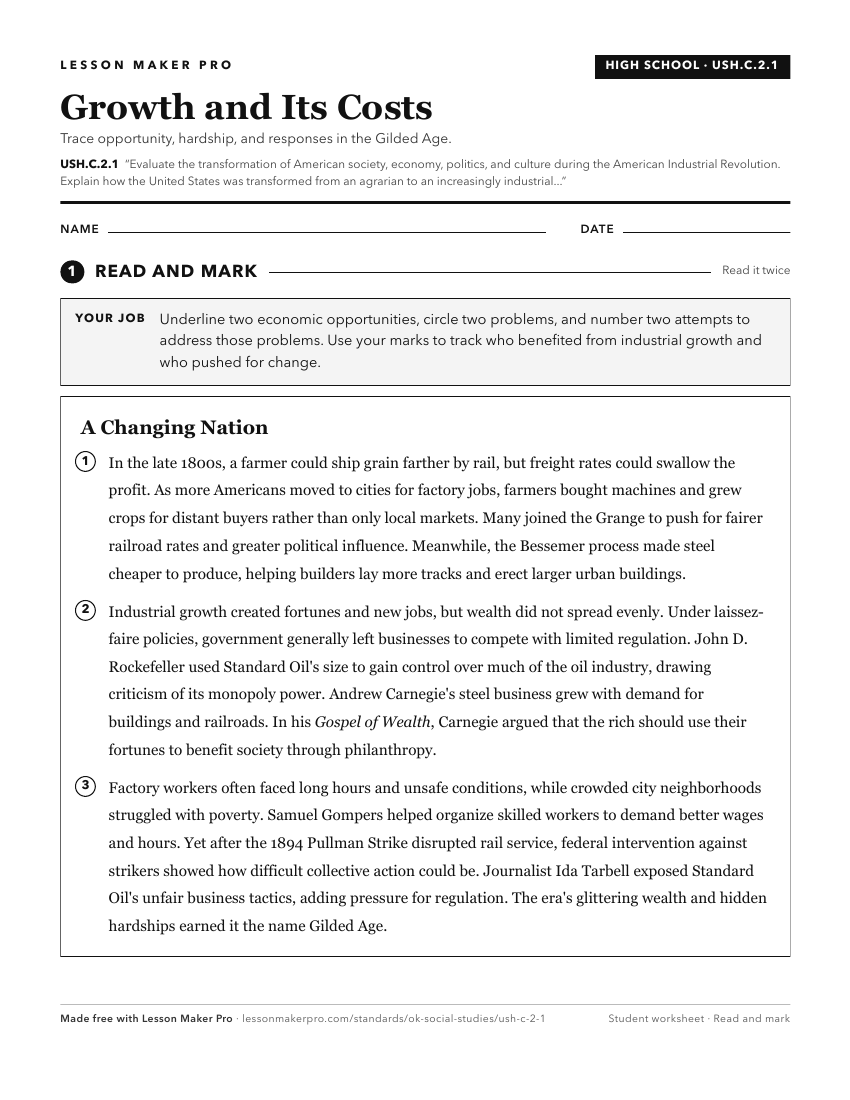
A ready-to-print activity worksheet aligned to USH.C.2.1, with an answer key for the teacher on its own page. No account needed.
PDF, US Letter, prints cleanly in black and white.
Download the worksheetKeep exploring
Related Standards
- USH.C.2
Analyze the social, economic, and political changes that occurred during the American Industrial Revolution, the Gilded Age, and reform movements.
- MWH.C.5
Analyze the massive social, economic, and cultural change brought about by the Industrial Revolution.
- MWH.C.5.2
Analyze responses to and the legacy of the Industrial Revolution.
- 8.C.10.1
Explain the impact of the Industrial Revolution on American culture and its economy.
Turn this cluster into a lesson
Grade, subject, topic, and the complete cluster are prefilled. Create one free, no account needed.
Also for this cluster:Make a WorksheetMake a QuizMake a Sub Lesson