Oklahoma Social Studies MWH.C.5.2
Standard Cluster
- MWH.C.5
- Analyze the massive social, economic, and cultural change brought about by the Industrial Revolution.
Analyze responses to and the legacy of the Industrial Revolution. Examine how the abolition of slavery within the British Empire was influenced by Christian humanitarianism and examine the role of various antislavery societies, including the work of William Wilberforce. Explain the rise of trade unionism and the birth of the Labor Party, including the effects of various social and political reforms, such as Liberalism (John Stuart Mill) and modern conservatism (school of Edmund Burke). Examine the concept of economic interventionism (e.g., economic protectionism, child labor laws, legislation for old age pensions, health insurance). Describe the rise of socialism, including the ideas and influence of Robert Owen and Karl Marx, as well as the major ideas of Marx and Engels' The Communist Manifesto. Describe the European intellectual revolution and the ideal of academic freedom, including leading figures (e.g., Marie Curie, Charles Darwin, Gregor Mendel).
Oklahoma Academic Standards for Social Studies (2026) · MWH.C.5
Cluster contents
Standards in This Cluster
MWH.C.5.2 is a cluster heading. These are the individual standards under it.
- MWH.C.5.2.A
Examine how the abolition of slavery within the British Empire was influenced by Christian humanitarianism and examine the role of various antislavery societies...
- MWH.C.5.2.B
Explain the rise of trade unionism and the birth of the Labor Party, including the effects of various social and political reforms, such as Liberalism (John Stu...
- MWH.C.5.2.C
Examine the concept of economic interventionism (e.g., economic protectionism, child labor laws, legislation for old age pensions, health insurance).
- MWH.C.5.2.D
Describe the rise of socialism, including the ideas and influence of Robert Owen and Karl Marx, as well as the major ideas of Marx and Engels’ The Communist Man...
- MWH.C.5.2.E
Describe the European intellectual revolution and the ideal of academic freedom, including leading figures (e.g., Marie Curie, Charles Darwin, Gregor Mendel).
Teacher's field guide
What This Cluster Means
What Students Need to Do
- Students explain how people worked to end slavery in the British Empire. They trace how unions, the Labour Party, reform laws, and political ideas responded to industrial problems. They describe scientific discoveries and explain why freedom to investigate mattered.
What Mastery Looks Like
- Students explain how Wilberforce, Christian antislavery groups, and enslaved people contributed to abolition. They connect union demands to reforms and distinguish the ideas of Mill, Burke, Owen, and Marx and Engels. They match Darwin, Mendel, and Curie to natural selection, inheritance, and radioactivity.
Common Misconceptions
- Students may confuse Britain's 1807 ban on the slave trade with its 1833 abolition law, or credit Wilberforce alone. They may treat Owen's cooperative communities and Marx and Engels' call for class struggle as the same plan. They may mix up Darwin's, Mendel's, and Curie's findings.
How to Assess It
- Exit ticket: Explain one way campaigners helped end slavery in the British Empire and one way workers sought change after industrialization. Name a finding by Darwin, Mendel, or Curie, and explain why freedom to investigate mattered.
Lesson moves
Ways to Teach It
Give pairs factory pay slips, a child labor schedule, and reform cards; have them match each hardship to a law or union demand.
Ask students: How did Wilberforce's Christian arguments and antislavery societies build support for abolition, and whose actions might that account leave out?
Post Mill, Burke, Owen, and Marx signs; call out 'individual liberty,' 'tradition,' 'cooperative mills,' or 'class struggle' for students to match.
Show a current child labor law; ask students to connect one provision to a factory hardship and a nineteenth-century reform proposal.
Free download
Printable MWH.C.5.2 Worksheet
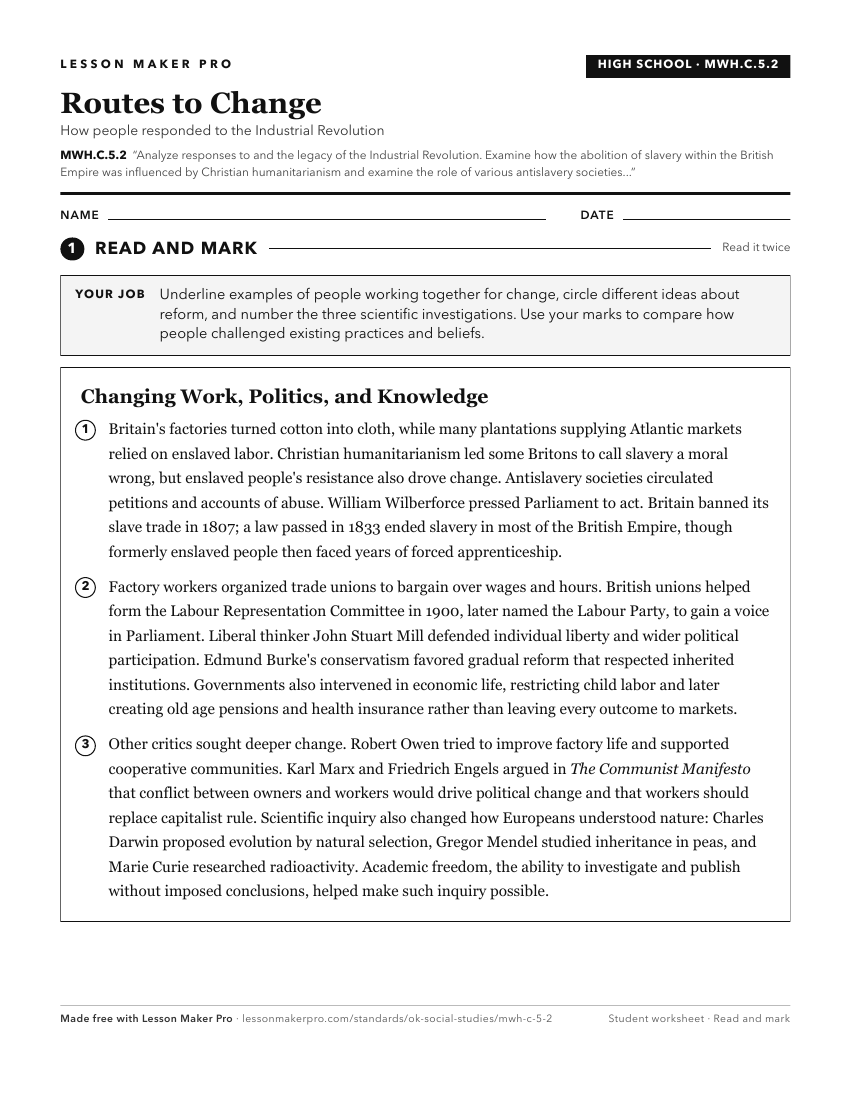
A ready-to-print activity worksheet aligned to MWH.C.5.2, with an answer key for the teacher on its own page. No account needed.
PDF, US Letter, prints cleanly in black and white.
Download the worksheetKeep exploring
Related Standards
- MWH.C.5.1
Examine the causes and characteristics of the Industrial Revolution.
- USH.C.2.1
Evaluate the transformation of American society, economy, politics, and culture during the American Industrial Revolution.
- MWH.C.5
Analyze the massive social, economic, and cultural change brought about by the Industrial Revolution.
- WG.C.6
Analyze the impact of industrialization on economic development.
Turn this cluster into a lesson
Grade, subject, topic, and the complete cluster are prefilled. Create one free, no account needed.
Also for this cluster:Make a WorksheetMake a QuizMake a Sub Lesson