Oklahoma Social Studies WG.C.6
Standard Cluster
Analyze the impact of industrialization on economic development. Examine the significance of access to natural resources, energy, and technological innovations (e.g., wind, solar, nuclear) to the economic development of a region. Compare the impact of government policies in both market and command economic systems on the availability and use of natural resources and development. Compare contemporary patterns of industrialization and development in selected regions of the world. Describe common characteristics of developed nations and compare variations in levels of development. Explain how changes in the physical environment and political environment influence changes in economic activity within a region.
Oklahoma Academic Standards for Social Studies (2026)
Cluster contents
Standards in This Cluster
WG.C.6 is a cluster heading. These are the individual standards under it.
- WG.C.6.1
Examine the significance of access to natural resources, energy, and technological innovations (e.g., wind, solar, nuclear) to the economic development of a reg...
- WG.C.6.2
Compare the impact of government policies in both market and command economic systems on the availability and use of natural resources and development.
- WG.C.6.3
Compare contemporary patterns of industrialization and development in selected regions of the world.
- WG.C.6.4
Describe common characteristics of developed nations and compare variations in levels of development.
- WG.C.6.5
Explain how changes in the physical environment and political environment influence changes in economic activity within a region.
Teacher's field guide
What This Cluster Means
What Students Need to Do
- Students compare how factories, resources, energy, and new technology affect jobs and growth in different regions. They explain how floods, political changes, and government rules can change economic activity. They compare market and command decisions about resources, then use income, health, and infrastructure data to judge development.
What Mastery Looks Like
- Given maps and data for Germany, China, and Nigeria, students explain why industry grows faster in some places than others. They predict how flooding or a new energy rule could change jobs. They compare market incentives with command quotas and use health and income data to show differences among wealthy countries.
Common Misconceptions
- Students may assume natural resources guarantee wealth, even where electricity and roads are unreliable. They may treat all wealthy countries as alike or assume factories alone prove high living standards. They may think market economies have no government rules.
How to Assess It
- Exit ticket: A region has iron ore but unreliable electricity. Explain why steel factories might stay away, then name one government action that could change that.
Lesson moves
Ways to Teach It
Give groups resource, power-grid, and road maps of Nigeria; have them place three factory cards and explain each site.
Ask: Would a solar plant create more factory jobs in a region with good roads or poor roads? Write two reasons.
Match cards showing U.S. renewable-energy tax credits and Soviet steel quotas to likely resource-use outcomes, then explain each match.
Use a local floodplain map and city zoning map to choose a factory site and predict how a zoning change would affect jobs.
Free download
Printable WG.C.6 Worksheet
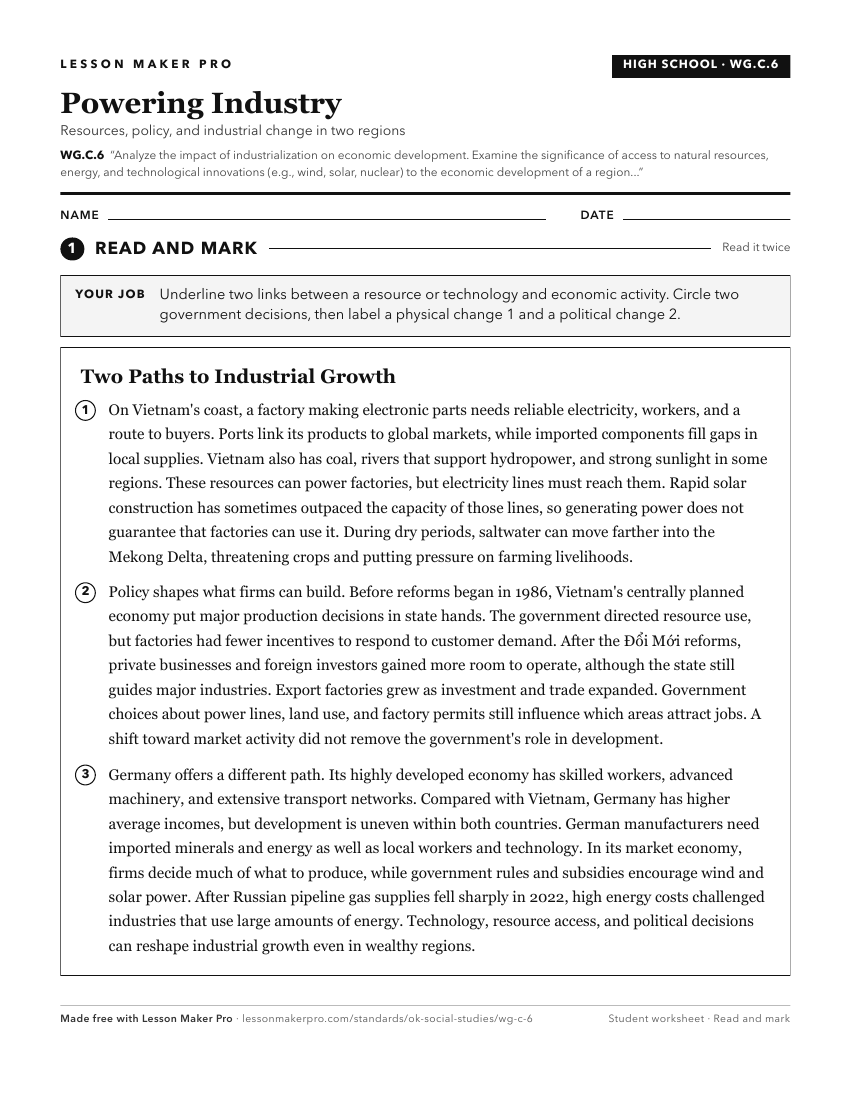
A ready-to-print activity worksheet aligned to WG.C.6, with an answer key for the teacher on its own page. No account needed.
PDF, US Letter, prints cleanly in black and white.
Download the worksheetKeep exploring
Related Standards
- MWH.C.5.3
Evaluate the impact of industrialization on global imperialism.
- MWH.C.5
Analyze the massive social, economic, and cultural change brought about by the Industrial Revolution.
- MWH.C.5.2
Analyze responses to and the legacy of the Industrial Revolution.
- OKH.C.3.2
Evaluate the lasting effect of early industries on economic growth.
Turn this cluster into a lesson
Grade, subject, topic, and the complete cluster are prefilled. Create one free, no account needed.
Also for this cluster:Make a WorksheetMake a QuizMake a Sub Lesson