Oklahoma Social Studies MWH.C.5.3
Standard Cluster
- MWH.C.5
- Analyze the massive social, economic, and cultural change brought about by the Industrial Revolution.
Evaluate the impact of industrialization on global imperialism. Explain the economic, political, and social justifications supporting imperialist ideology and colonialism ‘ (e.g., Social Darwinism, economic gain and resources, Christian missions, strategic advantage, and Nationalism). Describe the consequences of imperialism in Asia, Africa, and the Americas, i ncluding settler colonies, exploitation of natural resources, and reshaping of colonial economies, resistance movements, and cultural exchange. Describe the outcomes of the Berlin Conference and the impact of superimposed boundaries on Africa’s Indigenous populations. Assess the political, economic, and cultural impact of the British Raj, Britain’s subordination of India, as characterized by economic, educational, and infrastructure investments, at the costs of exploitation and self-rule. Describe major developments contributing to the decline of the Qing dynasty, including Western influence, internal unrest, and the Boxer Rebellion.
Oklahoma Academic Standards for Social Studies (2026) · MWH.C.5
Cluster contents
Standards in This Cluster
MWH.C.5.3 is a cluster heading. These are the individual standards under it.
- MWH.C.5.3.A
Explain the economic, political, and social justifications supporting imperialist ideology and colonialism (e.g., Social Darwinism, economic gain and resources,...
- MWH.C.5.3.B
Describe the consequences of imperialism in Asia, Africa, and the Americas, i ncluding settler colonies, exploitation of natural resources, and reshaping of col...
- MWH.C.5.3.C
Describe the outcomes of the Berlin Conference and the impact of superimposed boundaries on Africa’s Indigenous populations.
- MWH.C.5.3.D
Assess the political, economic, and cultural impact of the British Raj, Britain’s subordination of India, as characterized by economic, educational, and infrast...
- MWH.C.5.3.E
Describe major developments contributing to the decline of the Qing dynasty, including Western influence, internal unrest, and the Boxer Rebellion.
Teacher's field guide
What This Cluster Means
What Students Need to Do
- Students explain why industrial nations sought raw materials, markets, and ports. They identify claims used to defend empire, including nationalism, Christian missions, and Social Darwinism. They compare colonial rule, resistance, and cultural change in Africa, Asia, and the Americas.
What Mastery Looks Like
- Students explain how the Berlin Conference sped up Africa's partition and how new borders divided communities. They weigh railways and schools under British rule in India against resource extraction and lost self-rule. They connect Western pressure, internal unrest, and the Boxer Rebellion to Qing decline.
Common Misconceptions
- Students may think African leaders agreed to the borders Europeans imposed. They may assume British-built railways mainly served Indians, or that China became a British colony. They may treat Social Darwinism as a fact rather than a claim used to justify control.
How to Assess It
- Exit ticket: Why might a factory owner support empire, and how could that empire harm people it ruled? Use India or Africa as your example.
Lesson moves
Ways to Teach It
Give pairs a 1914 Africa map and a map of African language groups; have them trace a border that splits a group.
Ask students to write four sentences on whether British-built railways in India mainly helped Indians or served British trade.
Give teams cards labeled factories, rubber, nationalism, missions, borders, and resistance; have them build and explain two cause-and-effect chains.
Place today's African borders beside a 1914 colonial map; students mark two matching lines and discuss who chose them.
Free download
Printable MWH.C.5.3 Worksheet
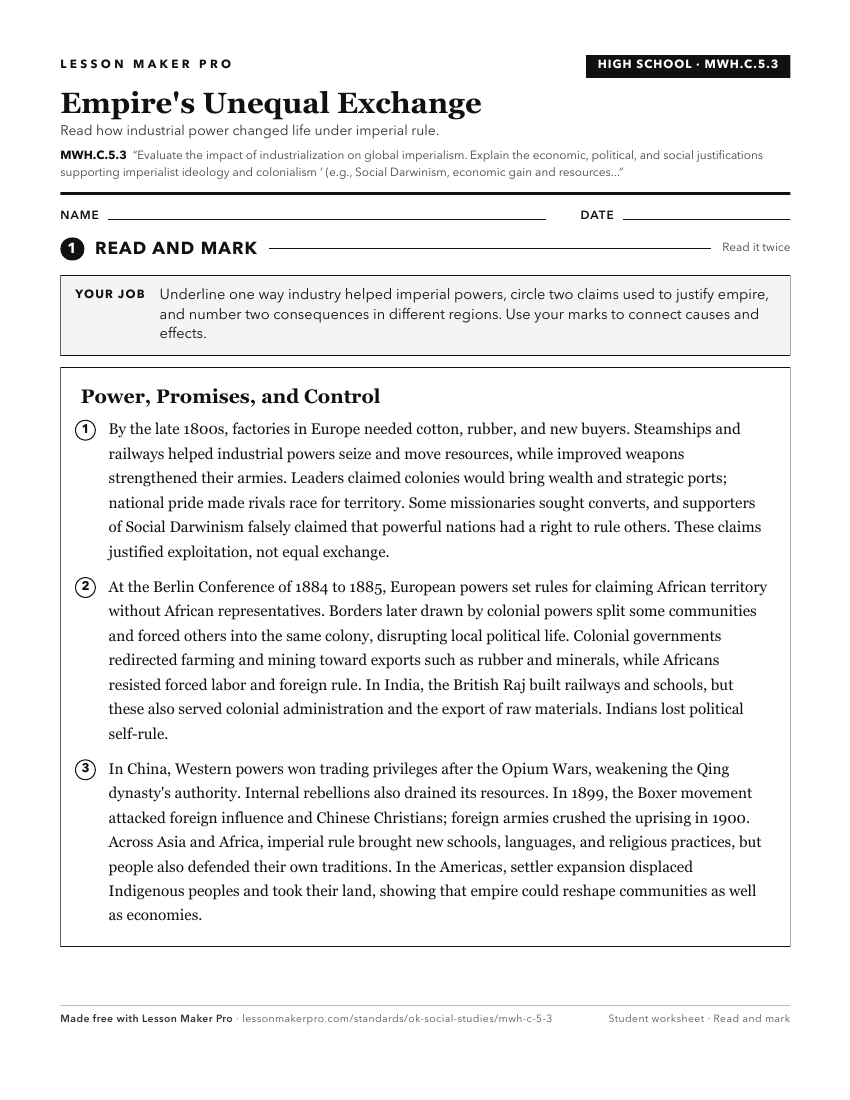
A ready-to-print activity worksheet aligned to MWH.C.5.3, with an answer key for the teacher on its own page. No account needed.
PDF, US Letter, prints cleanly in black and white.
Download the worksheetKeep exploring
Related Standards
- 7.C.4.3
Evaluate the effects of human modification of the natural environment through processes related to industrialization.
- MWH.C.5.2
Analyze responses to and the legacy of the Industrial Revolution.
- USH.C.3.1
Evaluate the impact of Imperialism on international relations and its effect on developing nations.
- WG.C.6
Analyze the impact of industrialization on economic development.
Turn this cluster into a lesson
Grade, subject, topic, and the complete cluster are prefilled. Create one free, no account needed.
Also for this cluster:Make a WorksheetMake a QuizMake a Sub Lesson