Oklahoma Social Studies MWH.C.5.3.A
The Standard
- MWH.C.5
- Analyze the massive social, economic, and cultural change brought about by the Industrial Revolution.
- MWH.C.5.3
- Evaluate the impact of industrialization on global imperialism.
Explain the economic, political, and social justifications supporting imperialist ideology and colonialism ‘ (e.g., Social Darwinism, economic gain and resources, Christian missions, strategic advantage, and Nationalism).
Oklahoma Academic Standards for Social Studies (2026) · MWH.C.5.3
Teacher's field guide
What This Standard Means
What Students Need to Do
- Students identify the arguments imperial powers used to defend colonial rule. They sort claims about trade, military power, religion, nationalism, and Social Darwinism into economic, political, and social reasons. They use period sources to explain what each claim was meant to justify.
What Mastery Looks Like
- Given an imperial-era speech, students can point to specific claims about markets, naval bases, missions, national pride, or Social Darwinism. They can explain whose interests each claim served without treating the claim as fact.
Common Misconceptions
- Students may treat Social Darwinism as sound science or assume colonized people welcomed missionaries. They may label every reason economic and miss the role of naval power and national rivalry.
How to Assess It
- Exit ticket: Read, “We need overseas ports for our navy, markets for our goods, and schools to spread Christianity.” Label each reason political, economic, or social.
Lesson moves
Ways to Teach It
Give groups cards labeled “rubber profits,” “naval port,” “mission school,” “national prestige,” and “Social Darwinism” to sort into economic, political, or social claims.
Read a short excerpt from Dadabhai Naoroji on India's economic drain, then write a reply to Britain's claim that empire benefited India.
Call out “more markets,” “naval base,” “spread Christianity,” and “stronger nation”; students hold up economic, political, or social cards.
Compare a 1914 colonial map of Africa with a current map, and circle two present-day borders that match former colonial boundaries.
Free download
Printable MWH.C.5.3.A Worksheet
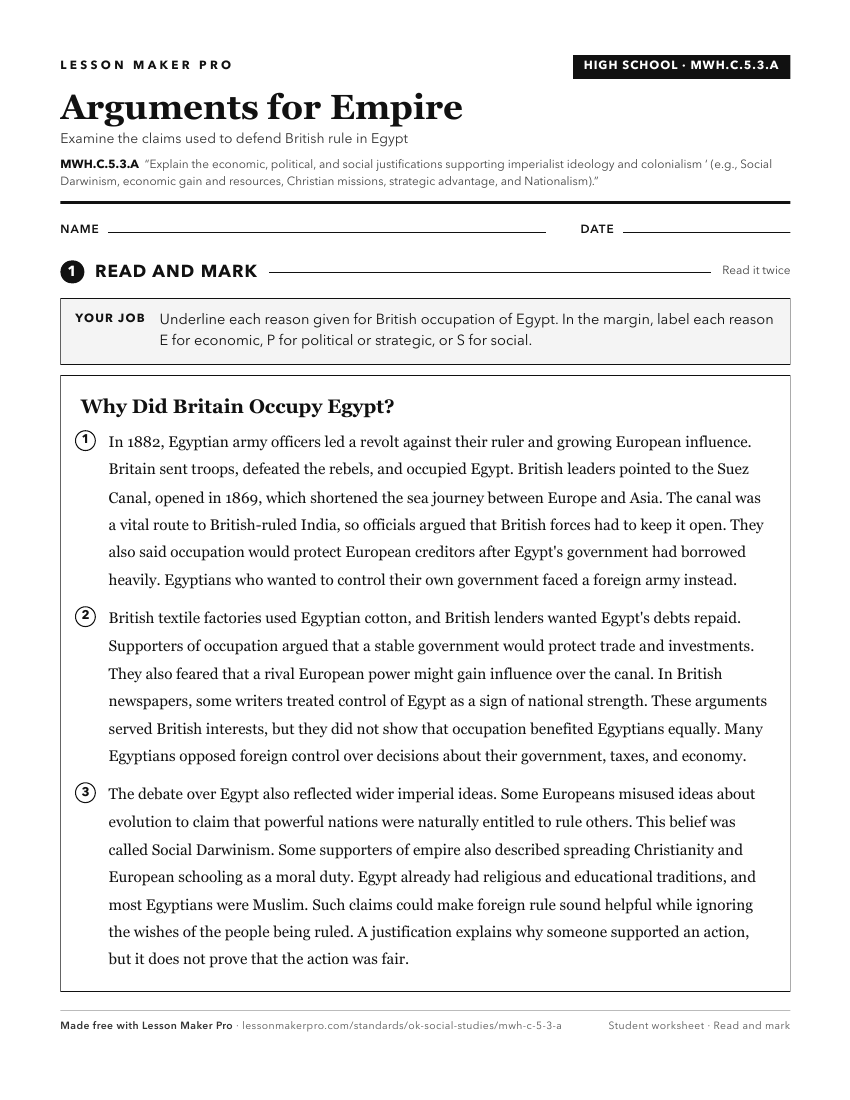
A ready-to-print activity worksheet aligned to MWH.C.5.3.A, with an answer key for the teacher on its own page. No account needed.
PDF, US Letter, prints cleanly in black and white.
Download the worksheetKeep exploring
Related Standards
- MWH.C.5.3.B
Describe the consequences of imperialism in Asia, Africa, and the Americas, i ncluding settler colonies, exploitation of natural resources, and reshaping of col...
- USH.C.3.1.B
Compare the economic, religious, social, and political rationales for American imperialism, comparing the concept of Social Darwinism to arguments made by Anti-...
- 5.C.1.2
Summarize the economic, political, and cultural reasons for European colonization of North America, including competition over the continent’s land and natural ...
- USH.C.3.1
Evaluate the impact of Imperialism on international relations and its effect on developing nations.
Turn this exact standard into a lesson
Grade, subject, topic, and the complete standard are prefilled. Create one free, no account needed.
Also for this standard:Make a WorksheetMake a QuizMake a Sub Lesson