Oklahoma Social Studies USH.C.3.1.B
The Standard
- USH.C.3
- Analyze the expanding role of the United States of America in international affairs as the United States of America was transformed into a world power in the late 19th and early 20th centuries.
- USH.C.3.1
- Evaluate the impact of Imperialism on international relations and its effect on developing nations.
Compare the economic, religious, social, and political rationales for American imperialism, comparing the concept of Social Darwinism to arguments made by Anti-Imperialists and colonial responses.
Oklahoma Academic Standards for Social Studies (2026) · USH.C.3.1
Teacher's field guide
What This Standard Means
What Students Need to Do
- Students sort reasons for U.S. expansion into economic, religious, social, and political motives. They compare Social Darwinist claims with anti-imperialist arguments and responses from people the U.S. sought to rule.
What Mastery Looks Like
- A student can explain how a call for new markets differs from a call for naval bases or Christian missions. They can identify Social Darwinism as a claim used to justify rule, then explain why an anti-imperialist and a Filipino independence supporter rejected it.
Common Misconceptions
- Students may treat Social Darwinism as proven science rather than a racist argument used to justify conquest. They may assume all Americans supported expansion or that people in places the U.S. controlled responded alike.
How to Assess It
- Exit ticket: List one economic, religious, social, and political reason given for U.S. expansion. Then explain how an anti-imperialist and a Filipino independence supporter might answer a Social Darwinist claim.
Lesson moves
Ways to Teach It
Give pairs cards labeled markets, missions, racial hierarchy, and naval bases; have them sort short historical excerpts under each motive.
Read an Anti-Imperialist League statement, then ask: How does its call for consent challenge Social Darwinist claims?
Run a quote match using brief claims from Albert Beveridge, Mark Twain, and Emilio Aguinaldo; students name each speaker's position.
Show Puerto Rico's presidential voting rules and ask how island residents' lack of a general-election vote relates to arguments about consent.
Free download
Printable USH.C.3.1.B Worksheet
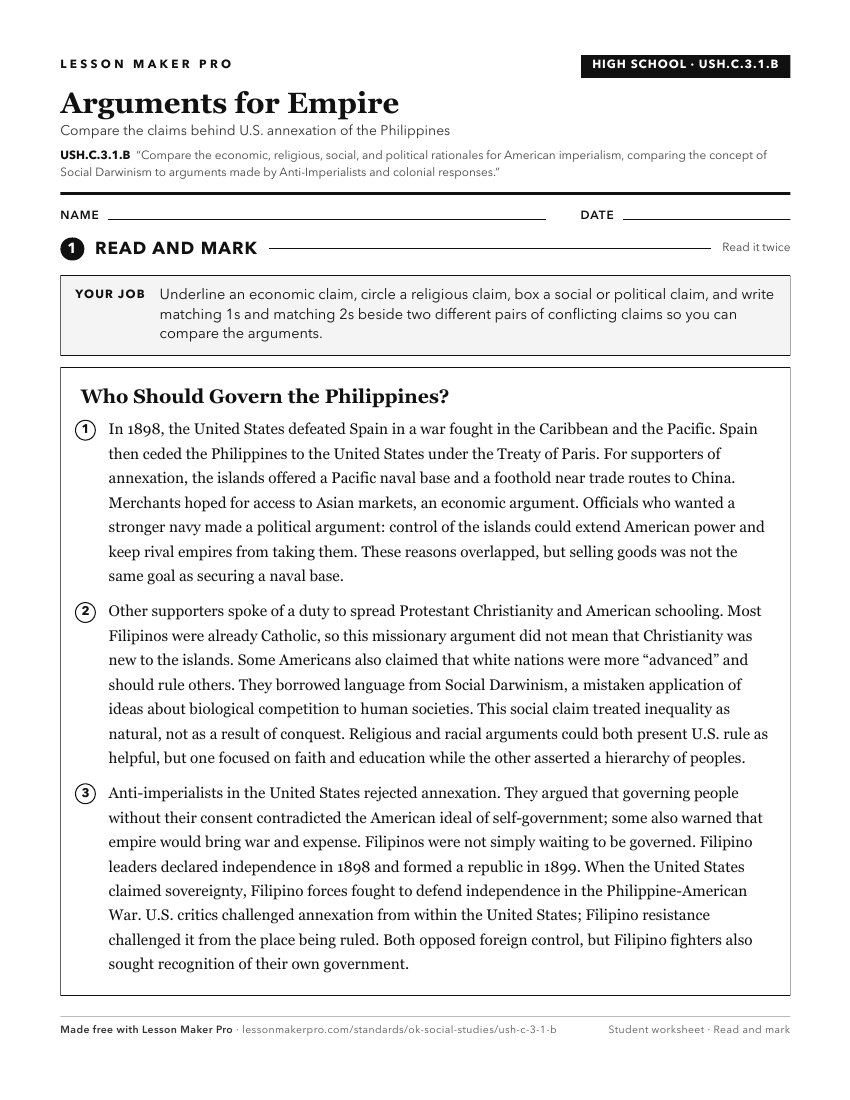
A ready-to-print activity worksheet aligned to USH.C.3.1.B, with an answer key for the teacher on its own page. No account needed.
PDF, US Letter, prints cleanly in black and white.
Download the worksheetKeep exploring
Related Standards
- MWH.C.5.3.B
Describe the consequences of imperialism in Asia, Africa, and the Americas, i ncluding settler colonies, exploitation of natural resources, and reshaping of col...
- MWH.C.5.3
Evaluate the impact of industrialization on global imperialism.
- MWH.C.5.3.A
Explain the economic, political, and social justifications supporting imperialist ideology and colonialism (e.g., Social Darwinism, economic gain and resources,...
- USH.C.3.1
Evaluate the impact of Imperialism on international relations and its effect on developing nations.
Turn this exact standard into a lesson
Grade, subject, topic, and the complete standard are prefilled. Create one free, no account needed.
Also for this standard:Make a WorksheetMake a QuizMake a Sub Lesson