Oklahoma Social Studies MWH.C.5.3.B
The Standard
- MWH.C.5
- Analyze the massive social, economic, and cultural change brought about by the Industrial Revolution.
- MWH.C.5.3
- Evaluate the impact of industrialization on global imperialism.
Describe the consequences of imperialism in Asia, Africa, and the Americas, i ncluding settler colonies, exploitation of natural resources, and reshaping of colonial economies, resistance movements, and cultural exchange.
Oklahoma Academic Standards for Social Studies (2026) · MWH.C.5.3
Teacher's field guide
What This Standard Means
What Students Need to Do
- Students track who gained land, who lost work, and where raw materials went in colonial India, Algeria, and Puerto Rico. They describe how people resisted and how language or customs changed.
What Mastery Looks Like
- Students explain how French settlers took Algerian farmland. They connect British control of Indian cotton trade and U.S. control of Puerto Rican sugar exports to changes in local work. They name the 1857 rebellion in India and explain why French remains in use in Algeria.
Common Misconceptions
- Students may think every colony had large numbers of foreign settlers. They may assume exports made local workers wealthy rather than benefiting foreign owners. They may assume resistance was always armed or that learning French meant Algerians accepted French rule.
How to Assess It
- Exit ticket: Explain one effect of British rule on Indian cotton, French settlement on Algerian farmland, and U.S. rule on Puerto Rican sugar. Name one act of resistance or lasting cultural change.
Lesson moves
Ways to Teach It
Give pairs blank maps and cards on Indian cotton, Algerian land, and Puerto Rican sugar; have them draw export routes and settler land claims.
Give short accounts of Abd al-Qadir and the 1857 rebellion in India; ask students to compare what each resisted.
Play a card match: pair rubber, farmland, and sugar with Congo, Algeria, and Puerto Rico, then explain each colonial consequence.
Show current Algerian headlines in Arabic and French; ask why both languages appear after French colonization.
Free download
Printable MWH.C.5.3.B Worksheet
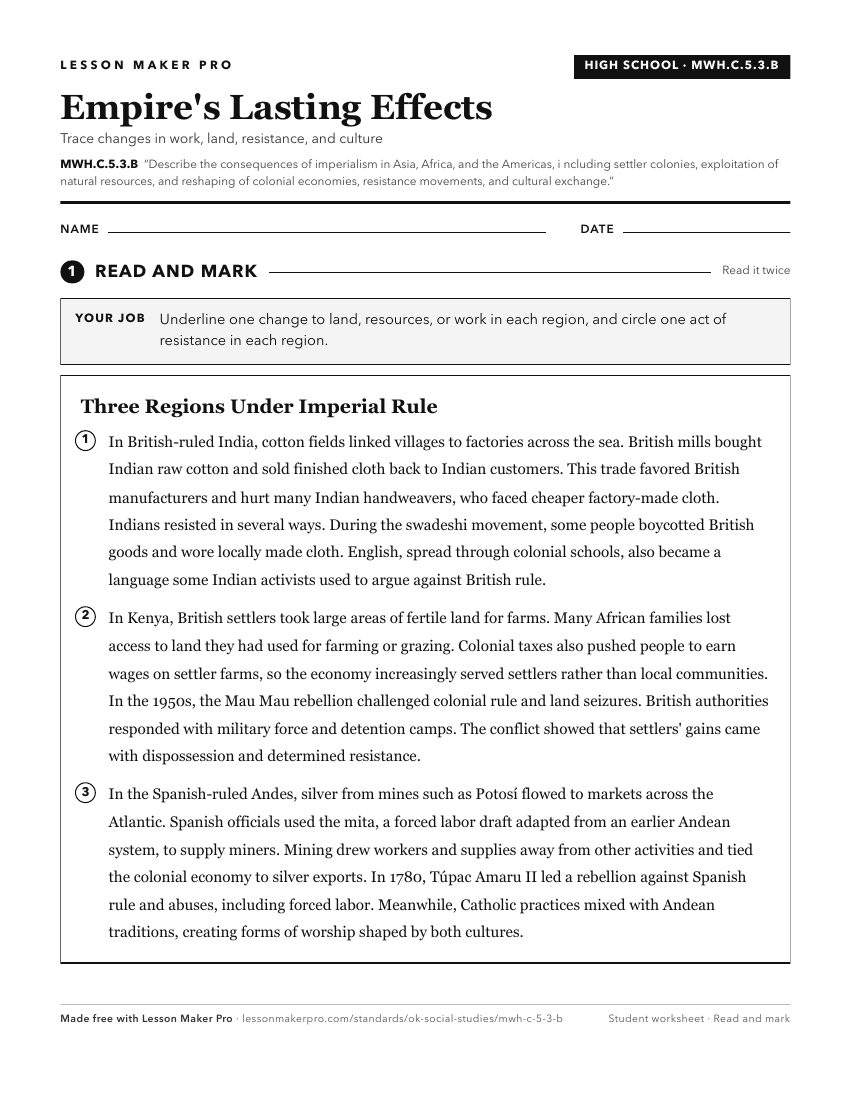
A ready-to-print activity worksheet aligned to MWH.C.5.3.B, with an answer key for the teacher on its own page. No account needed.
PDF, US Letter, prints cleanly in black and white.
Download the worksheetKeep exploring
Related Standards
- USH.C.3.1.B
Compare the economic, religious, social, and political rationales for American imperialism, comparing the concept of Social Darwinism to arguments made by Anti-...
- MWH.C.5.3
Evaluate the impact of industrialization on global imperialism.
- MWH.C.2.5.D
Describe the major economic and cultural effects of the Columbian Exchange and explain how the enslavement of Indigenous peoples and Africans was used for the d...
- USH.C.3.1
Evaluate the impact of Imperialism on international relations and its effect on developing nations.
Turn this exact standard into a lesson
Grade, subject, topic, and the complete standard are prefilled. Create one free, no account needed.
Also for this standard:Make a WorksheetMake a QuizMake a Sub Lesson