Oklahoma Social Studies MWH.C.2.5.D
The Standard
- MWH.C.2
- Analyze patterns of social, economic, political, and cultural changes during the Late Middle Ages to the Age of Exploration.
- MWH.C.2.5
- Analyze migration, settlement patterns, and the impact on indigenous peoples caused by a competition among European nations during the Age of Exploration.
Describe the major economic and cultural effects of the Columbian Exchange and explain how the enslavement of Indigenous peoples and Africans was used for the development of colonial economies.
Oklahoma Academic Standards for Social Studies (2026) · MWH.C.2.5
Teacher's field guide
What This Standard Means
What Students Need to Do
- Students trace crops, animals, and diseases across the Atlantic and describe changes to diets and daily life. They explain how disease harmed Indigenous communities. They show how colonists used enslaved Indigenous people and Africans to produce goods and build colonial wealth.
What Mastery Looks Like
- A student can map potatoes moving to Europe and horses moving to the Americas, then describe a change each caused. They can explain how smallpox devastated Indigenous communities. They can link enslaved labor in mines and on plantations to colonial profits.
Common Misconceptions
- Students may think only food moved across the Atlantic, missing animals and disease. They may call work in colonial mines and plantations paid labor, or assume only Africans were enslaved. They may overlook how forced labor produced colonial wealth.
How to Assess It
- On an exit ticket, ask: How did a crop or animal change life after crossing the Atlantic? How did colonists profit from enslaving Indigenous people and Africans?
Lesson moves
Ways to Teach It
Give pairs an Atlantic map and cards labeled potatoes, horses, and smallpox; have them draw arrows and note one effect per card.
Have students write two sentences answering: Who profited from colonial sugar and silver, and whose forced labor produced them?
Use matching cards to pair silver mining with Indigenous forced labor, sugar plantations with enslaved African labor, and potatoes with new European diets.
Show a photo of tomato pasta; students trace tomatoes from the Americas to Europe and explain how they changed Italian cooking.
Free download
Printable MWH.C.2.5.D Worksheet
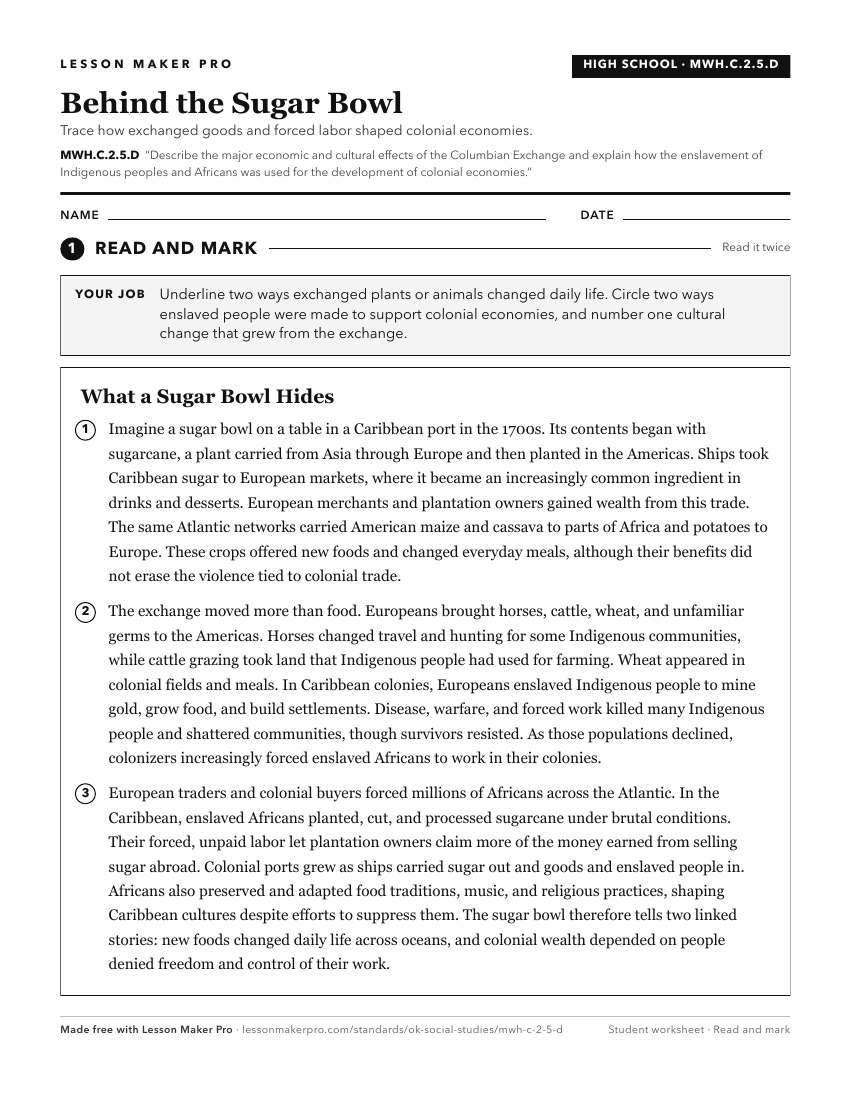
A ready-to-print activity worksheet aligned to MWH.C.2.5.D, with an answer key for the teacher on its own page. No account needed.
PDF, US Letter, prints cleanly in black and white.
Download the worksheetKeep exploring
Related Standards
- 4.C.3.2.D
Evaluate the mutual benefits and consequences of the Columbian Exchange, including agriculture, trade, military alliances, technology, slavery, and disease resu...
- 5.C.2.3
Explain the economic and cultural interactions resulting from the triangular trade routes, including the forced migration of Africans through the Transatlantic ...
- 6.C.3.6.A
Identify examples of cultural diffusion (e.g., Columbian Exchange: availability of new commodities and technology; assimilation of American Indian into colonial...
- 6.C.3.6.D
Explain the effects of plantation agriculture and the importation of enslaved labor on the economic development and cultural heritage of regions.
Turn this exact standard into a lesson
Grade, subject, topic, and the complete standard are prefilled. Create one free, no account needed.
Also for this standard:Make a WorksheetMake a QuizMake a Sub Lesson