Oklahoma Social Studies MWH.C.5.3.D
The Standard
- MWH.C.5
- Analyze the massive social, economic, and cultural change brought about by the Industrial Revolution.
- MWH.C.5.3
- Evaluate the impact of industrialization on global imperialism.
Assess the political, economic, and cultural impact of the British Raj, Britain’s subordination of India, as characterized by economic, educational, and infrastructure investments, at the costs of exploitation and self-rule.
Oklahoma Academic Standards for Social Studies (2026) · MWH.C.5.3
Teacher's field guide
What This Standard Means
What Students Need to Do
- Students trace how British rule changed who held power in India. They examine railways, schools, and trade to weigh gains against extraction and lost self-rule. They support their judgments with evidence.
What Mastery Looks Like
- A student can explain how railways helped Indians travel while also moving raw materials to ports for British trade. They can describe how English-language schooling created opportunities and changed education. They can explain how limited political rights helped drive demands for independence.
Common Misconceptions
- Students may assume railways and schools were built only to help Indians, or that Indians gained nothing from them. They may mistake British-directed projects for Indian self-rule. Some assume English-language schools replaced all local languages and schools.
How to Assess It
- On an exit ticket, ask students to name one political, one economic, and one cultural effect of British rule in India. Have them explain one benefit and one cost using a specific example.
Lesson moves
Ways to Teach It
On printed colonial rail maps, have pairs use thread to trace cotton shipments to ports and passenger trips, then label who benefited.
Have students write a claim about whether railways helped Indian travelers while strengthening British control, citing two details from a source excerpt.
Hand out cards labeled English-language schools, land taxes, railways, and restricted voting; teams match each to political, economic, or cultural effects.
Compare a 1900 rail map with a current Indian rail map; students circle two routes still in use and discuss who uses them now.
Free download
Printable MWH.C.5.3.D Worksheet
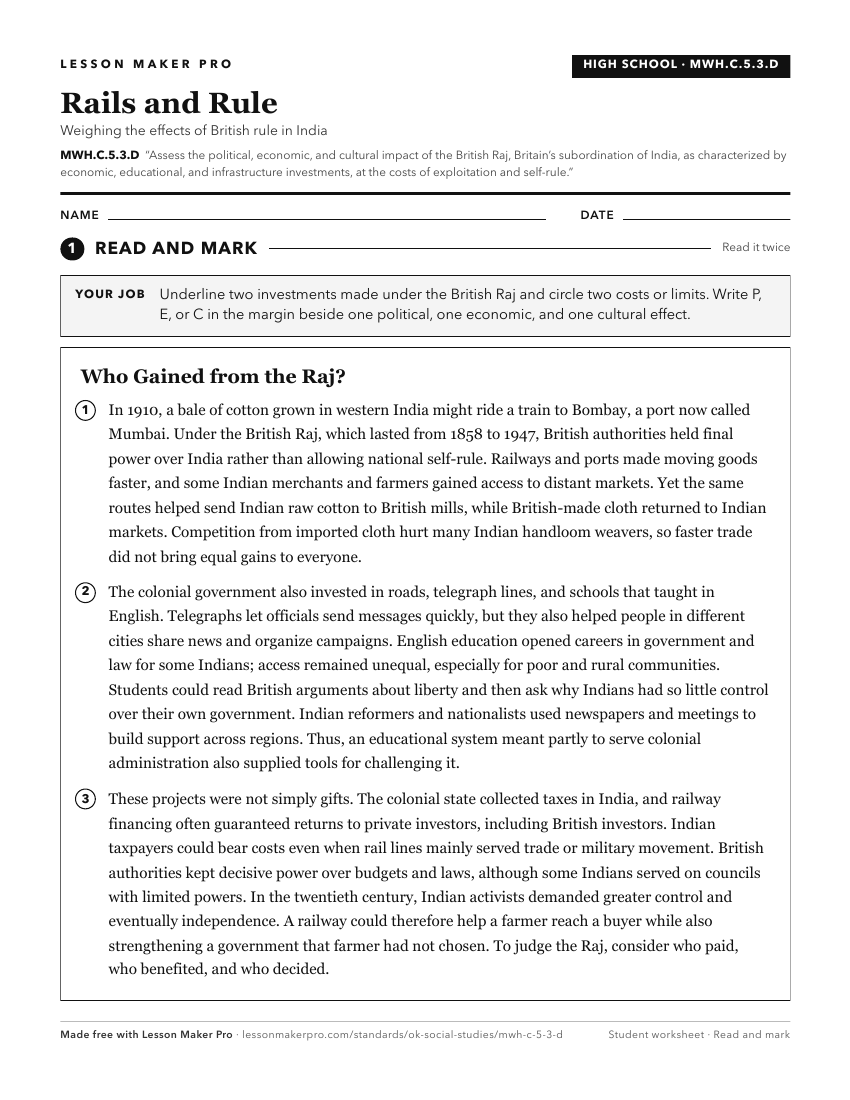
A ready-to-print activity worksheet aligned to MWH.C.5.3.D, with an answer key for the teacher on its own page. No account needed.
PDF, US Letter, prints cleanly in black and white.
Download the worksheetKeep exploring
Related Standards
- 8.C.1.1
Analyze the political and economic climate in the British colonies on the eve of the French and Indian War.
- MWH.C.7.3.A
Describe the fall of the British Raj and the emergence of an independent India and Pakistan, including the influence, ideas, and acts of civil disobedience by M...
- USH.C.3.1
Evaluate the impact of Imperialism on international relations and its effect on developing nations.
- AWH.C.8.3
Describe important political, economic, and cultural aspects of Indian history, including the Maurya and Kushan Empires, the Gupta Empire, Golden Age of India, ...
Turn this exact standard into a lesson
Grade, subject, topic, and the complete standard are prefilled. Create one free, no account needed.
Also for this standard:Make a WorksheetMake a QuizMake a Sub Lesson