Oklahoma Social Studies 8.C.1.1
Standard Cluster
- 8.C.1
- Analyze the foundations of the United States of America by examining the causes, events, and ideologies which led to the American Revolution.
Analyze the political and economic climate in the British colonies on the eve of the French and Indian War. Examine how the unofficial British policy of salutary neglect created an environment suited to self-determination in the colonies. Explain how the British policy of mercantilism sought to increase England’s prosperity through restrictive trade practices, such as the Navigation Acts. Examine how British colonial ideas and practices of self-government (e.g., town meetings and colonial legislatures) influenced American political thought. Describe the influence of the First Great Awakening on concepts related to individual equality and self-rule, including its role in promoting a revolutionary fervor. Examine the goals of the Albany Plan of Union and how it reflected colonial reactions to changing imperial economic policies. Compare the Haudenosaunee (Iroquois) Confederacy with early attempts to unite the colonies.
Oklahoma Academic Standards for Social Studies (2026) · 8.C.1
Cluster contents
Standards in This Cluster
8.C.1.1 is a cluster heading. These are the individual standards under it.
- 8.C.1.1.A
Examine how the unofficial British policy of salutary neglect created an environment suited to self-determination in the colonies.
- 8.C.1.1.B
Explain how the British policy of mercantilism sought to increase England’s prosperity through restrictive trade practices, such as the Navigation Acts.
- 8.C.1.1.C
Examine how British colonial ideas and practices of self-government (e.g., town meetings and colonial legislatures) influenced American political thought.
- 8.C.1.1.D
Describe the influence of the First Great Awakening on concepts related to individual equality and self-rule, including its role in promoting a revolutionary fe...
- 8.C.1.1.E
Examine the goals of the Albany Plan of Union and how it reflected colonial reactions to changing imperial economic policies.
- 8.C.1.1.F
Compare the Haudenosaunee (Iroquois) Confederacy with early attempts to unite the colonies.
Teacher's field guide
What This Cluster Means
What Students Need to Do
- Students explain how British trade rules and loose enforcement shaped colonial life before the French and Indian War. They show how town meetings, colonial legislatures, and religious revivals affected ideas about authority. They compare a colonial plan for union with the Haudenosaunee Confederacy.
What Mastery Looks Like
- A student can explain why colonists practiced self-government while Britain still controlled trade. They can describe how revivals encouraged people to question authority, without claiming everyone gained equal rights. They can explain that the Albany Plan proposed joint defense under British rule, while the Haudenosaunee Confederacy was an existing union of self-governing nations.
Common Misconceptions
- Students may think loose British enforcement meant there were no trade laws. They may mistake the Albany Plan for a call for independence. They may assume religious talk of equality applied to everyone, or that the proposed colonial union and the Haudenosaunee Confederacy worked the same way.
How to Assess It
- Ask students: “How could British trade limits and loose enforcement both shape colonial self-rule? Name one local government practice, then give one difference between the Albany Plan and the Haudenosaunee Confederacy.”
Lesson moves
Ways to Teach It
Give pairs cards for Navigation Acts, town meetings, revival sermons, the Albany Plan, and Haudenosaunee councils; sort them by who made decisions.
Ask: “Could colonists govern themselves while Britain controlled trade?” Have students cite town meetings and the Navigation Acts in three sentences.
Put 1651 Navigation Acts, 1730s revivals, and the 1754 Albany Plan on cards; teams order them and name one political effect each.
Use a school club charter and district rules; ask students which decisions club members control and which rules limit them, then compare colonial assemblies.
Free download
Printable 8.C.1.1 Worksheet
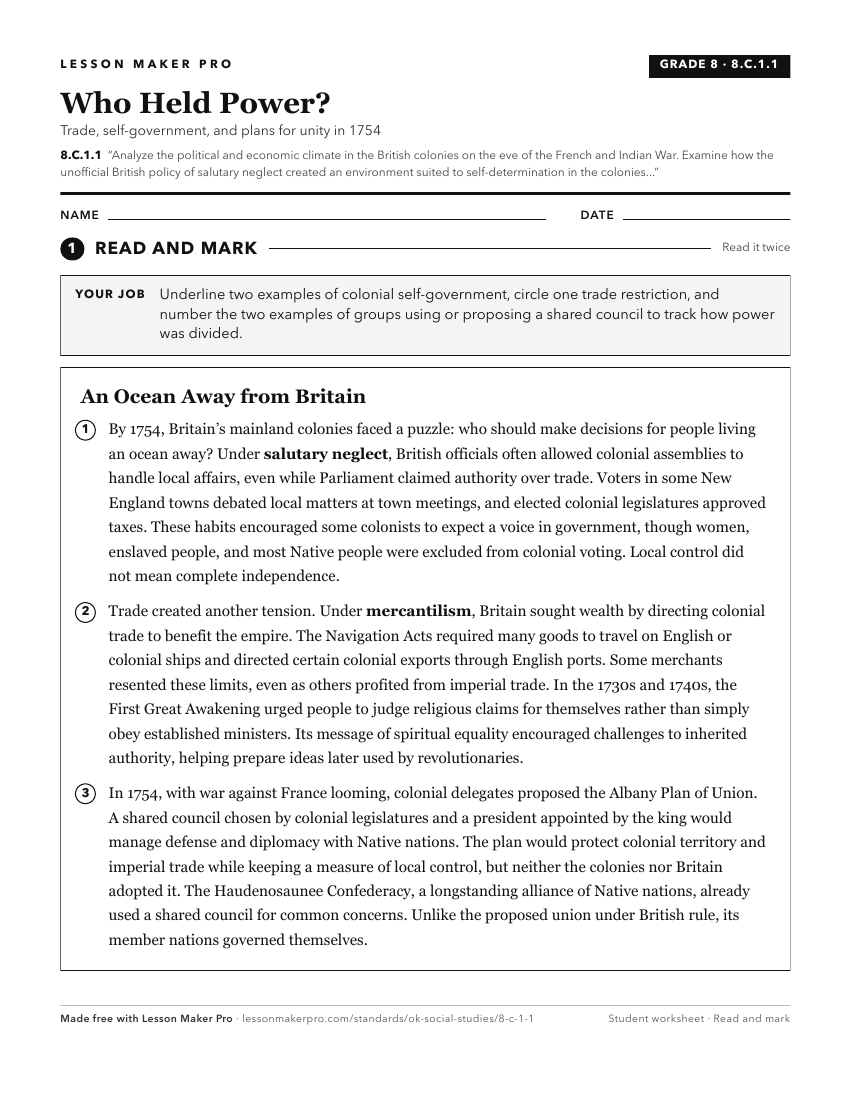
A ready-to-print activity worksheet aligned to 8.C.1.1, with an answer key for the teacher on its own page. No account needed.
PDF, US Letter, prints cleanly in black and white.
Download the worksheetKeep exploring
Related Standards
- 8.C.1.2
Summarize the political and economic consequences of the French and Indian War.
- 5.C.3
Analyze the series of events and policies which led colonists to seek and declare independence.
- 8.C.1.5.E
Evaluate the diverse political, economic, and religious influences that shaped colonial arguments for independence.
- 8.C.1.3
Examine growing tensions between the North American colonies and Britain.
Turn this cluster into a lesson
Grade, subject, topic, and the complete cluster are prefilled. Create one free, no account needed.
Also for this cluster:Make a WorksheetMake a QuizMake a Sub Lesson