Oklahoma Social Studies 8.C.1.3
Standard Cluster
- 8.C.1
- Analyze the foundations of the United States of America by examining the causes, events, and ideologies which led to the American Revolution.
Examine growing tensions between the North American colonies and Britain. Analyze the primary cause of the American Revolution as it relates to violations of rights as Englishmen, exemplified in the lack of colonial representation in Parliament. Describe the effect on colonial economics and local self-government created by the series of trade restrictions and imposed taxes, such as the Sugar Act, Stamp Act, Townshend Acts, and Quartering Act. Explain the strategies utilized by colonists to oppose imperial policies, including the issuance of the Stamp Act Resolves and the use of propaganda, exemplified by the work of the Committees of Correspondence, the Sons of Liberty, and the boycott of British goods. Describe escalating tensions, exemplified by the Boston Massacre and the Boston Tea Party. Explain continued attempts by Parliament to exert its authority through the Coercive Acts (Intolerable Acts), prompting the formation of the First Continental Congress and its Declaration of Resolves, stating that colonists possess the same rights as Englishmen. Explain why the Battles of Lexington and Concord were perceived as major military victories, known as the “shot heard ‘round the world.”
Oklahoma Academic Standards for Social Studies (2026) · 8.C.1
Cluster contents
Standards in This Cluster
8.C.1.3 is a cluster heading. These are the individual standards under it.
- 8.C.1.3.A
Analyze the primary cause of the American Revolution as it relates to violations of rights as Englishmen, exemplified in the lack of colonial representation in ...
- 8.C.1.3.B
Describe the effect on colonial economics and local self-government created by the series of trade restrictions and imposed taxes, such as the Sugar Act, Stamp ...
- 8.C.1.3.C
Explain the strategies utilized by colonists to oppose imperial policies, including the issuance of the Stamp Act Resolves and the use of propaganda, exemplifie...
- 8.C.1.3.D
Describe escalating tensions, exemplified by the Boston Massacre and the Boston Tea Party.
- 8.C.1.3.E
Explain continued attempts by Parliament to exert its authority through the Coercive Acts (Intolerable Acts), prompting the formation of the First Continental C...
- 8.C.1.3.F
Explain why the Battles of Lexington and Concord were perceived as major military victories, known as the “shot heard ‘round the world.”
Teacher's field guide
What This Cluster Means
What Students Need to Do
- Students trace how British trade rules, taxes, and troop housing affected colonial trade and local control. They explain why taxes passed without colonial representation seemed to violate colonists’ rights as English subjects. They connect colonial protests to the fighting at Lexington and Concord.
What Mastery Looks Like
- A student can explain how a specific law affected colonists and name a response, such as a boycott or the Stamp Act Resolves. They can place the Boston Massacre, Boston Tea Party, Coercive Acts, First Continental Congress, and Lexington and Concord in order. They can explain that colonial militia forced British troops to retreat after the fighting began.
Common Misconceptions
- Students may think every colonist opposed Britain or that the Quartering Act was a tax. They may mix up the Boston Massacre and the Boston Tea Party. Some think the First Continental Congress declared independence, when it argued for colonists’ rights as English subjects.
How to Assess It
- Exit ticket: Explain why a tax passed without colonial representation angered colonists, name one way they resisted, and explain why colonial leaders met after the Coercive Acts.
Lesson moves
Ways to Teach It
Give pairs short descriptions of four British acts; have them sort the cards by effects on costs, trade, or local control.
Ask students to write two sentences answering: Why did colonists object to taxes if Parliament claimed the power to pass them?
Run a timeline relay with event cards from the Boston Massacre through Lexington and Concord; require one cause for each next event.
Bring a store receipt and ask who elects the lawmakers who set its sales tax, then compare that with colonial taxes.
Free download
Printable 8.C.1.3 Worksheet
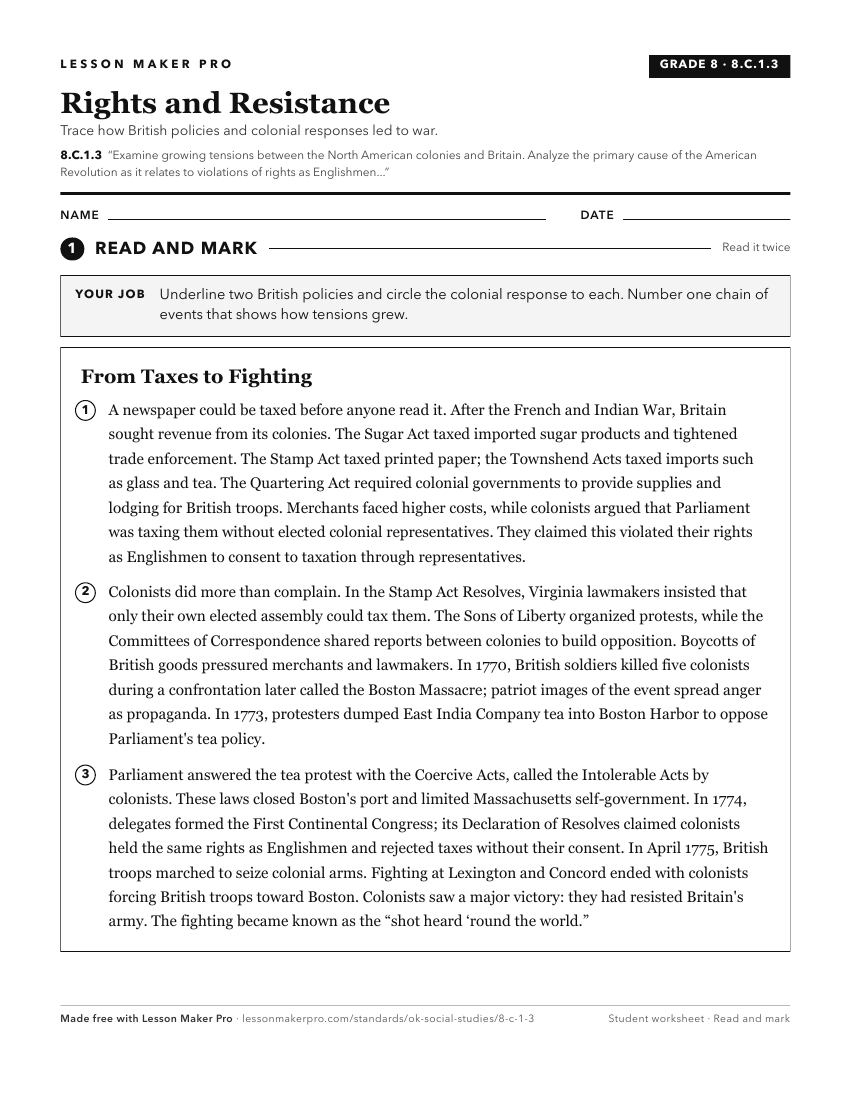
A ready-to-print activity worksheet aligned to 8.C.1.3, with an answer key for the teacher on its own page. No account needed.
PDF, US Letter, prints cleanly in black and white.
Download the worksheetKeep exploring
Related Standards
- 8.C.1.1
Analyze the political and economic climate in the British colonies on the eve of the French and Indian War.
- 5.C.2.4.C
Examine early discussions on intercolonial cooperation exemplified by the Albany Plan of Union and Benjamin Franklin's “Join or Die” political cartoon.
- 8.C.1.5.E
Evaluate the diverse political, economic, and religious influences that shaped colonial arguments for independence.
- 5.C.3.1
Analyze how growing political and economic tensions led to dissent among colonists by explaining
Turn this cluster into a lesson
Grade, subject, topic, and the complete cluster are prefilled. Create one free, no account needed.
Also for this cluster:Make a WorksheetMake a QuizMake a Sub Lesson