Oklahoma Social Studies MWH.C.5.3.E
The Standard
- MWH.C.5
- Analyze the massive social, economic, and cultural change brought about by the Industrial Revolution.
- MWH.C.5.3
- Evaluate the impact of industrialization on global imperialism.
Describe major developments contributing to the decline of the Qing dynasty, including Western influence, internal unrest, and the Boxer Rebellion.
Oklahoma Academic Standards for Social Studies (2026) · MWH.C.5.3
Teacher's field guide
What This Standard Means
What Students Need to Do
- Students trace how forced trade concessions, large rebellions, and the Boxer uprising reduced Qing control. They explain how these pressures helped bring down the dynasty.
What Mastery Looks Like
- Students link the Opium Wars to unequal treaties and the Taiping Rebellion to lost resources. They connect the Boxer defeat to foreign occupation and a large indemnity. They explain how these setbacks weakened Qing authority.
Common Misconceptions
- Students may think the Boxers overthrew the Qing, but the dynasty survived until 1912. They may mix up the Taiping and Boxer uprisings or assume foreign powers controlled all of China.
How to Assess It
- Exit ticket: In three sentences, explain how unequal treaties, the Taiping Rebellion, and the Boxer defeat each weakened Qing rule.
Lesson moves
Ways to Teach It
Give pairs dated cards for the Opium Wars, Taiping Rebellion, Boxer Rebellion, and 1912 abdication; have them order the cards and label each consequence.
Ask students to write: How did unequal treaties and the Taiping Rebellion weaken Qing rule in different ways?
Play a matching game with event cards and consequence cards, including unequal treaties, drained resources, and the Boxer indemnity.
Show a modern Shanghai shipping map beside a Qing treaty-port map; ask who controlled access to trade in each period.
Free download
Printable MWH.C.5.3.E Worksheet
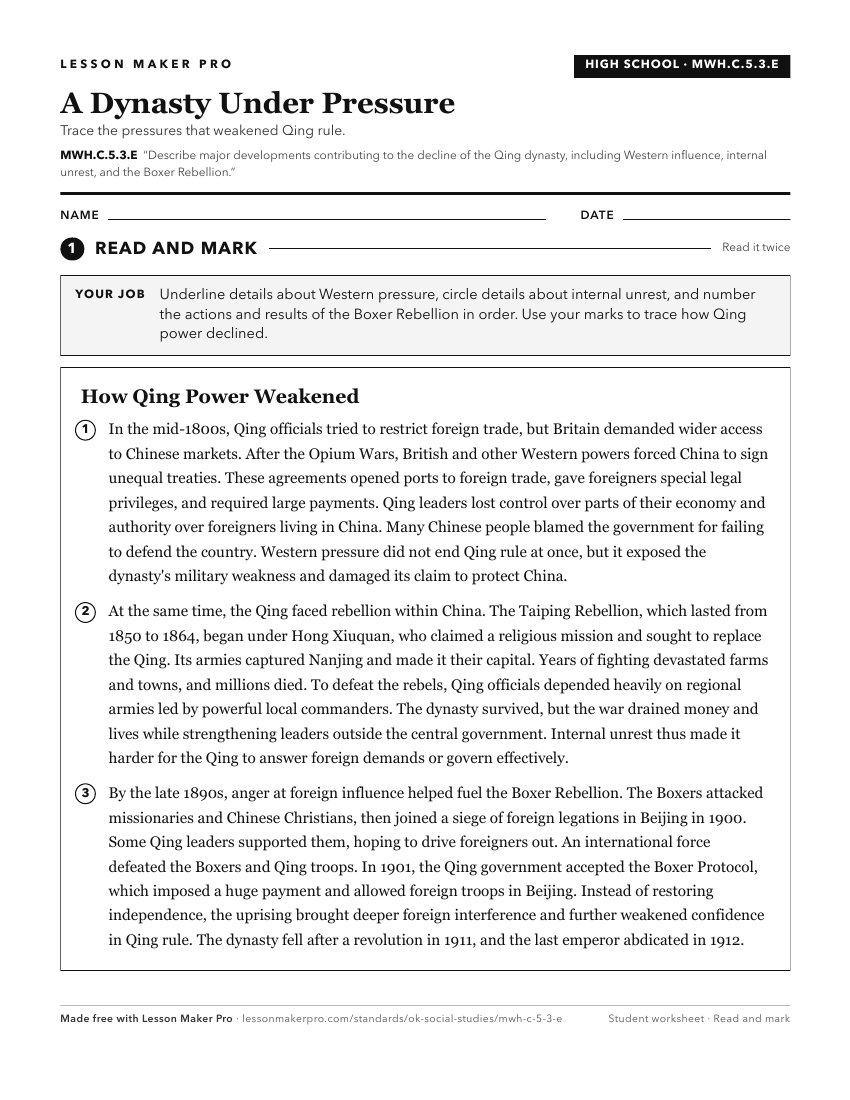
A ready-to-print activity worksheet aligned to MWH.C.5.3.E, with an answer key for the teacher on its own page. No account needed.
PDF, US Letter, prints cleanly in black and white.
Download the worksheetKeep exploring
Related Standards
- MWH.C.7.4.B
Describe significant political and economic change in China, including the influence of Sun Yat-Sen and the 1911 Revolution, and examine the consequences of the...
- MWH.C.7.4.D
Explain the significance of pro-democracy movements such as Tiananmen Square and evaluate how economic reforms under Deng Xiaoping contributed to China’s modern...
- AWH.C.11.3
Examine the significant political, economic, and cultural aspects of the history of the Song, Yuan, and Ming dynasties (e.g.,the civil service, Mongol conquest,...
- AWH.C.8.6
Assess the significance and legacy of political, economic, and cultural aspects of the Qin, Han, and Tang dynasties (e.g., unification of China, construction of...
Turn this exact standard into a lesson
Grade, subject, topic, and the complete standard are prefilled. Create one free, no account needed.
Also for this standard:Make a WorksheetMake a QuizMake a Sub Lesson